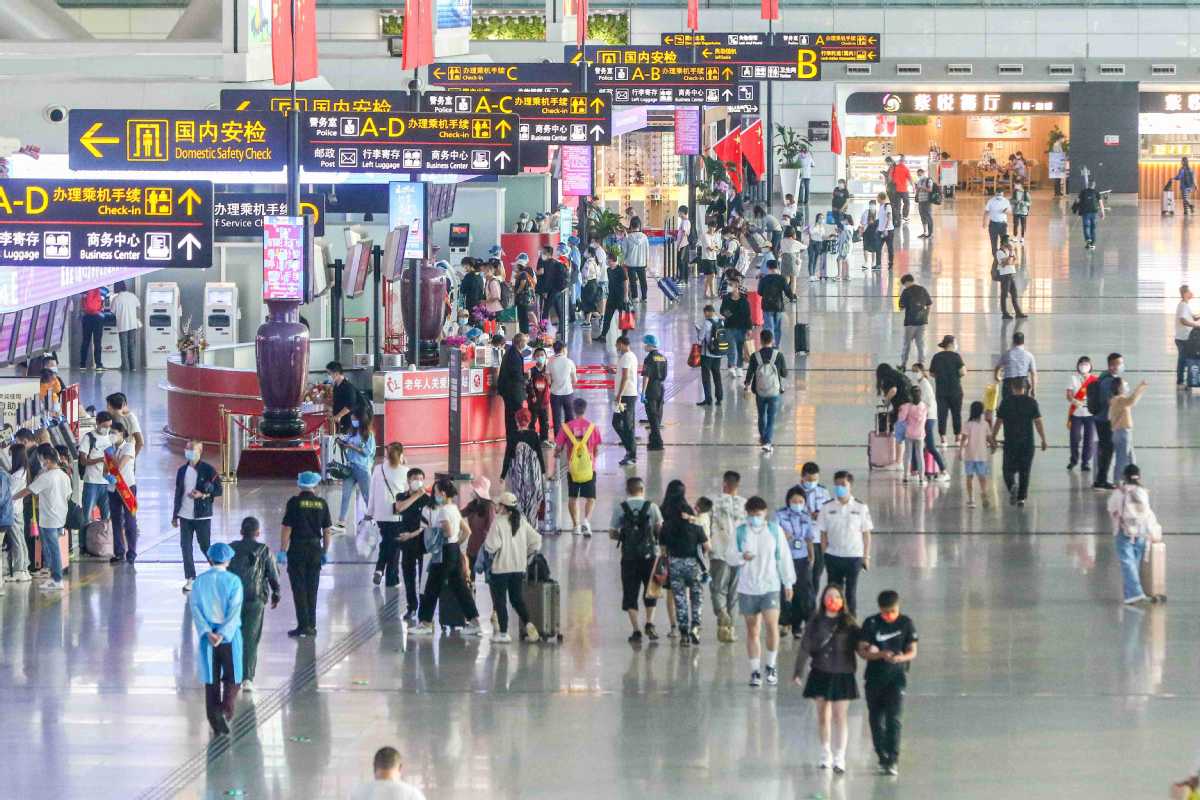
China will have built up significantstrength in transportation by 2035, with a modern and integrated transportsystem supporting the country's national modernization goal, according to areport released by the China Academy of Transportation Science, at the secondUN Sustainable Transport Conference in Beijing on October 14. China highlighted its "National 1-2-3Travel Circle" plan which aims to set up the transport system with onehour to commute in cities, two hours to travel within city clusters, and threehours to travel between major domestic cities, by 2035. International logistics efficiency is alsoexpected to be increased. Based on the "Global 1-2-3 LogisticsCircle" plan, express package delivery will only take one day withinChina, two days to neighboring countries, and three days to major globalcities. According to the Outline on DevelopingIntegrated National Transport Network, China will complete a nationalcomprehensive and multidimensional transport network by 2035, featuring safety,intelligence, green and energy-intensiveness. The network will offer a smooth andconvenient traffic system with efficient operation, and modern services will bein place as well. By 2035, China will establish an innovationsystem for transport with advanced and safe key equipment, high-caliberprofessionals and a sound market environment, achieving the basic modernizationof its transport governance, according to the report. Four international transport hub clusterswill be fully established, namely, the Beijing-Tianjin-Hebei Region, theYangtze River Delta, the Guangdong-Hong Kong-Macao Greater Bay Area, and theChengdu-Chongqing Economic Circle, the report noted. The three-day UN Sustainable Conferencebegan on October 14, focusing on opportunities and challenges for all modes oftransport – road, rail, aviation as well as waterborne, and seeking to provideconcrete solutions for developing global transport systems in a safe, accessible,green and resilient way. Curbsand uncertainty crimp global flights; home markets gains recovery During the week-long National Day holidayin the first week of October, thebusiness performance of the domestic air travel market was worse than expected,as some sporadic cases of the COVID-19 pandemic in China have crimped part oftravel demand. Yet, demand has maintained an upward trend, albeit with somefluctuations, and the market is expected to further thrive next year, industryexperts said. The average passenger load factor ofdomestic flights during the holiday reached 73.7 percent, which was 4.8percentage points lower than that of the same period last year, according tothe Civil Aviation Administration of China. From Oct 1 to Oct 7, China recorded 515million domestic tourist trips, according to the Ministry of Culture andTourism. The daily average number of domestic flights operated during theperiod reached 12,952, which was 11.27 percent lower than that of the sameperiod last year, according to the CAAC. "With the COVID-19 pandemic broughtunder better control in China, the domestic travel demand is foreseen growinggradually, and the domestic circulation provides backbone support for theeconomy when the external part is relatively weak," analysts of Guotai JunanSecurities said in a report. "When the stagnating internationaltravel market started to return to normal, the domestic market and theinternational market will achieve balance again. Carriers will graduallyrestore their profitability by then," said the Guotai Junan report. Despite the decline in flight ticketbookings, the average ticket price edged up. During the holiday, the averageprice of a one-way domestic flight was 821 yuan ($127.3), which was 7 percenthigher than that of the same period last year, according to data from Trip.comGroup, China's largest online travel agency. Particularly, popular destinations saw asubstantial increase in the ticket prices of flights to those places. Forinstance, the average price of a one-way flight from Shenzhen in Guangdongprovince to Beijing during the holiday jumped 47 percent from the level seenduring the holiday last year, Trip.com found. In September, the daily average number ofdomestic flights operated in China reached 21,329, which was 43 percent higherthan the number seen in August, according to VariFlight, a China-based civilaviation data service provider, showing that the regular domestic passengertravel demand is recovering steadily. On the other hand, due to the impact of thepandemic, the rate of increase of new aircraft in China has slowed. In 2020,the fleet size in China was 2.2 percent higher than that of 2019. This issignificantly lower than the average annual growth rate of 10 percent recordedbefore the pandemic, according to the projection of Guosen Securities. In addition, Boeing's single-aisle B737 MAXaircraft remained grounded in China. The aircraft model has been groundedworldwide after two fatal crashes in Indonesia in 2018 and in Ethiopia in 2019,and there is no specific timetable for the model to resume flights in China. With the grounding of the B737 MAX and thesuspension of introductions of new aircraft of the model, the number ofcommercial aircraft in China grew only 4.9 percent in 2019. Meanwhile, the International Air TransportAssociation announced its latest outlook in October for the airline industry,and the financial performance showed improved results amid the continuingCOVID-19 crisis. The net industry losses are expected toreduce to $11.6 billion in 2022 after a $51.8 billion loss this year. Theoverall air travel demand is expected to be 40 percent of the 2019 levels forthis year, and rise to 61 percent in 2022, the IATA said. International demand is the slowest torecover, due to continuing restrictions on the freedom of movement acrossborders, quarantine measures and traveler uncertainty. This year, internationaldemand is expected to reach 22 percent of the pre-pandemic levels in 2019. In2022, international demand is expected to reach 44 percent of the 2019 levels. Domestic demand, with fewer restrictions inmost countries, is driving the recovery. This year, domestic demand is expectedto reach 73 percent of the pre-pandemic levels in 2019. In 2022, domesticdemand is expected to reach 93 percent of the 2019 levels. "The magnitude of the COVID-19 crisisfor airlines is enormous. To survive, airlines have dramatically cut costs andadapted their business to whatever opportunities were available. We are wellpast the deepest point of the crisis. While serious issues remain, the path torecovery is coming into view. Aviation is showing its resilience yetagain," said Willie Walsh, director-general of the IATA. "People have not lost their desire totravel, as we see in solid domestic market resilience. But they are being heldback from international travel by restrictions, uncertainty andcomplexity," Walsh said. "More governments are seeingvaccinations as a way out of this crisis. We fully agree that vaccinated peopleshould not have their freedom of movement limited in any way. In fact, thefreedom to travel is a good incentive for more people to be vaccinated." In the next 20 years, the average annualgrowth rate of passenger turnover in China is expected to reach 5.7 percent,and the annual growth rate of the fleet size in China is foreseen to be 5.2percent, according to the forecast of domestic aircraft manufacturer CommercialAircraft Corp of China, which is known as COMAC. By 2040, the world will need 41,429 newcommercial airplanes valued at $6.1 trillion, based on the catalog price oflast year. By then, China will become the single-largest aviation market, andChinese carriers are expected to acquire 9,084 new airplanes with more than 50seats each. China's demand will account for 22 percent of the total newaircraft required globally, the report said. The C919, China's domestically manufacturednarrow-body passenger jet, is on the fast track to receiving airworthinesscertification before its commercial debut in the near future. "The current aircraft manufacturingcapacity of Boeing and Airbus can't fully meet the demand of global airlines,and the future debut of the C919 will provide new options for globalcarriers," said Yang Yang, deputy general manager of marketing and salesat COMAC. |