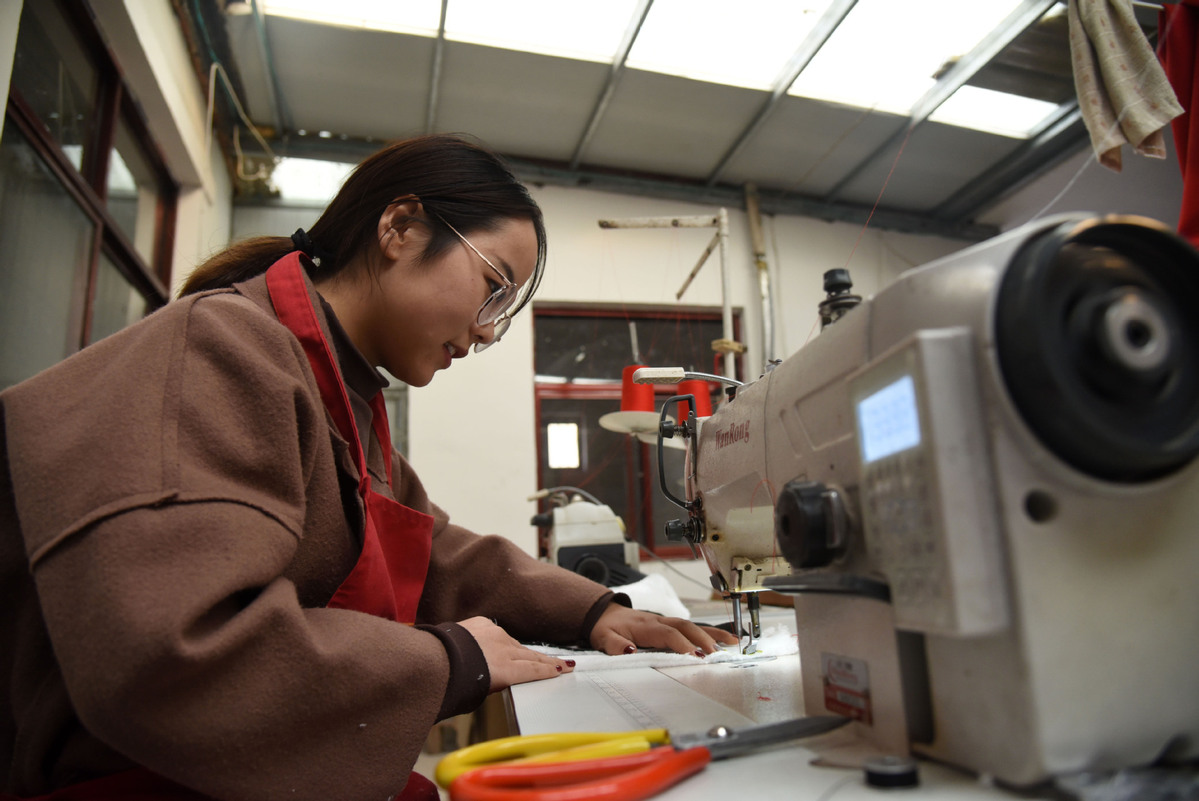
Sun Zhiguo is bracing for a busy monthahead. His online shop just received an order of 30,000 Santa Claus costumesfrom Thailand, for which his staff is working extra hours to guarantee deliverybefore Christmas. "The quality of my products is second to none, and weare seeing an impressive growth of foreign orders," the 33-year-old saidproudly. After spending seven years in Brazilselling petty commodities, Sun returned to his home village of Sunzhuang inCaoxian county of Heze city, East China's Shandong province, in 2015, whene-commerce started to boom in China's rural areas. Inspired by relatives and neighbors, Suninitiated his garment business on Taobao.com, a major e-commerce site ofinternet giant Alibaba, committed to making quality goods and improving thelivelihood of his family. Things went unexpectedly well. In 2019, theturnover of Sun's shop reached 5 million yuan (around $750,000). Thebusiness-savvy risk-taker now has his eye on Brazil's costume market, wherecarnivals are often celebrated with hundreds of thousands of dressed-upparaders. Just a few miles away, Sun Yan was workingon a sewing machine in her courtyard trying to turn her latest design intoreality, with colorful cloth and elaborate accessories piled up around her.With a passion for Hanfu, a type of traditional clothing of the Han ethnicgroup, the 27-year-old returned to Sunzhuang village after graduating fromcollege and established a Taobao shop in 2018 selling her own designs. "I still remember how excited I waswhen I received the first order, which was from France," she recalled.Since then, several thousand pieces of her works have been sold to Hanfu-loversaround the world. Loaded with successful e-commerce entrepreneurs, Sunzhuangvillage was designated a "Taobao village" in 2014, a title granted tovillages having total annual e-commerce transactions of over 10 million yuan. Such villages should also have more than100 businesses, or at least 10 percent of households involved in e-commerce, asrequired by the title's creator Alibaba. When the project was launched in 2009,only three villages in China met the aforementioned standards; 10 years later,the number has soared to more than 4,000, according to AliResearch, the researcharm of Alibaba. Heze city alone is now home to 307"Taobao villages," which in total have 180,000 online shops and morethan 570,000 employees. Over 50 e-commerce industrial parks have beenestablished around the city, local authorities said. Relying on its ever-growing garmentbusiness, Sunzhuang village has kept the title for six straight years, withover 70 percent of its 760 households owning a Taobao shop, according to SunXueping, Party chief of Sunzhuang. In 2019, the village's total online sales ofgarments exceeded 200 million yuan, while its market keeps expanding to more andmore countries and regions. The development of Taobao villages hashelped lift many rural areas in China out of poverty by promoting agriculturalproducts and other local specialties online. It has also improved rural infrastructures,bringing along new roads, broadband internet services, power supply andlogistics sponsored by local authorities and Alibaba. Furthermore, said theParty chief Sun, farmers no longer have to leave their hometowns and be migrantworkers in order to make more money. "In Sunzhuang village, no single caseof juvenile delinquency has been reported since 2014," he noted. "Nochildren or elderly people are left alone at home anymore, as the developmentof e-commerce has created abundant local jobs." Entrepreneurs in Suning county, Hebeiprovince, have seized opportunities created by e-commerce, a good businessenvironment, and infrastructure that is already excellent but will improve evenmore due to the Beijing-Tianjin-Hebei development plan and the creation of theXiongan New Area. Until recently, Suning was a fairly remotecounty in Hebei and most of its people were farmers. It still has a successfulagricultural sector-growing vegetables, corn, pears, and seedlings. But many of itspeople are taking advantage of the recently created capability to sell directlyto customers on Alibaba's Taobao online sales platform and other similarplatforms to build new businesses. Expanding on long-established skills, thecounty now has manufacturing clusters in the production of fishing rods, clothing,seedlings and musical instruments. Businesspeople in Suning estimated thataverage incomes in the county have at least doubled in the eight years sincee-commerce has become common there. The county government attaches suchimportance to Taobao villages that it plans to hold the 2020 Eighth TaobaoVillage Forum from Friday to Sunday. In many "Taobao villages" in thecounty, up to 90 percent of the people work in online sales-either asbusiness owners or as employees of those businesses. Many people arelivestreamers, directly pitching their products to customers throughout Chinaand, in some cases, foreign countries. None of this would be possible withoutgovernment support. Without very good 4G and other internet connectivity,e-commerce would be impossible. Without road and rail links, rural companieswould not be able to ship their products to customers in a timely manner. Suning, for example, has very good roadlinks and two freight rail lines cross the county. Soon, a high-speed railstation will be built. Suning is 50 kilometers from the Xiongan New Area, so itwill soon become very tightly linked with the entire Beijing-Tianjin-Hebeiregion. A key to making e-commerce work is supportoffered by local governments, ranging from clear and rapid business regulatoryapprovals to education and training in information technology to neededinfrastructure. Businesspeople in Suning said that the local government hasbeen consistently friendly and helpful. Li Yong, the founder and owner of WaterHunter Fishing Gear Co in Haner village, said that people in the area are muchricher than they were a few years ago. He said that before Taobao and otheronline sales, there were only three or four cars in the village. Now, manypeople have the achievable dream of buying a Mercedes-Benz or a BMW, somethingthat would have been unthinkable a few years ago. Li has built a company thatemploys over 100 people making, distributing and selling fishing rods online. Similarly, Chen Lei in Xiqianbo village hasbuilt a good life for his entire family making fishing rods and selling themonline. His daughter-in-law, Guo Sui, has become a well-known livestreamer withfans around the country signing on to see her selling fishing rods. Since Chenwas elected village Party secretary, he has dedicated himself to helping otherpeople in Xiqianbo to develop the skills needed to sell products online. Suning also has industrial clusters-networks ofsuppliers and producers in the same industry-making clothing,musical instruments, and seedlings. Many of the companies in these industriesexisted before the invention of e-commerce, but their ability to interactdirectly with customers has greatly boosted their sales and profits. For example, Jinxidie Clothing is upgradingits production line using smart technology and uses e-commerce to constantlyadjust to the demands of its customers. Yuehai Musical Instrument Co usesonline platforms not only to sell traditional Chinese instruments, but also toprovide education and entertainment. According to Alibaba, the number of Taobaovillages in China exceeded 4,000 in 2019. A Taobao village is defined as havingannual online transactions of at least 10 million yuan ($1.48 million), andwith at least 10 percent of households involved in e-commerce or where thereare at least 100 active e-shops. AliResearch, Alibaba's research arm,estimated that Taobao villages created 6.8 million jobs in the 12 months endingJune 2019 throughout the e-commerce value chain. In 2019, the 63 Taobaovillages located in the country's most impoverished areas generated about 2billion yuan in e-commerce sales. Total sales of Taobao villages exceeded 700billion yuan in the financial year from July 2018 to June 2019, according toAlibaba. E-commerce is not just raising rural peopleout of poverty, it is giving the opportunity to achieve real prosperity. AnAugust 2019 report by the World Bank and AliResearch found that the averagehousehold incomes in Taobao villages are almost three times higher than therural average in China, and close to the urban average. "Average household per capita incomein Taobao villages (some 35,000 yuan per year in 2017) is nearly three timeshigher than the rural average in China (13,432 yuan per year in 2017), andclose to the urban average (36,396 yuan in 2017)," the report states. Even just 10 years ago, many young peoplehad to leave their rural or small city homes to find opportunities. Now, manycan use e-commerce to create their own opportunities near their families.Others have worked in the bigger cities but take the skills and knowledge theylearned while away to build businesses in their home areas. The rural e-commerce village phenomenon ismade in and invented in China. China's Taobao village model has been opening anew pathway for rural development in other developing countries, inspiringnetprenuers in Africa and Southeast Asia to seek innovative developmentsolutions by leveraging rural e-commerce. Alibaba is not exactly helping them"establish Taobao villages", because those countries are using theirown homegrown platforms to develop rural e-commerce, so they cannot be calledTaobao villages and also the rural e-commerce systems in those countries havetheir own features and are not necessarily a replica of China's Taobaovillages. Actually, they regard China's Taobaovillages more as a good example, which could enlighten themselves to grow theirown rural e-commerce model fitting into their own development. But in no otherplace is it so large nor has it been so transformative as in China. In China, Taobao competes fiercely withdirect competitors such as Pinduoduo or JD. This leads to a very vibrant marketthat brings great benefits to small entrepreneurs. In the United States, incontrast, the Amazon-Facebook-Google oligopoly suppresses meaningfulcompetition and is a hindrance to small businesses. In the US, e-commerce is dominated by onelarge company, Amazon, which retains monopolistic power over its suppliers. Itkeeps the customer information for itself, instead of sharing it with thesupplier company. Recently, Amazon was even caught using supplier informationto produce a competitor product itself. Google's YouTube does allow channel ownersto interact directly with watchers, but it does not have the kind ofinteraction seen on Taobao sites, so there is no equivalent of thelivestreaming sales seen on the many Chinese e-commerce internet platforms.Reportedly, Facebook owner Mark Zuckerberg strongly lobbied the US governmentto ban TikTok because he wanted to eliminate a strong competitor that mighthave opened up the US market. I've recently been reading DavidMcCullough's 2016 book The Wright Brothers, a biography of Wilbur and Orville Wright,the inventors of the airplane. McCullough describes the area around Dayton,Ohio-the Wrights' hometown-in the late 19th century. It was a highly entrepreneurial andproductive environment in which many Americans were starting smallmanufacturing businesses and trying out new business ideas. In Dayton alone,there were more than 30 bicycle manufacturers. Sadly, Dayton is not thatentrepreneurial today. Suning county reminds me of the wayMcCullough describes the American Midwest in its entrepreneurial and inventiveheyday. The dynamism of Dayton and many places like it more than 100 years agoset the stage for the American economic success in the 20th century. The current dynamism of millions ofbusinesspeople in counties around China portends a richer future in whichaverage people have the opportunity to build businesses and improve theirlives. This transformation of rural and small-town China, combined with thebroader range of market-based reforms being implemented at the national level,sets the stage for China's 21st century transformation and growth. |