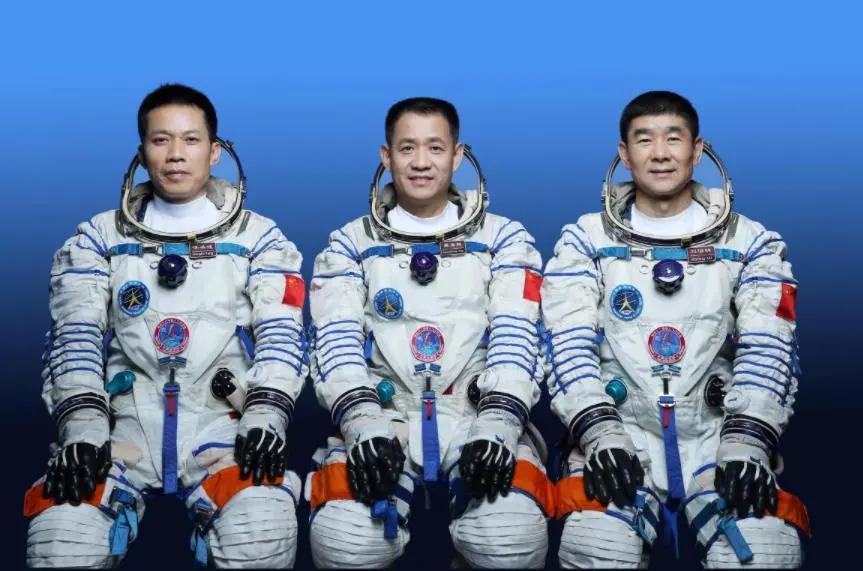
Having worked in the space station coremodule Tianhe for three months -- the longest-ever human space mission in theChinese history, three "taikonauts" of the Shenzhou-12 crew returnedto Earth on September 17, hitting a new milestone in China's space exploration. With a resolution for self-reliance inaerospace technology and an open mind for international cooperation, theseyears China has been converting its space ambitions into splendid achievementsstep by step. China's first self-developed space station,Tiangong, is independently constructed and operated by the country,demonstrating the country's breakthroughs in technologies concerning theastronauts' long-term stay and health care, recycling and life support system,supply of space materials, extravehicular activities and operations, as well asin-orbit maintenance. As scheduled, the Tianzhou-3 cargo craftand the Shenzhou-13 manned spaceship will also be launched later this year todock with the Tianhe module, and another trio of astronauts will stay in orbitfor six months. For 2022, China is mulling over a blitz ofspace missions, including the launch of the Wentian and Mengtian lab modules,two cargo spacecraft and two crewed spaceships, for the building of Tiangong,which is slated to be completed next year. Back in 1992 when constructing a mannedorbiting laboratory was still a flight of fancy to the Chinese people, Chinaembarked on a "three-step" strategy to boost its human space program,formulating the goals of sending astronauts into space and ensuring their safereturn, testing key technologies needed for a permanent space station, andassembling and operating a permanent crewed space station. The intervening decades saw China launchseven manned spacecraft, two cargo spacecraft, Tiangong-1 experimental spacelab and Tiangong-2 space lab, and send 12 astronauts into space, with the first"two steps" achieved, and the construction of Tiangong will mark anew peak of China's space technology. Such vigorous stride in space, in some sense,is pushed by the United States, which would change deep space from a frontierof science into a political front with the Wolf Amendment adopted in 2011. The law prohibited the U.S. NationalAeronautics and Space Administration (NASA) from direct bilateral cooperationwith Beijing, thus depriving Chinese spacefarer of access to the InternationalSpace Station (ISS) since then. Nevertheless, China's advancing capabilities inaerospace have proved the U.S. manoeuvre to hinder China from space adventure isa vain attempt. China has always stood for internationalspace cooperation based on equality and mutual benefit, peaceful utilizationand inclusive development, keeping its space station open to collaborativeprojects from all countries. The China Manned Space Agency has workedwith the United Nations Office for Outer Space Affairs to invite UN members forscientific experiments aboard the Tiangong station. In 2019, China released the first batch ofnine jointly-selected international projects, involving 23 institutions from 17countries, in aerospace medicine, life sciences, biotechnology, microgravityphysics, combustion science, and other emerging technologies. With its orbital station to offer brand-newfacilities, China is encouraging experiments not attempted in space before,Tricia Larose, a medical researcher at the University of Oslo, was quoted byNature as saying. As NASA chief scientist for humanexploration and operations Julie Robinson put it, "Increased scientificaccess to space is of scientific benefit globally, no matter who builds andoperates platforms." The Chinese space station, seen as"playrooms of scientists" though smaller than the ISS, can alsomitigate the uncertainty brought by the aging and retiring multi-national spacelaboratory, which has housed rotating crews and about 3,000 experiments over thepast two decades. Should the ISS stop running sometimebetween 2024 and 2028, Tiangong could become the only space station orbitingEarth, continuing to answer scientific questions from the blue planet. There is no limit for the vast universe,nor for humanity's exploration endeavors. Tiangong, as a new outpost in spaceand a platform for cooperation, will be China's gift and contribution to allhumankind. “You Are MyGlory”, a Blockbuster about China’s Space Industry Inputting "space engineer" on Chinesesearch engines usually leads to webpages and posts that recruit suchprofessionals, discuss their incomes and career paths, or tell of theirachievements. However, such searches this summer produceddifferent results-turning up countless media reports and micro blogs featuring thestreamed television series You Are My Glory. Based on a novel by Gu Man, the 32-episodeblockbuster starring actor Yang Yang and Uygur superstar Dilraba Dilmurat tellsthe love story of a rising actress and her high school classmate who now worksas an engineer at a State-owned space conglomerate. Created by internet giant Tencent'sproduction companies, the series premiered on the company's streaming platformsin late July and has generated more than 3.6 billion views, despite only beingaccessible to subscribers. One of the country's biggest entertainmenthits this year, it has become the most-viewed series on Tencent's streamingwebsite and mobile device apps. Although there have been many TV seriesabout workers in the nation's space industry in recent years, You Are My Gloryis widely believed by observers to be the most successful and recognized.According to leading market research company CCData, more than 30 percent offrequent online viewers streaming content from late July to late last month hadwatched the series. On Sina Weibo, nearly 1.5 billion posts mentioned theblockbuster. Many viewers-a considerablenumber of them spouses of employees in China's space sector-said theseries realistically depicts the work and lives of these employees, adding thatthey like the show because it helps them learn more about their loved ones' jobs. Liang Sixuan, an office worker in Tianjinand wife of a space engineer at China Aerospace Science and Technology Corp,the country's leading space contractor, said, "I'm not joking, but Ireally don't know exactly what my husband does at his institute. "When we first met five years ago, hetold me he was working on some big projects closely related to the nationalinterest, but he refused to tell me more about them, only saying that thenature of his job is classified. "Since then, we have never discussedthe details of his work, not only because they are secret, but also because asfar as I know, his work relates to carrier rockets-and that isall about science, technology and engineering, which I don't understand,"Liang said. She added that she had always wanted toknow more about China's space programs and the people behind them. Then, in July, she read reports about YouAre My Glory and quickly discovered the series. "The series interests me, as it showswhat it is like for the scientists, designers and engineers such as my husbandwho work for our nation's space programs," Liang said. "I made myhusband watch two episodes that featured a lot of content about spacecraftresearch, and he told me some scenes were very like situations he hasexperienced." Liang added that she and other wives oftencomplain about their husbands' excessive overtime and insufficient attention totheir families, but they have gradually come to understand more about theengineers' choices and career hopes. "I'm not saying that we won't grumbleanymore because of the series, but we truly want to thank the show'sscreenwriter, director and actors. Their work shows people the struggles,pursuits, sacrifices and happiness of those striving for our nation's spacecause, and also helps bring them greater understanding and respect from thepublic, including family members such as myself," Liang added. Zhang Jingyi, a freelance Beijingphotographer specializing in work involving night sky and space missions andwife of a senior designer at China Aerospace Science and Industry Corp, saidthe TV series shows the real conditions of many space industry professionals,instead of reinforcing stereotypes about typical space engineers. She added that the show has educated manyyoung viewers about the country's space efforts. DetailedDescription of China’s Efforts in Developing Space Industry A group of engineers from the ShanghaiAcademy of Spaceflight Technology was involved in making You Are My Glory, andtheir participation laid a foundation for the show's success, according to GuMan, whose book was dramatized for the series. The academy, one of China's leadingspacecraft and carrier rocket manufacturers, is part of China Aerospace Scienceand Technology Corp. In a post on Sina Weibo, Gu said she isgrateful to the many space industry experts who helped with the book'sdramatization. "They arranged tours to Xi'an (Shaanxiprovince) and Hainan province for us to meet people working at space facilitiesand to watch rocket launches. They also fact-checked and proofread sections ofmy script concerning space industry operations and taught actors how to portrayreal space engineers," Gu posted. "Without their help, I would not havebeen able to complete parts of the script about space programs and it wouldhave been harder for the production team to film certain episodes." Wei Ran, a project manager at the ShanghaiInstitute of Aerospace System Engineering, a subsidiary of the Shanghaiacademy, said he and dozens of other engineers at the institute were invited toadvise Gu and members of the production crew for the series. "After receiving permission from theacademy, we organized a guided tour of our institute for the production crew tolearn some basic facts about a State-owned space research entity, such as thecode of conduct and confidentiality rules. For instance, we showed them how anengineer should put his or her phone inside a specially designedsignal-blocking locker before entering the office, and how employees arereminded of confidentiality requirements by their computer's screen saver. "We also demonstrated some basicexamples of being a space engineer, such as putting on an electrostaticdischarge garment and using the air shower antechamber before entering a highlypurified production facility," he said. To enable the production crew members tofamiliarize themselves with the way in which engineers meet and discussresearch issues, Wei and his colleagues arranged a meeting attended byspacecraft professionals. "We couldn't take them to a realbusiness meeting because of secrecy rules, so we organized a mock one and askedengineers to discuss the feasibility of a fictional deep-space explorationproject," he said. "However, the procedures at the meeting were thesame as for real ones, which helped the production staff better understandoperations at a space institute," Wei said. Moreover, some scenes were shot inside theinstitute's facilities, he added. "It was difficult or impractical forthe crew to build some facilities, such as those with large, sophisticatedtesting equipment or a huge ground control center, so we decided to let themuse some of our infrastructure on condition that no secrets were leaked,"Wei said. "Interestingly, scenes of engineershaving dinner were filmed in our dining hall. Most of those appearing in thesescenes are researchers at the institute, while the food eaten by the actors wastypical of the dishes served to institute workers that day." You Are My Glory is popular with Chineseviewers because it uses an enchanting storyline involving two attractiveprotagonists, features stylish modern city scenes, and portrays many aspects ofthe lives and jobs of space industry workers, Wei added. Opportunity seized The institute's participation in the serieswas a successful "toe-dipping" experience with the TV industry, Weisaid. "We also want to use the increasedinterest in space exploration to market a set of interlocking plastic bricktoys that we are designing to enable young people, especially students, todevelop their knowledge and affection for space exploration," he said. He added that a subsidiary of the institute-ShanghaiASES Spaceflight Technology-uses the institute's resources to popularize space industryknowledge and culture. Fans said products such as commemorativepins for each space voyage undertaken by the Shanghai academy are highlycollectible items. Wei's institute is not the only one at theShanghai academy looking to tap the burgeoning space culture market. Theacademy's 808th Institute is cooperating with Shanghai Education TV to producea series of programs for students about the science and technology involved inspace exploration, according to Wang Shiying, a video production manager at theinstitute. Wang Ya'nan, editor-in-chief of AerospaceKnowledge magazine, said that along with the successes of China's spaceprograms, more people, especially the younger generation, have becomeinterested in the country's space missions. They have started to follow developmentsin the industry, and they are generating considerable increased demand forproducts related to the space program. Many young people watched TV news aboutChina's robotic landings on the lunar and Martian surfaces, missions byastronauts to build a massive space station, and construction of a globalnavigation network. Magnificent scenes of giant rockets blasting off,astronauts walking in space, and a probe touching down on Mars are deeplyrooted in their memories. "It is only natural for them to wantto learn more about China's space endeavors and to own something connected withspace programs, such as books, pins and toys," he said. |