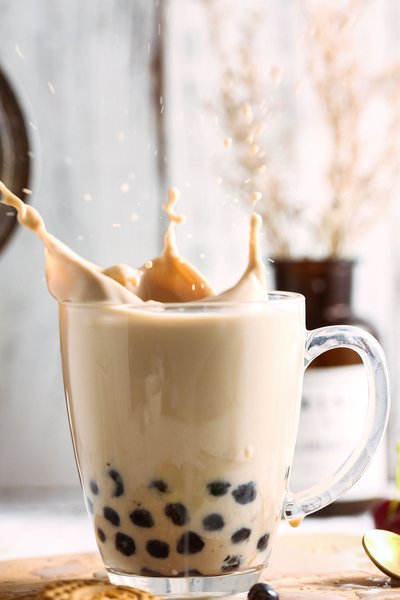
Milk tea has become somewhat of a nationalobsession and a booming business in China. Its popularity has fueled manyretailers whose main activities lie elsewhere to open milk tea stores to generateextra revenue and attract more customers. China Post Drugstore, a branch of ChinaPost Hengtai Pharmaceutical Co Ltd-itself a subsidiaryof China Post-has opened a milk tea store offering drinks and healthcare servicesin downtown Fuzhou, Fujian province. Named Post Oxygen of Tea, the store hasrecently gone viral online. Many people got to know the brand through socialmedia sites like Weibo and short video app Douyin, as well as stamp collectinggroups, as they are naturally curious about all things postal. Opened late last year, Post Oxygen of Teaprovides various drinks including traditional teas, or teas flavored with milk,fruits and other varieties. The beverages range from 7 yuan ($1.08) to morethan 20 yuan each. "China Post Drugstore is bullish onthe growth potential of the milk tea sector and thus has opened a store toexpand its business operations. It is expected to see growing businessopportunities fueled by strong demand," said Zhang Weilin, an analyst atthe LeadLeo Research Institute. "The milk tea sector has beenextremely popular in recent years, and it doesn't lack any attention fromcapital markets and social media platforms. A non-beverage retailer opening amilk tea business is in itself an eye-catching event,"Zhang said. The store is located on the first floor andinside a China Post Drugstore in the Gulou district of Fuzhou. On the secondfloor, shelves are stacked with books and healthcare, and psychologicalcounseling services by pharmacologists are also available. It is common to see long queues outside thestore for its popular drinks. Customers said it usually takes at least ahalf-hour wait to get a drink, and tea fans tend to linger on premises afterordering. The store doesn't have plans to open stores nationwide for now. Lin Qingjing, store director of Post Oxygenof Tea, said: "Our original intention was to make the pharmacy moreinnovative and distinctive, and we didn't intend to open a commercial milk teastore that would become popular online. We didn't expect such popularity. Mostpharmacies nationwide are ordinary and look a bit staid, and buyers won't staylong when they purchase medicines. We wanted to do something different to letpeople relax. "Physical and mental health andhappiness are equally important, and opening a milk tea store can help providea lighthearted environment for consumers as they take their time to selectmedicines." Last year, the number of consumers whobought bubble teas and related potables exceeded 340 million, and salesexceeded 100 billion yuan. With a constant consumption upgrade trend in China,annual sales are expected to hit 160 billion yuan within the next five years,according to Lead Leo. Over the next two to three years, a largenumber of retailers are expected to open new milk tea stores, as the number ofsuch stores currently in existence is far from reaching a saturation point inthe country. Over the long term, the business growthpotential of a milk tea store depends on its core competence rather than someeye-catching short-term gimmicks. Core competence relies on stable andstandardized product quality, the capability to research and develop newproducts, and the strength of comprehensive supply chains, LeadLeo added. "Opening a milk tea store requiresrelatively low upfront costs and it can generate high gross profits. It canquite readily help companies create extra revenue, given the strong demand formilk tea among young consumers in China. That's a key reason why manynon-beverage enterprises have expanded their business to the beveragesector,"Zhang of LeadLeo said. Meanwhile, orange soda drink retailerBeibingyang (meaning: Arctic Ocean), a brand rolled out in 1936 from an oldice-making factory in Beijing, recently opened its first milk tea store in thecapital's Daxing district close to company headquarters. Besides selling different drinks, the storealso offers pastries, chocolates and some derivative products such as umbrellasand shirts. Beibingyang hopes to attract more attentionand help market its main business by opening a milk tea store. However, thecompany is unlikely to expand further into the milk tea business. The supplychain and store management of freshly made drinks would be a brand-new challengecompared to its original business, said Xiao Yao, partner at Ries, a globalconsulting group. In addition, Swisse, an Australian vitaminand supplement brand, has opened three milk tea stores in Shanghai. The stores,named Swisseland, focus on maintaining beauty and staying young. They also sellsupplements such as drinks with collagen proteins and sesame mixed in. Swisse has been taking advantage of thereputation of its main business and taking a path of differentiatedcompetition. Most consumers of milk tea in China are females born after 1990.The age group is willing to purchase new types of foods and drinks that focuson healthy living, low sugar and products that improve physical appearance. "Swisse has a clear advantage indifferentiating its products from others by selling drinks combined withsupplements. Its brand reputation and discussions of milk tea stores can helpgenerate customer flow. If it can offer drinks with good quality and taste, itwould be easy for the company to draw more consumers," Zhang said. Still, for companies whose main business isnot beverage retail, their operations of milk tea stores will be limited totheir original brand positioning. Consumers are unlikely to have a deepimpression of their milk tea business, Zhang added. Compared with China's leading milk teachains Heytea, Coco and Nayuki, the milk tea business of other companies willhave difficulty achieving market scale and having a noticeable impact onexperienced brands. The operational efficiency of nonprofessional milk teabrands is likely to be affected by their main business, and resource allocationskills may not be in place perfectly, Zhang said. As of September last year, China had340,000 milk tea stores, including about 3,200 high-end shops, according to aresearch report by Zhongtai Securities. Among total milk tea plays, more than 50brands received funding from investors, and investment has often been madesince 2016, according to Qichacha, a company that tracks businessregistrations. In the first half, total value of disclosedinvestment in milk tea stores reached 5.34 billion yuan. Last year, the totaldisclosed value stood at 1.7 billion yuan, said Qichacha.
"The Chinese tea market continues tooffer huge potential in markets like Southeast Asia and beyond," saidWeng, whose enterprise has more than 300 employees and brings in 100 millionyuan in sales each year. "With the latest geographical listing,we'll focus on remaining at the forefront of the industry. We are investing inresearch and development and considering fast-growing, higher-yielding productslike milk tea" that are popular among younger consumers. Heng County Good Young is another majorplayer set to leverage Hengxian's pole position. The company has an annualproduction capacity of about 6,000 tons, ranging from traditional dried teas tomodern premix products. Company spokesman Huang Rongjin said thatwhile the group's focus is on the domestic market, Hengxian's EU-protectedjasmine tea indication is still an important nod to the local industry. "Our group has attained many globalcertifications and standards," Huang said. "The geographicalindication will also be an advantage. We supply to international brands, andour clients will most certainly consider the latest listing as an affirmationof our product quality and practices." The industry growth and optimism inHengxian are also felt on the ground. Jasmine pickers like Liang carry their bagsof flower buds on scooters to a new collection center. Just two years ago, theyhad to exchange their daily pickings for cash on the roadside. Li Kejin, deputy secretary of the county'sShijing village Party committee, said the collection center, which covers 2hectares and can handle 150,000 kilograms of jasmine buds a day, is acollective effort that has brought significant improvements to the sector,including better distribution channels and traffic conditions. "The workers can cash in their budsmore efficiently," Li said. "We're also getting good returns fromrunning the center, which can contribute to the development of the industry asa whole." In Fuzhou, the geographical listing drawson a long tradition of jasmine tea production. The city was one of the teatrading hubs of China founded in the late Qing Dynasty (1644-1911), accounting formore than one-third of the country's total tea exports, with jasmine teaforming the bulk of the trade, according to industry records. The cityregistered nearly 1,000 enterprises involved in jasmine tea production by thelate 1990s, according to local government figures. Jasmine cultivation areas in Fuzhou grew tocover about 1,670 hectares by 2019, an increase of 16 percent year-on-year. Thecity recorded jasmine output of 11,000 tons in 2019, up 6.8 percentyear-on-year, with output value at 380 million yuan, an increase of 5.8 percentyear-on-year. Amid the rapid diversification of products,processing area and brands, Fuzhou's jasmine tea sector has continued toachieve notable growth, riding on its "traditional handmade tea marketposition", according to the China Tea Marketing Association. |