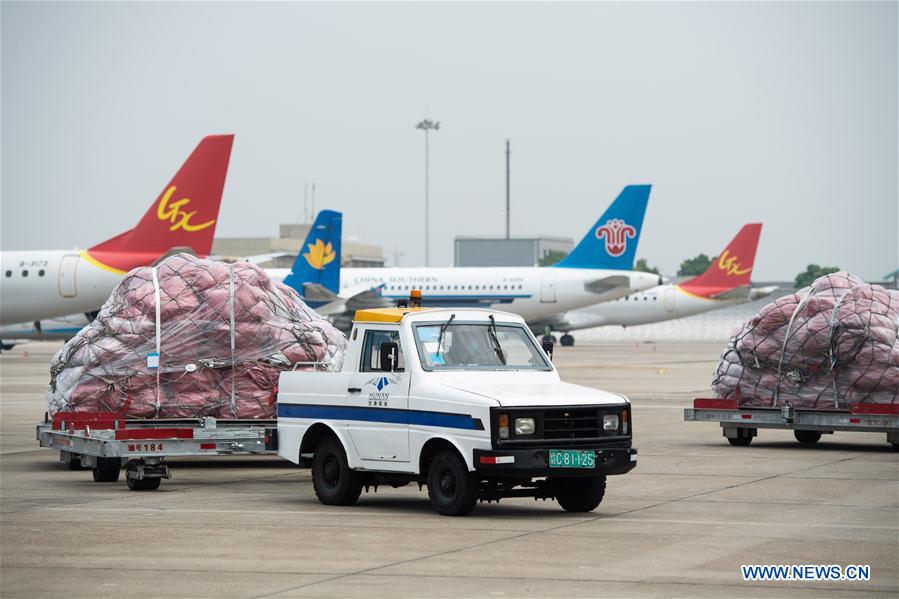
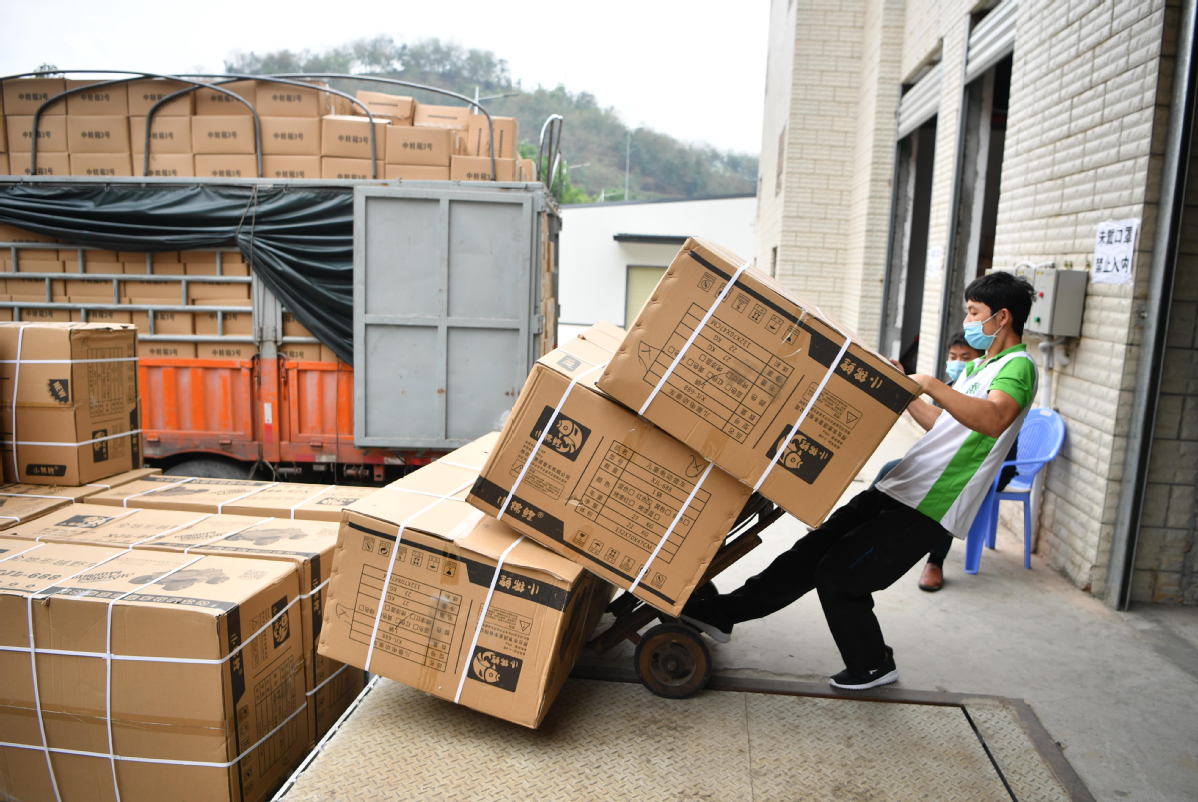
Two months after 10 Chinese customs began an experimental supervision mode to boost B2B e-commerce export, 12 more customs were added to the pilot program on Tuesday by China's General Administration of Customs. B2B e-commerce export refers to either direct export of goods from domestic businesses to overseas businesses by cross-border logistics based on their mutual deals over a cross-border e-commerce platform, or the export of goods by a domestic company to its overseas warehouse, from which the goods will be delivered to overseas buyers based on their deals over a cross-border e-commerce platform. Compared with traditional export, e-commerce B2B exporters, starting from Tuesday, will be given support in various forms, including one-off registration, streamlined declarations, expedited clearance at lower costs, as well as prior inspection and customs transit at the 12 newly-added customs nationwide, including Chongqing, Chengdu, Changsha, and Shanghai. Between July 1 and August 30, the 10 pilot customs had inspected and cleared a total of 6.32 million batches of exported goods under the pilot program. "Customs clearance time is shorter under the new mode, which helps avoid overdue returns caused by unstable international transportation," said Li Ou, general manager of a logistics firm in Chengdu, which is about to ship a batch of goods to the United States via cross-border e-commerce B2B export. The pilot program will provide cross-border e-commerce B2B export enterprises in Chengdu, especially to micro, small and medium-sized ones, with more convenient channels, and help "made-in-Chengdu" products to enter global industrial and supply chains, according to the municipal bureau of commerce. Also on Tuesday, 45 tons of clothing, shoes, daily necessities, and electronic accessories worth more than 2.5 million yuan ($366,750), were declared to the Changsha Customs in Central China's Hunan province through the new mode and are being exported to the United States, Germany, Kazakstan, and other countries. In Shanghai, local customs, taking into account the actual circumstances of small businesses, has introduced paperless processes of clearance for certain goods when a single consignment is worth less than 5,000 yuan. Customs statistics showed that the value of imports and exports transacted online by cross-border e-commerce enterprises reached 604.4 billion yuan in the first half of 2020, up by 6.7 percent year-on-year. Zhuang Rui, deputy dean of the Institute of International Economy at the University of International Business and Economics, said the number of customs agencies in the pilot program has more than doubled in just two months, showing the program is effective and helpful for enterprises. "It also reflects China's accelerating pace of opening up and the world's increasing demand for Chinese products. The expansion of pilot program is a win-win move," Zhuang said. Amid global economic uncertainties caused by the COVID-19 pandemic, China's foreign trade sector has delivered a better-than-expected performance so far this year, with cross-border e-commerce providing strong impetus. In the first half of the year, trade via cross-border e-commerce platforms, under the oversight of Customs authorities, increased by 26.2 percent year-on-year, with exports and imports up by 28.7 percent and 24.4 percent, respectively, data from the General Administration of Customs (GAC) showed. As COVID-19 dealt a heavy blow to traditional trade models, cross-border e-commerce has become a major driving force for stabilizing foreign trade, said Wei Jianguo, vice-chairman of the China Center for International Economic Exchanges. Expansion in the sector came as authorities unveiled several supportive measures, including further optimizing the business climate at ports, quickening Customs clearances, and accelerating export tax rebates. In April, the State Council decided at an executive meeting to set up 46 new, comprehensive cross-border e-commerce pilot zones, bringing the total number to 105. In addition to applying practices proven effective in boosting the flow of commerce, firms in these zones will enjoy supportive policies, such as exemption of value-added and consumption taxes on retail exports, and assessed levies of corporate income tax. Companies will be supported to jointly build and share overseas warehouses, a statement released after the meeting said. In Zhengzhou, capital city of Central China's Henan province and one of the second batch of such pilot cities, total foreign trade via e-commerce channels in the Zhengzhou Xinzheng Comprehensive Bonded Zone surged by 114 percent to 4.45 billion yuan ($642 million) in the first half. The imports in the zone almost doubled from last year, while exports rose more than fivefold. Because of its advantages, including online trading and contactless delivery, cross-border e-commerce has played a positive role in helping foreign trade firms cushion COVID-19 shocks as a new form of trade, GAC spokesperson Li Kuiwen said at a news conference. The GAC announced on June 12 it is carrying out pilot regulations for cross-border e-commerce business-to-business exports in 10 cities starting July 1. It offered enterprises simplified export declarations and paperless Customs clearance, among other supportive measures. During the first week of implementation, the 10 local Customs checked and issued 266,000 bills of entry and declaration forms, involving 250 million yuan worth of goods, Li said. Starting Sept 1, the pilot regulations will be expanded to another 12 cities, the GAC announced on Thursday. As cross-border e-commerce embraced robust growth, China's foreign trade also beat market expectations in recent months despite the adverse impact from shrinking global demand and restrictive overseas measures to contain the pandemic. In April, the world's second-largest economy logged positive growth in exports for the first time this year. In June, exports and imports both rose.The momentum was sustained through July as total foreign trade volumes rose by 6.5 percent year-on-year. Exports and imports went up by 10.4 percent and 1.6 percent, respectively. Despite the shrinking global trade market, China's share is growing larger, indicating the sector's rising competitiveness and increasing capacity to counter pressure, head of the GAC Ni Yuefeng told Xinhua. The situation for foreign trade and investment, however, is still grim as the worldwide spread of COVID-19, a severe global economic recession, and significant declines in international trade and investment as well as rising protectionism are all taken into account, said Ren Hongbin, assistant minister of commerce. According to World Trade Organization estimates, global trade would slump between 13 percent and 32 percent this year. To further stabilize foreign trade, the State Council announced on Wednesday it had issued a guideline to roll out more measures aimed at protecting foreign trade entities and keeping supply chains stable. More efforts will be made to help foreign trade firms expand their clientele and improve trade facilities and services, including cross-border e-commerce platforms, cross-border logistics, and overseas warehouses, it said. For many traditional trade firms, cross-border e-commerce remains an important option for digital transformation and an effective hedge against external risks, analysts noted. In the latter half of the year, the GAC will further simplify clearance procedures and cut logistics costs to optimize the business environment at ports, Ni said, who pledged to advance reforms in the regulation of cross-border e-commerce to help businesses better tap the global market. When he was a child, Hu Chunqing thought being admitted into a college was the only way he could leave his village in Shandong province and live a better life in a city. So he studied hard until he obtained a doctorate. The 34-year-old from Daiji town, Caoxian county, Heze city, now lives a well-off life, but he hasn't had to leave Hulou village, where he was born. "Our village is not poor any more," said Hu, who runs a Taobao store online that sells stage costumes as well as a costume factory in Daiji. "Many families get rich by doing business on e-commerce platforms." Last year, Hu reaped 9 million yuan ($1.3 million) in sales, and his costumes have been sold to overseas markets. E-commerce platforms have become a main way to help farmers achieve a prosperous life in Caoxian, where they once made a difficult living mainly planting corn and wheat. The county saw sales generated on such platforms reach 19.8 billion yuan last year, a year-on-year increase of 25 percent. Over the past few years, the county government has carried out a series of measures including allocating special funds for building roads, developing logistics and offering preferential tax policies to encourage farmers to do business online. The number of Caoxian county's "Taobao villages"-communities with annual transactions of more than 10 million yuan-had risen to 124 last year, making the county the second-largest Taobao village cluster in China. In Daiji alone, more than 26,000 farmers-over 55 percent of the town's population-are involved in the e-commerce industry, running 16,000 Taobao stores. "E-commerce has proved to be an efficient way to enrich both villagers' material and spiritual lives," said Sun Xueping, the Party secretary of Sunzhuang village in Daiji. Sunzhuang's main road is lined with shops providing materials for making clothes and shoes. Zhao Ying's stage costume-making workshop is a five-minute drive from the road, making it convenient for her to buy materials. "Business was impacted by the epidemic, but it is recovering," Zhao said. "We usually need to make hundreds of stage costumes every day." Zhao had a hard life when she married her husband from Sunzhuang and moved there 10 years ago. Her husband went to the city to work temporary jobs, and she had to stay at home to take care of her son and parents-in-law. While at home, she learned how to make costumes and tried to run a Taobao shop online in 2011. With orders increasing, her husband returned to help in the business two years later. Now her workshop employs several women who need to take care of their children at home. "We have bought a car and a new house," she said. "The most important thing is family members can stay together, and I have a good relationship with my parents-in-law." The e-commerce boom has driven many young people working in cities to return to rural areas and launch startups, which also provide jobs for older villagers. Like Hu, Sun Zhiguo returned to the town in 2015 after working in Brazil for seven years. With his overseas experience, the 33-yearold is planning to open an online shop to explore overseas markets. "Not far away from us, there is a cross-border e-commerce base that provides convenient services on cross-border trade," Sun said. To strengthen the e-commerce sector by integrating resources, the local governments are building an industrial park that has convenient logistics, e-commerce platforms, markets and apartments in Daiji. The park is expected to provide jobs for 15,000 people when complete. |