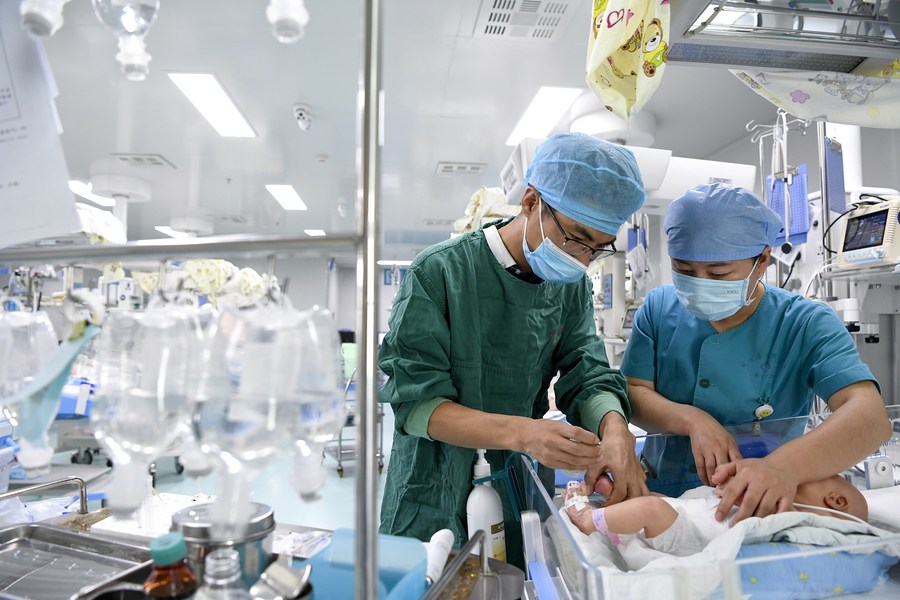
China will strive to build an integratedmedical-service system that provides high-quality services and is efficient inresource allocation and medical-facility management. Starting this year, efforts will be made toimprove public-health prevention and treatment capabilities, facilitate thehigh-quality development of public hospitals, strengthen health services forkey populations and promote the inheritance and innovation of traditionalChinese medicine, said Xu Shuqiang, an official with the National HealthCommission (NHC), at a press conference in Beijing. To further deepen medical reform, anotherkey task is to balance medical resources and improve the tiered system ofmedical diagnosis and treatment, said Li Bin, deputy head of the NHC. The reform of centralized procurement ofdrugs and medical consumables will also be advanced, said Wang Guodong, anofficial with the National Healthcare Security Administration. He added that more varieties will beincluded in the centralized drug procurement system, to reduce the burden onpeople while giving consideration to the reasonable profits of enterprises. As part of this year's reform, efforts willalso be made to promote nationwide the successful medical reform experiencegained in the city of Sanming in east China's Fujian Province, as well as tobuild up the country's public-health system under regular epidemic control,according to Li. Medicalleaders share thoughts on high quality development Directors of China's top hospitals gavesuggestions on the construction of high-quality hospitals at a summit on September5, as they celebrated the 100th anniversary of the establishment of Peking UnionMedical College Hospital. As the experimental unit of the nation’smodern hospital management system and high-quality development plan, thehospital aims to become a world-class hospital. Qualities it developed over the pastcentury include a spirit of service to the nation and Chinese people, respectfor scientific knowledge and regard for the motives of personnel and carryingforward a culture of excellence, all of which provide an example for theirmedical peers, said Li Bin, deputy director of China’s National HealthCommission. Li also noted construction requirements,which involve new systems, more sophisticated service and management abilities,promoting co-development of medical insurance and the drug industry andstrengthening Party leadership over public hospitals. In June, the General Office of the StateCouncil published an announcement regarding the high-quality development ofpublic hospitals, with detailed guidance for medical reform. "The principal position of publichospitals has to be strengthened," said Xu Shuqiang, director of theinstitutional reform department of the commission. "Public hospitals inChina will make efforts to refine their management through talent-orientedresource allocation to improve operating efficiency." Hospital leaders shared their inspirationsabout the management process, with many highlighting the significance ofdigitalization through high-tech skills. "We commit to providing conveniencefor patients with digital devices, so that they can finish their entiretreatment procedure with a smart phone," said Ning Guang from ShanghaiRuijin Hospital. High-tech companies have also played anindispensable role in medical services. The volume of patients using internethealthcare services has doubled during the COVID-19 pandemic. The advantages oftechnology in balancing medical resources, which could contribute to promotingconvenient and specific treatment processes, as well as increasing hospitalmanagement efficiency. Jiao Yahui, director of the National HealthCommission's Bureau of Medical Administration, summarized the objectives forthe high-quality improvement of public hospitals, including graduallyperfecting system construction, improving overall efficiency and quality andmotivating medical personnel. Innovationgives Chinese biopharma edge on global stage Innovative domestic biopharmaceuticalcompanies are beginning to bring their research and development results beyondChina after at least 15 years of accumulating experience in new drugdevelopment and carrying out clinical trials, industry experts said. Such high-speed growth of Chinese medicalresearch results will stay on pace for another decade before entering astabilization phase, they said. Recent examples include a new drugapplication for an innovative drug to treat neuroendocrine tumors developed byHutchison China MediTech-or Hutchmed-which was submitted to the United States Food and DrugAdministration. Its market application in Europe is underway. In the US, the oral capsule, whichcompleted its market launch in China in January, was granted fast track statusin its application to treat pancreatic and non-pancreatic NETs, the companysaid. "Many domestic pharmaceuticalcompanies believe that the local market is seeing its best years of vitalityand the overseas market is also a land of mass opportunities," said MaJun, an expert with the Chinese Society of Clinical Oncology. "Medicines from China can enrich drugoptions for overseas markets and provide foreign patients with therapies atlower prices," Ma said. Data showed that a rising number of strongdomestic medical plays are showcasing themselves on the international stage andare becoming destinations for capital investment. Figures showed that the total market valueof innovative Chinese biotechnology companies and ecosystem participants listedon the Nasdaq, and in Hong Kong and Shanghai was nearly $220 billion last year,which surged rapidly for consecutive years from $12 billion in 2017. Hutchmed's new drug surufatinib is theworld's first therapy to treat NETs of many kinds. Su Weiguo, chief scientific officer ofHutchmed, said that after evaluating the drug's functioning mechanism,effectiveness and safety, they are confident of its future potential in bothdomestic and foreign markets. "It also showcases to the globalmedical community that China's innovative drugs are rapidly benefiting patientsin the country and even the world with cutting-edge research concepts,standardized and rigorous R&D processes and high levels of quality,"said Chen Kaixian, an academician with the Chinese Academy of Sciences. In the field of gene sequencing, somedomestic startups said that their speed of development in overseas markets evenoutgrew that in the local market. "Revenue from overseas markets, mainlyEurope and the US with their developed life sciences and biomedicalfoundations, accounted for 35 percent of the company's global sales.Globalization is one of the company's key orientations for the future,"said Li Ruiqiang, founder and CEO of Novogene, a Beijing-based provider ofgenomic services and solutions established a decade ago. Domestic gene technology firm Burning Rock,dedicated to R&D of tumor testing, was listed on the Nasdaq last year afterits establishment in 2014. Han Yusheng, founder and CEO of the company, saidthat some of their products are superior to US counterparts in variousindicators by US Food and Drug Administration evaluations. They have advantagesin price and order delivery speed as well. "In addition to the US and Europe, weregard Japan and some leading economies in South America, including Brazil, asoverseas markets worth expanding to," Han said. Both Li and Han made the remarks at anindustry summit held by US-based Illumina, a world-leading biotech company, inShanghai in mid-May. Li Qing, vice-president of Illumina andgeneral manager of Illumina Greater China, said the summit was held in part dueto rapid advances in the gene sequencing industry. "We attributed the explosion to thestrengthening of scientific research in the industry and the soaringdevelopment of clinical applications," Li said. Last year, the compound annual growth rateof data output in gene sequencing in China was 33 percent per quarter, accordingto an Illumina report. I-Mab, a Shanghai-based biomedicine startupthat has built an innovative and competitive pipeline mainly in oncology andautoimmune diseases since its founding in 2016, reached a strategiccollaboration agreement with AbbVie from the US over I-Mab's CD47 antibody fornext-phase R&D and global commercialization. I-Mab has reaped 18.9 billionyuan ($2.94 billion) from the collaboration. "By collaborating with multinationalindustry leaders for commercial interests outside of China, we wanted to usetheir strength to push forward the innovative medicine to the market, even theglobal market, in a swift manner," said Zang Jingwu, founder and chairmanof I-Mab, which is dedicated to novel and highly differentiated biomedicinedevelopment and was listed on the Nasdaq in January 2020. Explaining the advantage of the CD47antibody to win over AbbVie's investment, Zang said that clinical trials in theUS proved its advantages of maximally reducing the occurrence of anemia amongpatients, which differentiated it from all other alternatives during R&D sofar. "This is a globally competitiveantibody with unique characteristics. We have fairly high expectations on thisfuture product," he said. By the end of this year, the company willhave altogether conducted 16 clinical trials in China and the US,simultaneously. Many of them will be phase-II or phase-III for innovativecandidates from a mature pipeline, Zang said. "Clinical trial data from the US canbetter help us win opportunities for future collaboration with leadingmultinational companies so that we can play up our advantages to make our productsstronger," he said. Zang said the startup has evolved from anearly-stage discovery company into a clinical stage company. "Thecompany's plan is to further develop into a China-rooted global enterprisecovering entire industrial chains over the upcoming three years." Shen Huaqiong, CEO of I-Mab, said that thecompany's ambition is to serve global innovation. "Our enterprise isheadquartered in Shanghai but we have sites in Beijing, Hong Kong and Maryland(in the US) so that we can collaborate globally by availing of their respectiveadvantages," she said. Experts said that the country's reform ofthe drug regulatory system and drug review and approval mechanism since 2015has prompted the pharmaceutical innovation ecosystem to basically take shape. Other measures, including a modernmanagement method of clinical trial institutions, encouraging basic researchand strengthening protection over intellectual property of drugs, also led tosignificant improvement in the environment for China's pharmaceuticalinnovations, experts said. Ma, who is also director of the HarbinBlood Disease and Tumor Institute of Harbin First Hospital, said that China iscurrently in an explosive era of biopharmaceutical development. For example,there are more than 50 PD-1 inhibitors-potential tumortherapies-being developed by domestic enterprises. "Homogeneous competitions should notbe necessarily discouraged as they can often benefit patients by bringingtherapy options at lower prices," Ma said. Shen Lin, vice-president of both Beijing CancerHospital and the Beijing Institute for Cancer Research, said she observed thatmost Chinese biotech startups start from local needs while having globalvision. "That'll also attract leadingmultinational companies' rising attention to Chinese patients' unmetneeds," she said. For example, Medtronic, a US-based medicaltechnology company, reached a strategic collaboration with Beijing iTrasonTechnology Co Ltd-a high-tech enterprise specializing in ultrasound imaging devices-in April tojointly improve the accessibility of ultrasound-guided percutaneous transluminalangioplasty in China. Inspired by the local startup's tabletultrasound technology, the partnership aimed to help doctors maintain valuablevascular access resources for patients with end-stage renal diseases who relyon hemodialysis and ultimately improves the quality of life for the patients,Medtronic said. The partners will also jointly promote theapplication of the technologies to primary medical institutions so thatfront-line healthcare workers can provide better medical services to thehundreds of thousands of patients relying on hemodialysis in China. |