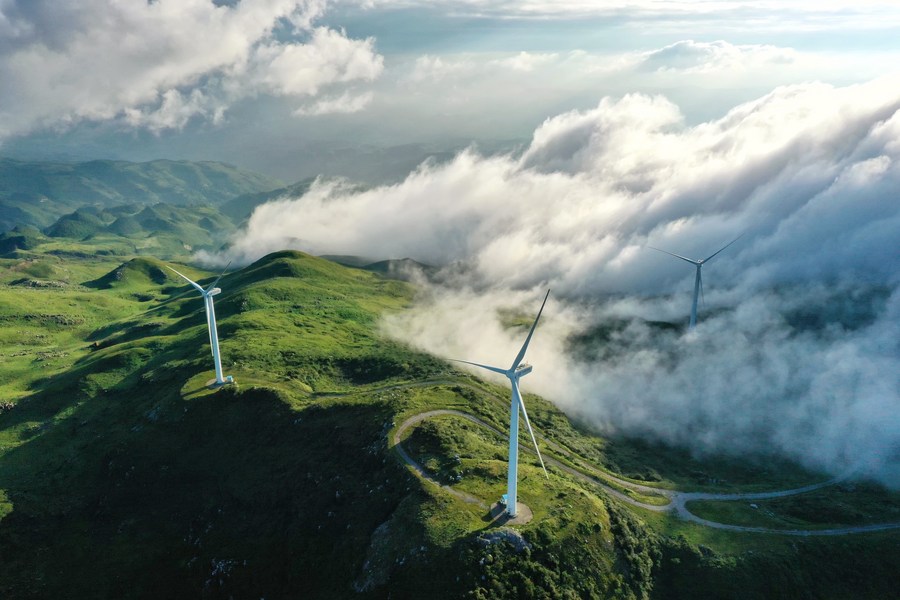
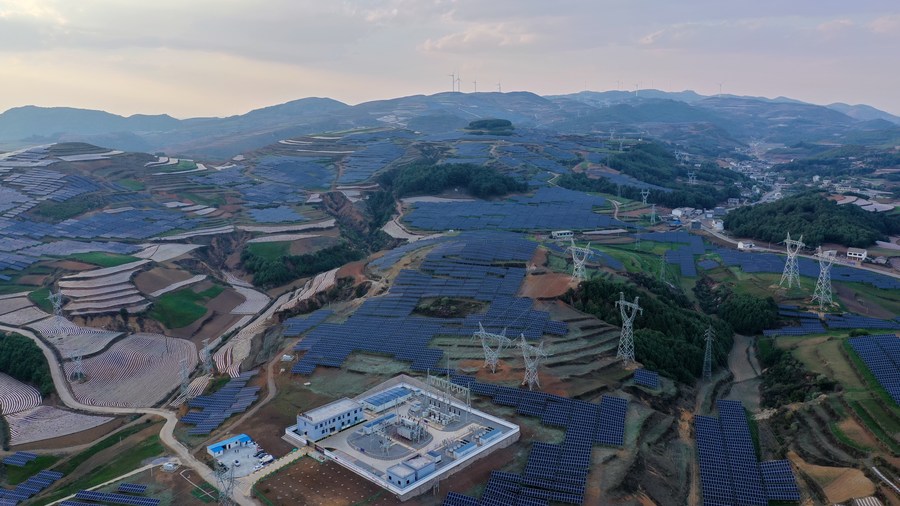
A global forum on ecological civilization,Eco Forum Global Guiyang 2021, opened on July 12 in Guiyang, capital ofsouthwest China's Guizhou Province. The forum witnessed a range of online andoffline activities. Lots of guests are expected to join the event online, whilearound 500 are attending the forum on site. It is tipped to evolve into a globalcampaign aimed at dramatically reducing the world's carbon footprint, saidPeter Koenig, a former senior economist with the World Bank, attending theevent via video link. China is the world's largest producer andconsumer of energy, with fossil fuels making up about 85 percent of the energystructure. China has vowed to attain carbon dioxideemissions peak before 2030 and achieve carbon neutrality before 2060. The country is going full throttle todevelop new energy resources and increase their proportion in primary energyconsumption nationwide, which are expected to lighten the burden on theenvironment and ecosystems and provide practical solutions to mitigating soil,surface water and air pollutions, said Lei Yizhu, head of Guizhou's carbonneutrality research institute. "Such efforts can also greatly promoteChina's carbon dioxide emission reduction, slowing down global warming andimproving the global climate conditions," Lei said. During the 14th Five-Year Plan period(2021-2025), as the country strives for low-carbon transition, relevanteco-friendly industries in fields such as clean energy are to cash in thebonanza, said Zhao Weidong, head of the institute of energy conservation andenvironmental protection affiliated with the Center for Information andIndustry Development, under China's Ministry of Industry and InformationTechnology. The overall geography of China featureshigh altitudes in its western areas. Geographical conditions and poorfoundation of transportation infrastructure used to hamper economic developmentin those regions. Nowadays, however, the highlands withstrong wind and sunny weathers see a flourishing clean energy market. "Guizhou is a newcomer in developingnew energy resources as it has to grapple with mountainous terrains, low windspeeds and rainy weather," said Shi Shaogui, director of the new energyand renewable energy department of the provincial energy bureau. A decade ago, Guizhou had no installedpower capacity of wind and photovoltaic energy. In 2011, however, themountainous province pooled over 800 million yuan (about 124 million U.S.dollars) to build its first wind power plant in Jiucaiping. When colossal wind turbines arrived, Li Xu,a local resident in Hongxing Village, Hezhang County, was startled. Hewitnessed the difficult transport of hulky wind turbines up to the highmountain. The development of new energy has sincequickened in Guizhou, said Shi. By the end of 2020, the province had installedmore than 5.8 million kilowatts of wind power capacity. Guizhou's first photovoltaic power stationstarted operation in 2015, and by the end of 2020, the province's installedphotovoltaic power capacity had exceeded 10.57 million kilowatts. The Xianshuiwo photovoltaic power plant inYina Township of Bijie City, Guizhou, is built at an elevation of around 2,200meters. The power plant with rows of solar panels glittering in the sun hashelped the local households make good use of their wastelands and photovoltaicresources. It is estimated that the power plant will generate around 504million kWh of electricity with an average of 1,231 hours of solar powerutilization in 2021. At the Wujiangyuan wind power plant, 198generator units rotate in the wind. "Though wind farms are demanding intheir locations, they can bring huge economic and social benefits to the localresidents. The wind power plants are conducive to adjusting the regional energystructure and cutting carbon and harmful gas emission," said Xu Chaohua,vice general manager of Guizhou clean energy branch under China Huaneng Group. The Wujiangyuan wind farm has generatedover 4.2 billion kWh of power since it started operation, which is equivalentto saving 1.33 million tonnes of standard coal. A total of 3.65 million tonnesof carbon dioxide and 119,900 tonnes of sulfur dioxide have been slashedannually thanks to the wind turbines. By the end of 2020, more than 40 percent ofChina's installed power generation capacity came from renewable resources,supporting nearly one third of the country's electricity consumption, data fromthe National Energy Administration showed. As a result, 15.9 percent of China'sprimary energy consumption came from non-fossil energy, surpassing a target of15 percent set for 2020. In 2018, the National Energy Administrationlaunched a three-year action plan to improve the utilization rate of renewableenergy in power generation. Last year, the average utilization rate of windpower and photovoltaic power reached 97 percent and 98 percent, respectively. Nevertheless, China's goal of achievingcarbon neutrality by 2060 is not an easy battle. Gao Jinshan, vice president of Goldwind, aleading renewable energy company located in northwest China's Xinjiang UygurAutonomous Region, assessed the existing gap between China's current energystructure and its promise of carbon neutrality at the forum. By the end of last year, the country'soverall installed capacity of wind power and photovoltaic power generation camein at 280 million kilowatts and about 260 million kilowatts, respectively.However, to achieve the goal of reaching carbon dioxide emissions peak before2030 and realizing carbon neutrality before 2060, an capacity to generatearound 1.2 billion kilowatts of electricity from wind and photovoltaic energyis needed. Since the total installed capacity of thetwo energy sectors is expected to reach 540 million kilowatts by the end of2021, there still lies a gulf of about 700 million kilowatts to fill in, saidGao. To bridge the gap, China has stepped up itsgreen transition and made comprehensive plans. Guizhou plans to slash 40.55 million tonnesof carbon dioxide emissions annually by 2025 and reduce a whopping 71.56million tonnes of carbon dioxide emissions annually by 2030 through the use ofnew energy. Moreover, the province's overall output ofshale gas and coal bed gas is expected to surpass 100 million cubic meters in2021, while 10 more garbage power plants will be built this year. Guanling Buyi and Miao Autonomous County inGuizhou, known for its soil erosion and desertification, had faced numerouschallenges on the road to prosperity, but now it has found golden opportunitiesin the recent renewable energy boom. "We will have wind farms on themountains, photovoltaic power plants halfway up the mountain top, andhydropower stations down the mountains in the future, all for the sake ofreaching carbon emission peak and neutrality," said Wei Chaohu, Partysecretary of the county. Currently, the county has an installedpower generation capacity of over 4 million kilowatts from renewable resources,and the figure is expected to rise to 5.3 million kilowatts by the end of 2025. "The photovoltaic power plants needhuman labor, which are expected to create thousands of job opportunities forlocal residents and 3 billion yuan of output value when the projects are fullyimplemented," Wei said. A report published in July by ChongyangInstitute for Financial Studies, Renmin University, notes that the green reformof the energy industry and its transition to renewable energy plays animportant role for realizing China's ambitious goal of carbon neutrality. In the future, China plans to promote theeco-friendly transformation of thermal power enterprises with long-term heavypollution and further explore renewable energy alternatives in the constructionof new infrastructure. "With its low-carbon commitment to theworld, China buckles down to develop new energy resources to replaceconventional fossil fuels, which greatly demonstrates its responsible stance asa major country and its firm determination to build a community with a sharedfuture for humanity," said Lei Yizhu. On July 13,China also startedconstruction of the world's first commercial small modular reactor (SMR)project on land in the country's southern-most island province of Hainan. The project is based at the Changjiangnuclear power plant and uses Linglong One (ACP100) technology. It wasself-developed by the China National Nuclear Corporation. The multi-purpose, small modularpressurized water reactor is a massive achievement of independent innovationafter Hualong One, a domestically designed third-generation nuclear reactor. Compared with the bigger Hualong One, the125 MWe Linglong One reactor is designed for electricity generation, urbanheating, urban cooling, industrial steam production, or seawater desalination. The Linglong One was the world's first SMRapproved by the International Atomic Energy Agency in 2016. |