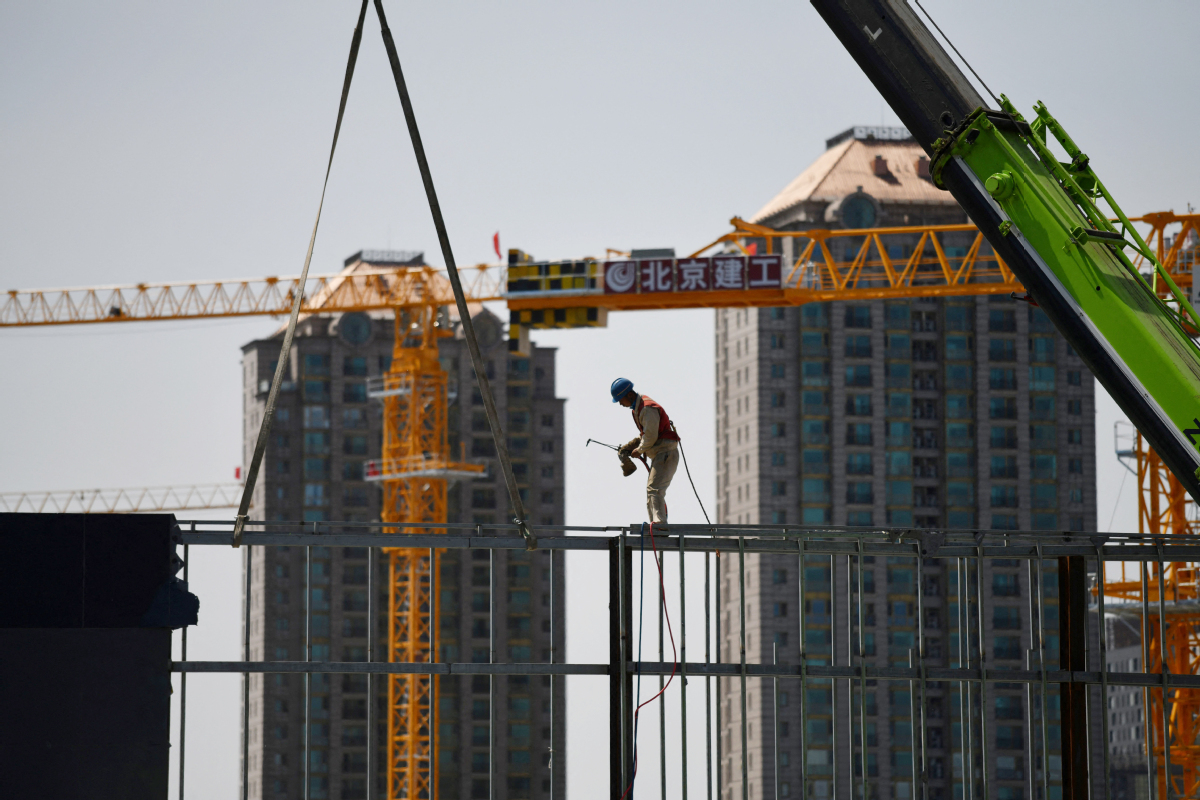
Real estate investment in China rose by21.6 percent to 4.02 trillion yuan ($624 billion) during the first four monthsof the year from a year ago, official data showed on Monday. Nearly 3.02 trillion yuan of the total wasused for residential development, up 24.4 percent on a yearly basis, accordingto the National Bureau of Statistics. Property investment growth slowed downduring the four months compared to an increase of 25.6 percent in the firstthree months, further eclipsed by a 28.8 percent rise in residential propertyinvestment between January and March from a year ago, it said. Experts expect the sector to remain stablealong with an improving business environment and continue to abide by thecentral authorities' guideline that housing is for living in, not forspeculation. Property sales from January to April grewby 48.1 percent on a yearly basis in terms of floor area, slowing from a 63.8percent rise in the first quarter of the year. Home sales grew 51.1 percent and73.2 percent on yearly basis in terms of gross floor area and sales revenue,both of which were relatively milder than the 68.1 percent and 95.5 percentseen in the first quarter, respectively, according to NBS data. The slower investment data and salesfigures are due to the curbs on the property market as well as a seasonalslowdown, said Pan Hao, a senior analyst with the Beike Research Institute. Since the beginning of this year, citieslike Dongguan in Guangdong province, Jiaxing and Ningbo in Zhejiang province,Nanjing of Jiangsu province, Hefei of Anhui province, Guangzhou of Guangdongprovince and Chengdu of Sichuan province have announced various policiesincluding purchase restrictions, price caps, lucky draws for home purchase, andpresales management, which have effectively stabilized local home prices, saidPan. The rapid economic recovery from COVID-19has buoyed demand for new homes in China, and in response to the market demand,property developers are becoming more active in terms of land acquisition, saidZhang Dawei, chief analyst at Centaline Property Agency Ltd. The NBS also released data on new homeprices in the nation's 70 major cities on Monday, which showed anacross-the-board growth in April, while pre-owned apartment sales showed variedtrends, said Sheng Guoqing, chief statistician with the NBS. In April, new home prices in the 70 majorcities tracked by the NBS rose by 0.5 percent on a monthly basis and by 4.4percent on a yearly basis. "Although most of the major cities hadannounced restrictions on home purchases, prices continued edging up in April,showing the necessity for local governments to react more spontaneously whensurge signs appear," said Yan Yuejin, director of the Shanghai-basedE-house China Research and Development Institution. Of the 70 cities, 62 saw growth in new homeprices, three cities reported no change, while five posted declines. New home prices in the four first-tiercities rose by 0.6 percent on a monthly basis, with Guangzhou taking the leadwith 1.1 percent growth, followed by Beijing with 0.6 percent, Shenzhen with0.5 percent and Shanghai with 0.3 percent. Compared to a year ago, the four top-tiercities saw a 5.8 percent growth in new home prices, up 0.6 percentage pointfrom that of the previous month, according to the NBS. First-tier cities outperformed smallercities in new home price growth. The 31 second-tier cities monitored by the NBSsaw prices increase by 0.6 percent on a monthly basis, and by 4.9 percent on ayearly basis, while the figures were 0.4 percent and 3.9 percent for 35third-tier cities. In the pre-owned home market, first-tiercities continued to take the lead in price gains. Compared with March, pricesof pre-owned homes in the top-tier cities rose by 0.8 percent on average, andwitnessed an 11.3 percent growth on a yearly basis. Used home prices in 31 second-tier cities,mostly provincial capitals, rose 0.5 percent from a month ago, and 3.4 percentyear-on-year. The 35 third-tier cities saw existing home prices edge up 0.3percent on a monthly basis, and by 2.5 percent from the same period a year ago. The long-term rental housing sector isentering a boom with its market scale expanding to the trillion-yuan level, andthe country's latest guideline on rental housing will provide policy supportfor guaranteeing the sector's healthy development, experts said. China's existing rental housing marketcurrently has a total asset value of some 500 billion yuan ($77.75 billion). The central government has made it clearthat a certain amount of residential land supply will be set aside for rentalhousing development during the 14th Five-Year Plan period (2021-25), which isexpected to add more than 500 billion yuan in new assets to the sector in thecoming five years, according to industry experts. "The COVID-19 outbreak has led to anindustrial reshuffle in the long-term rental housing sector over the past year,with the most famous case being Beijing-based Danke Apartment being delistedfrom the New York Stock Exchange," said Li Jianlin, research director ofrental business unit with China Real Estate Information Corp, owned by E-House(China) Enterprise Holdings Ltd. Li said since 2017, several long-termrental property firms have struggled with bankruptcy. "The fall of Danke displayed thefragility of rental housing enterprises, even publicly listed ones," saidYan Yuejin, director of Shanghai-based E-house China Research and DevelopmentInstitution. For players anxious to achieve success inthe sector, they should first acquire strong risk prevention capabilities andestablish a good reputation to become true industry leaders, Yan said. It's necessary to form a credit ratingsystem for long-term rental housing enterprises to reduce or prevent businessrisks, Yan said. In a guideline issued in late April, sixgovernment bodies-including the Ministry of Housing and Urban-Rural Development andthe National Development and Reform Commission-vowed to tightenregulations on asset-light housing rental enterprises and clarify regulatorymeasures for those engaged in subleasing activities. Under the guideline, real estate leasingcompanies and individuals subleasing more than 10 homes or rooms are legallyrequired to register as market entities and obtain business licenses, XinhuaNews Agency reported. The guideline also urged housing rentalcompanies to set up accounts to regulate rental funds at local commercial banksand defuse financial risks. Activities that attempt to disguise actualfinancial business practices, including embedding housing rental consumptionloans into lease contracts, using tenant credit to obtain consumption loans andprompting tenants to use such loans, are also prohibited by the guideline. "Stricter regulation is aimed atmaintaining order in the leasing market, guiding the market in a stabledirection and protecting tenant interests," said Hui Jianqiang, head ofresearch at Beijing Zhongfang-Yanxie Technology Service Ltd. Li said the country is further improvingleasing market development rules to ensure its healthy development in the longrun. In the future, market entry standards will become clearer for long-termrental market players, and those with truly stable operating capabilities canenjoy a stable business environment, which is also beneficial for the wholemarket. The guideline is the first systematicregulatory measure announced targeting the long-term rental housing sector, apromising industry that is expected to reach a market scale of 1 trillion yuanin the coming years, experts said. The central government has been encouragingthe development of rental housing by boosting supply, implementing industrialregulations and offering favorable policies since the 13th Five-Year Plan period(2016-20), and the sector is likely to welcome accelerated development in the14th Five-Year Plan period (2021-25). Premier Li Keqiang said in the GovernmentWork Report released in March that "by increasing land supply, earmarkingspecial funds and carrying out concentrated development schemes, China willincrease the supply of government-subsidized rental housing and sharedownership housing."
China will ensure well-regulateddevelopment of the long-term rental housing market, and cut taxes and fees onrental housing. China will make every effort to address the housingdifficulties faced by new urban residents and young people, the report said. Experts said the development of megacityclusters will create sufficient demand for leasing. Nationwide, many of the more than 200million migrant workers cannot afford to buy their own homes in large Chinesecities, forming solid demand for rental housing, Cifi Holdings Group Co said. Eyeing huge market potential, Cifi's rentalhome unit is seeking a public listing after seeing a rapid growth in itsportfolio, according to Zhang Aihua, chief executive officer of Cifi HoldingsGroup Co's rental home unit. The unit aims to further expand its assets undermanagement about tenfold to 100 billion yuan in the mid to long term. Zhang's confidence comes from measuresapplied by the government to develop the rental housing market. During the 13th Five-Year Plan period,Shanghai built more than 700,000 rental housing units. As of 2020, Shanghai hadlaunched 152 plots for construction of more than 10 million square meters ofgross floor area living space, which would inject at least 220,000 newapartment units for leasing, said Feng Ganghua, an official with the ShanghaiHousing Administration. Shanghai Mayor Gong Zheng said the citywill accelerate its rental housing development. More large land plots for rental housingwill be offered, and 18 out of the 22 major cities that China Real EstateInformation Corp monitored have announced their annual land supply plans. Themajority of them vowed to allocate some 10 percent of residential land supplyfor rental housing. Zhang of Cifi Holdings said average landcosts for rental homes are only about 23 percent that of conventionalresidential plots in Shanghai. The low-cost land makes it possible for rentalmarket to generate a similar profit margin as other property sectors. Experts see a promising outlook for rentalhousing both in terms of business scale and profitability. "Rental housing is going to become avery important part of China's housing market, and rental apartments could takeup between 20 percent and 30 percent of annual new homes supply in largeChinese cities in the future," Hui of Beijing Zhongfang-Yanxie TechnologyService said. Meanwhile, annual rent is equivalent to5.63 percent of the total property value in the United States, and 6.13 percentin Japan. But in Beijing, it is merely 1.7 percent, and it is 1.61 percent inShanghai and 1.56 percent in Guangzhou, Li of China Real Estate Informationsaid. Facing COVID-19-related hardships alongwith moves to reduce market risk, the long-term rental housing market, whichmakes up an important part of overall housing rentals, is actively adjustingitself with government support, and currently is on a path of steady andhealthy development, experts said. China Vanke said it operated a total of184,400 rooms of long-term rental housing as of the end of 2020, and itsavailable projects reported a combined occupancy rate exceeding 95 percent. Longfor Group Holdings Ltd said 88.5percent of its 90,000 rental flats were occupied, and 93.3 percent of thoseoperated for more than six months were leased out. Focused on Shanghai and other cities inEast China, Cifi is currently operating more than 74,000 rooms for leasing in18 major Chinese cities. |