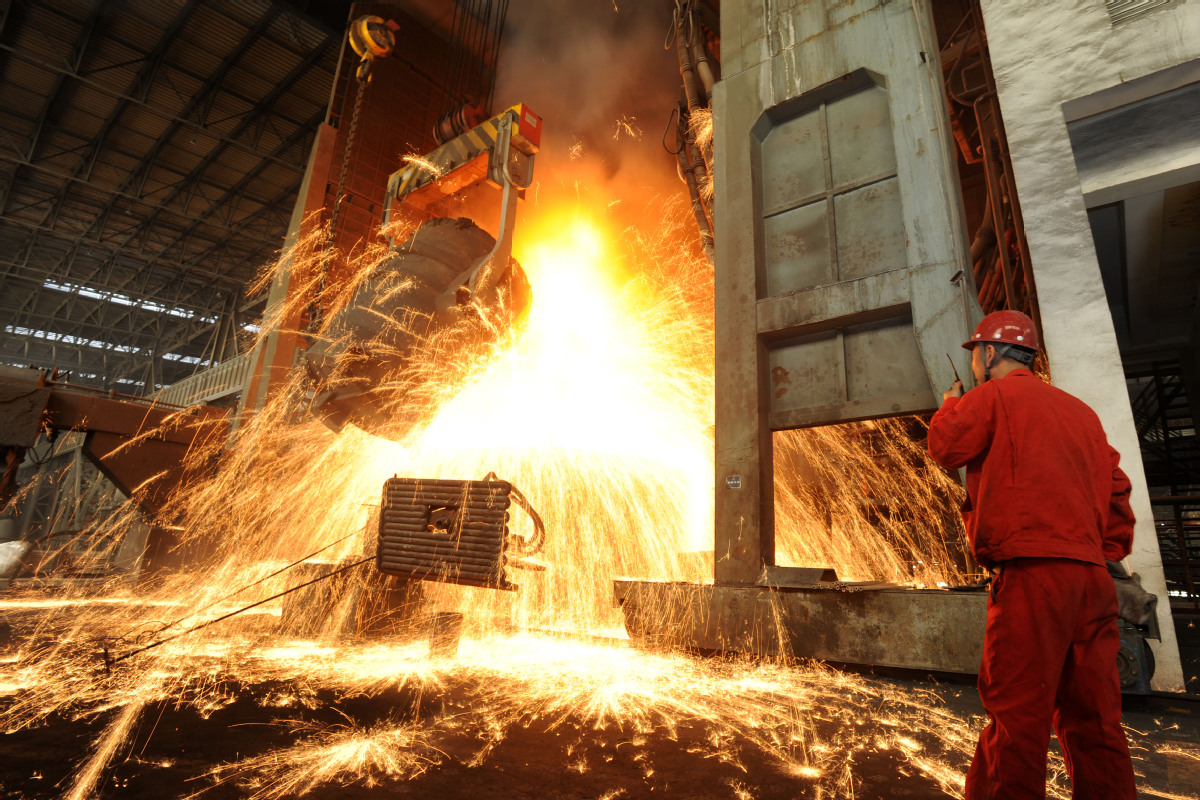
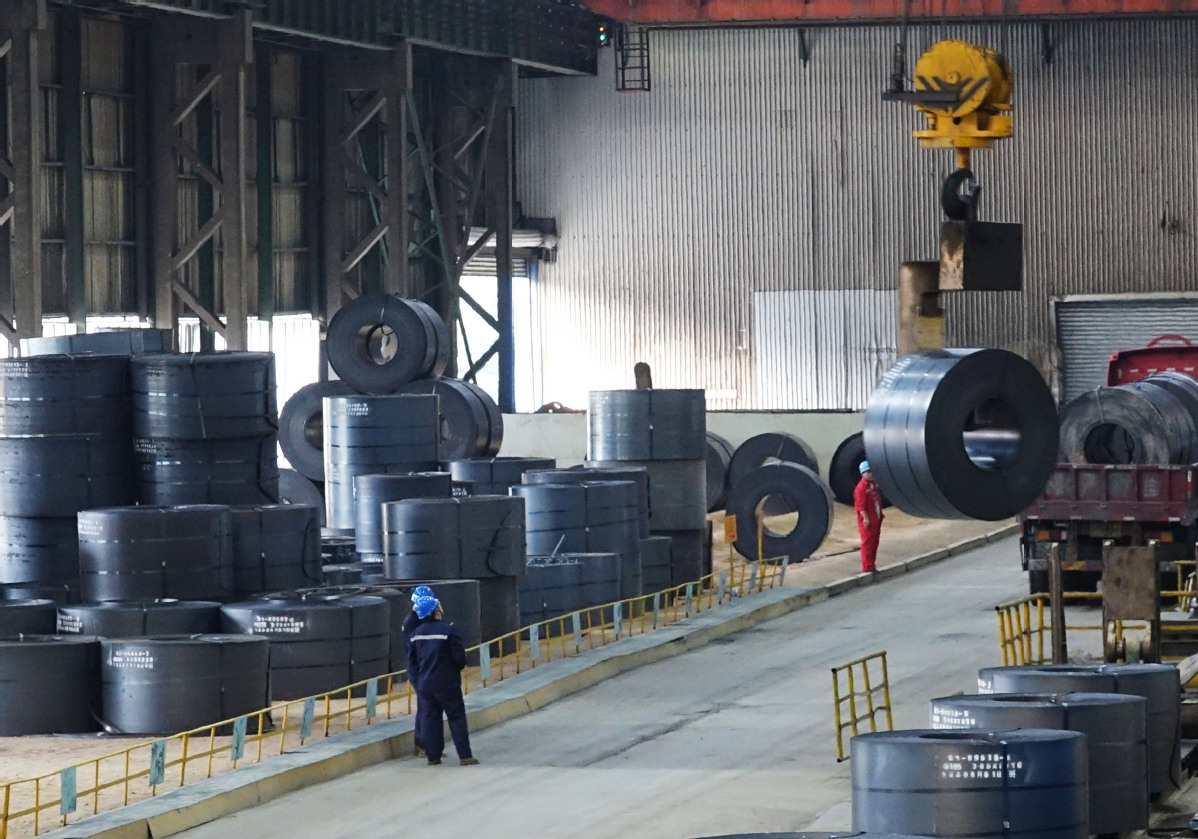
On May 12, steel product prices, tracked bythe center, rose by 6,510 yuan ($1,013) per metric ton on average, an intradayincrease of 6.9 percent. That was higher than the historic high seen in 2008,said experts. Prices of Grade-3 rebar rose by 389 yuan per ton, whilehot-rolled coil prices rose by 369 yuan per ton. The main futures for iron ore,hot-rolled roil and rebar all rose to their daily limit. The short-term steel price surge is largelydue to the apprehensions about supply shortage. China has said that it wouldlook to peak carbon emissions by 2030 and achieve carbon neutrality by 2060.The government is also planning to probe the steel industry's capacityreduction programs. Xiao Yaqing, minister of industry andinformation technology, said recently that China is determined to curb crudesteel production to ensure a year-on-year output fall this year. According to the China Iron and SteelAssociation, key steel mills produced about 2.4 million tons of crude steel inApril, up 19.27 percent from a year earlier. By May 7, total steel inventories in 29 keycities across the country reached 14.19 million tons, up 14,000 tons from theprevious week, and posted positive growth for the first time after successivedeclines for eight weeks, data from the Lange Steel center showed. China's national-level carbon emissionstrading system is expected to be a significant lever for the steel industry'scarbon emissions reduction and structural optimization, experts said. The national carbon emissions tradingsystem, scheduled to become operational by the end of June, will first open forthe power sector, to be followed by the steel industry as soon as possible,within the 14th Five-Year Plan period (2021-25), said Li Gao, head of thedepartment of climate change at the Ministry of Ecology and Environment, CNR BusinessRadio reported. To begin with, a company registered withthe trading system will be allocated a specific amount of carbon emissionsallowance for free, based on its history of production and carbon emissionsdata. If the company's carbon emissions subsequently exceed its allowance, ithas to buy more allowances in the trading system. "By putting a price on carbonemissions, and providing a marketplace to trade emission allowances, the carbonemissions trading system will rely on market mechanisms and economic toolsrather than administrative regulations to propel steel enterprises' efforts incarbon emissions control and reduction," said Wang Guoqing, director ofthe Lange Steel Information Center. "That will also underpin thehigh-quality development of the steel industry and help advance China's carbonneutrality." Rules will get increasingly tougher overtime, although in the beginning the free allowance calculation and allocationmechanism may be designed not to have an overwhelming effect, so as to offer atime window for steel enterprises to adjust to lower-carbon production andoperations, Wang said. She said she believes the amounts of freeallowances will diminish over time, while penalty for failing to reportaccurate data or meet compliance obligations will increasingly tighten. Trading of carbon emission quotas is not anew concept to China's steel industry. In 2011, the country started carbonemissions trading pilot works in seven provinces and cities such as Beijing,Shanghai and Tianjin, and Guangdong province. Data from the Ministry of Ecology andEnvironment showed nearly 3,000 companies from more than 20 industries,including power, steel and cement, have taken part in the pilot carbonemissions trading. By the end of March, the total amount of traded carbonemissions exceeded 440 million metric tons, with the aggregate trading valuereaching about 10.47 billion yuan ($1.6 billion). According to Li Xinchuang, chief engineerof the China Metallurgical Industry Planning and Research Institute, crudesteel production capacity of the steel enterprises participating in the pilottrading has covered one-seventh of national capacity, facilitating nationallow-carbon transition. "Through works such as monitoring,reporting, and verification to systematically provide accurate, comparable, andcredible carbon emissions data, as well as related training, steel enterpriseshave strengthened capacities for carbon trading, and furthered energy preservationand low-carbon development," Li said in a note. Participant steel enterprises in the pilotregions have accumulated better experiences in carbon asset management andtrading strategies, and some even have established professional carbon assetsubsidiaries or carbon emissions management units. However, Li also said establishment of awhole-industry carbon emissions trading system for the steel industry stillfaces challenges. Most enterprises are not familiar with theconcept and related rules, he said, adding pilot works differ from region toregion in terms of trading rules. So, market mechanisms should play a biggerrole. Besides, a comprehensive low-carbonstandards system needs to be established for the steel industry, which shouldcover standards on carbon-trading mechanisms, low-carbon technologies,greenhouse gases emission monitoring methods, and low-carbon products, he said. According to Huang Dan, vice-chairwoman ofBeijing Jianlong Heavy Industry Group Co Ltd, also known as Jianlong Group, a carbonemission factor database based on a scientific and reasonable carbonverification system is a must, to integrate the steel industry into thenational carbon emissions trading system. As China endeavors to peak its carbonemissions by 2030 and achieve carbon neutrality by 2060, the country's steelindustry, one of the main carbon emitters, is undergoing a new round oftechnological innovation and operational reforms. Green change is visible in both the privatesector and State-owned enterprises. This is expected to further the industry'scontribution to China's quest for high-quality development. On April 22, the China Iron and SteelAssociation, whose members are the country's major steel mills, set up a SteelIndustry Low-Carbon Promotion Committee to lead efforts aimed at reducingcarbon emissions. The committee comprises experts fromuniversities, research institutions, steel enterprises, engineering firms andconstruction companies. Their mandate is to research and develop carbonemission reduction technologies as well as to standardize criteria for relatedissues. Its main tasks also include promotinglow-carbon technologies and advancing the steel industry's efforts for greendevelopment and carbon emissions reduction, said Luo Tiejun, vice-chairman ofthe CISA. "The industry has already beenstrengthening efforts for carbon emissions reduction and low energy use since afew years ago, and such endeavors provide a firm basis for new efforts toachieve the new carbon goals," he said. Many steel companies, including centralState-owned, private, and regionally leading ones, have already been investingheavily in R&D of new technologies, he said. Industry insiders said becausethe majority of Chinese steel enterprises use blast furnace method of steelmaking,which relies on carbon as fuel and agent for iron ore reduction, it isimperative that they upgrade their production technologies and optimizeprocessing procedures to reduce carbon emissions.
Alternatives include adopting short-processelectric furnace steelmaking, increasing utilization of recycled or new rawmaterials and clean energy resources such as scrap steel and hydrogen, andreducing carbon emissions during transportation. Shao Zikai, an analyst at consultancy firmShanghai Ganglian E-commerce Holding Co, said in a note that the steel industryshould strictly curb crude steel output to control carbon emissions and thusachieve carbon emissions peak by 2030. To realize the carbon neutrality goal,measures like carbon capture, utilization and storage, using electricity inproduction, raw material structure optimization, and energy efficiencyimprovement are also very important, he said. "The carbon emissions per ton of steelproduced by blast furnace are about 2 metric tons, and that of electric arcfurnace is about 0.8 ton," he said. "Vigorously promoting electric furnacesteelmaking can help achieve the carbon neutrality goal." According to Wang Guoqing, director of theLange Steel Information Center, the production process contributes the largestshare of carbon emissions in the steel industry. Based on current technologicalprospects, short-process electric furnace steelmaking has been widely promotedby both central and local authorities. At the same time, steel mills capable ofbig-ticket investments have started tapping the potential of hydrogenmetallurgy, an emerging technology that applies hydrogen instead of carbon as areducing agent to reduce carbon dioxide emissions, she said. One example is Beijing Jianlong HeavyIndustry Group Co Ltd, or Jianlong Group, one of China's largest private steelenterprises. Just prior to the establishment of thecommittee, on April 13, China's first hydrogen-based high-purity pig ironproduction line, which uses hydrogen as an energy vector and a reducing agentto reduce pig iron from iron ore, went into trial operations in the InnerMongolia autonomous region, after 16 months of construction and with a totalinvestment of about 1.09 billion yuan ($170 million). Installed at Inner Mongolia Sesp TechnologyCo Ltd, a subsidiary of Jianlong Group, the plant is designed to have annualproduction capacity of 300,000 tons of pig iron from hydrogen-based smeltingand reduction. Smelting and reduction is a new steelmakingtechnology, an alternative to the blast furnace method, that overcomes certainfundamental problems in the latter, like dependence on large-scale operationand reliance on coking coal. On the first day of trial operations, theplant produced 156 tons of pig iron. It is designed to use 10,000 tons ofhydrogen for iron ore reduction annually, reducing carbon dioxide emissions by112,000 tons per year. Zhang Zhixiang, chairman of privately heldJianlong Group, said the plant is the world's first industrial-scaleapplication of hydrogen metallurgy. "Our ultimate goal is to replacecarbon completely with hydrogen in steelmaking as a reduction agent." Compared with the traditional blast furnacemethod that uses coke as fuel and agent to reduce iron ore, the hydrogen-basedproduction process can lower the emissions of sulfur dioxide and nitrogen oxideby 38 percent, cut the emissions of dust by 89 percent, and discharge nodioxins and phenol cyanide wastewater. Moreover, pig iron plant products are ofgreater purity, and exceed standard requirements for ultrahigh purity pig ironestablished by the Ministry of Industry and Information Technology. "We plan to apply the production linein our other subsidiaries, and then promote the technology nationwide togradually replace blast furnace with the working volume of under 1,000 cubicmeters," Zhang said. Jianlong Group and several scientificresearch institutions, including the University of Science and TechnologyBeijing, codesigned the first generation of the hydrogen-based iron oresmelting and reduction production line, on the basis of some new technologiesfrom home and abroad. All the key equipment and components are made in China. The company also plans to start R&D onthe second generation of the technology within the year, as well as to open asecond hydrogen-based smelting reduction iron-making plant then. Apart from Jianlong Group, some otherenterprises are incorporating hydrogen into their corporate developmentstrategies to reduce their carbon footprint. State-owned China Baowu Steel Group, a topChinese steelmaker, bought 60 heavy-duty hydrogen-powered trucks as part of atrial to test hydrogen as a fuel in logistics at the end of 2020. It hopes toreduce carbon emissions from the steel production and transportation chain. It also plans to build about 100 hydrogenrefueling stations within the next 10 years. HBIS Group Co Ltd, another Chinese steelgiant, based in Shijiazhuang, Hebei province, said it expects to have hydrogenmetallurgy capacity of 3.6 million tons by the end of the 14th Five-Year Planperiod (2021-25), and plans to use wind, solar and other renewable energies toelectrolyze water to produce hydrogen. The company has built the world's firstpilot project for direct reduction of iron ore by hydrogen-rich gases inZhangjiakou, Hebei province, which also adopts new technologies for distributedgreen energy application, low-cost hydrogen production and carbon dioxideremoval. Wang said steel enterprises, which take alead in moves such as technological innovation and capital investment to reducecarbon emissions, will be well-positioned to upgrade their steelmaking andcorporate operations, to meet the expected industrial and national compulsoryrequirements on carbon emissions under the carbon goals. That means, those visionary enterpriseswill have a better position in market competition, which will likely help themost progressive companies to pursue excellence, and thus improve theperformance of the whole industry, she said. Huang Dao, deputy secretary-general of theCISA, also said it is good for the whole industry to optimize layout andupgrade. China's steel enterprises have taken certain initiatives to reducecarbon emissions, which can become a driving force for the whole industry. This can advance technologies and enablebusinesses to survive based on orderly market competition, he said. However, he also expressed concern overunfair competition, and said it is necessary to study policies to promote thehealthy development of the industry while speeding up carbon emissionsreduction. |