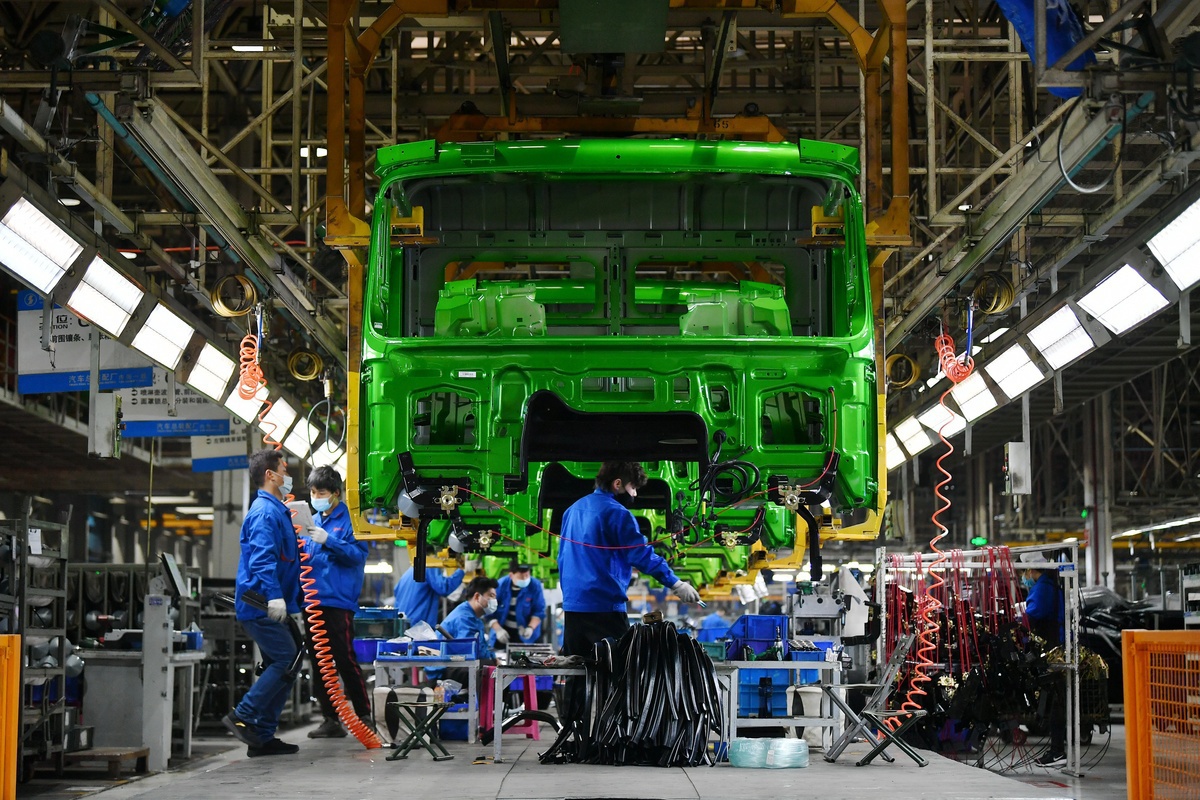
China on Tuesday announced key measures topromote the use of manufacturing services for the transformation and upgrade ofthe manufacturing sector and to foster high-quality development over the nextfive years. By 2025, the country's manufacturingservices sector will not only help boost the high-quality development of themanufacturing sector, but also improve innovation capabilities and resourceallocation efficiency, said a document jointly released by the NationalDevelopment and Reform Commission and 12 other central departments. There will also be substantial improvementin the specialization, branding, digitalization and internationalization of themanufacturing services sector, along with the creation of a group of leadingmanufacturing services clusters and enterprises. To further boost the high-qualitydevelopment of manufacturing services, the country will make a concerted pushto effectively use 5G, big data, cloud computing, artificial intelligence,blockchain and other emerging information technologies to further develop smartmanufacturing and cultivate shared manufacturing, design and data platforms. More efforts will also be made to developscience and technology services such as technology transfer, entrepreneurialincubation and intellectual property rights, formulate a road map for digitaltransformation in key industries, promote the development of 5G and industrialinternet, establish a global supply chain risk warning system for key sourcesand products, increase financing support for manufacturing service companiesand encourage qualified enterprises to go public both at home and abroad. Citing the new document, Wang Yong, avisiting professor at the KTH Royal Institute of Technology in Stockholm,Sweden, said the government's new measures will improve manufacturingproductivity, by developing the modern logistics service system and promotingthe sharing of information resources. Wang said the modern logistics system is animportant means to connect consumption and production, which is key to buildinga unified domestic market. "Under the new 'dual-circulation'development pattern, we need to build a high-quality modern logistics system toboost innovation-driven development for industries and consumption," Wangsaid. The country must strive to build anefficient system for technological innovation and transfer and spur thedevelopment of the digital economy, said Zhang Yuxian, director of theDepartment of Economic Forecasting at the State Information Center. During the past five years, China has madehuge strides in increasing the high-quality development of the manufacturingsector. Data from the Ministry of Industry andInformation Technology showed that the average growth rate of added value ofthe high-tech manufacturing industry was 10.4 percent from 2016 to last year,which was 4.9 percentage points higher than the average growth rate of addedvalue of industrial companies with an annual revenue of more than 20 millionyuan ($3 million) each for the same period. The country has pledged to further developthe real economy, strengthen industrial and supply chains, boost industrialupgrading and foster high-quality manufacturing, according to the outline ofthe 14th Five-Year Plan for National Economic and Social Development andLong-Range Objectives Through the Year 2035. Guangzhou has enhanced investment inadvanced manufacturing as a top priority in city's development plan, said HongQian, chief of Guangzhou's bureau of commerce. Last year, the number of contractedmanufacturing projects in Guangzhou accounted for 32.7 percent of the city'stotal. The new energy vehicle, biomedicine,digital economy, artificial intelligence and high-tech service industriesaccounted for nearly 70 percent of the city's foreign investment. The increase in the proportion ofmanufacturing projects will promote Guangzhou's real economy and accelerate theconcentration of key manufacturing industries such as digital economy,biomedicine, new energy and rail transit, Hong said. With a plug-and-play business environment,Guangzhou is home to many renowned companies in the digital sector, such asHuawei, BOE Technology and Visionox. There are also more than 3,800biopharmaceutical companies in Guangzhou, ranking the city third in the countrybehind Beijing and Shanghai. The city has centered its sector around theGuangzhou Science City, the China-Singapore Guangzhou Knowledge City and theGuangzhou International Biological Island, with industrial parks such as thehealth and medical center, the international health industry zone and theinternational pharmaceutical port. The Evergrande New Energy Automobile Nanshaproduction base is planned to be launched in 2021. The world's top 500companies and industry leaders such as ZF, Baidu and Hyundai Motor havedeployed smart car projects in the city. Guangzhou is also one of the most importantproduction bases and consumer market for the automobile industry in China. Its automobile production capacity ranksamong the strongest in the country, with an annual output of more than 3million automobiles and an output value of more than 500 billion yuan ($76.9billion). The local government's end-of-2020 reporton promoting the accelerated development of the automobile industry furthersupports the new energy smart cars and intelligent network connections. It willfocus on building a world-class automotive cluster base during the 14thFive-Year Plan (2021-25). Guangzhou has introduced 16 rail transitindustry projects, racking up a total investment of 36.35 billion yuan. Inrecent years, Guangzhou has focused on building high-end development platformssuch as the artificial intelligence and digital economy pilot zones. Also included in the city's high-enddevelopment is the Nansha Free Trade Zone, the Guangzhou Development Districtincluding the China-Singapore Guangzhou Knowledge City and the Airport EconomicDemonstration Zone. Industrial investment during the 13th Five-Year Plan(2016-20) increased by an average of 10.2 percent each year. The artificialintelligence and digital economy pilot zone has gathered more than 240projects, with a total investment of over 580 billion yuan. Last year, the added value of strategicemerging industries accounted for 30 percent of regional GDP. The added valueof the modern service industry accounted for 65.1 percent of the total serviceindustry. In particular, the Guangzhou FuturesExchange was approved to be established. It is the first national financialexchange in Guangzhou and will become an important national financial strategicplatform. It will gather a group of banks, securities, funds, futures companiesand other financial institutions in Guangzhou. Guangzhou has 35 industries out of the 41major industrial categories, and its industrial supporting capacity ranks amongthe top in China. A total of 13 State departments includingthe National Development and Reform Commission and the Ministry of Science andTechnology recently introduced a guideline document outlining measures to boostmanufacturing services and intelligently transform the manufacturing sector. The idea is to improve the quality andefficiency, innovation capacity and resource allocation efficiency of themanufacturing sector by 2025. Manufacturing is the backbone of acountry's economy. Manufacturing services are a new business form adapted tothe digital economy. Integration of services and manufacturing can enhance thecompetitiveness of products and promote the transformation, upgrading andhigh-quality development of the manufacturing sector. The guideline document is central toaccelerating the development of manufacturing services and thus promoting thetransformation and upgrading of the manufacturing sector. The global manufacturing sector hasincreasingly become service-oriented and intelligent, with about one-third ofthe value added to the global trade of finished products coming from services.However, China's manufacturing services sector is still lagging behind thedeveloped countries and needs to foster and build up some main actors toimprove the overall quality. The key to ensuring the high-qualitydevelopment of manufacturing services is to improve the professionaldevelopment ability of producer services. On the one hand, China should striveto boost its manufacturing industry innovation ability, develop suchmanufacturing services as technology transfer, startups incubation,intellectual property, technology consulting services, and accelerate theconversion of scientific and technological researches for practical purposes,to improve the innovation ability of manufacturing technologies and themodernization level of the industrial supply chain. On the other hand, it also needs to improvethe supply quality of the manufacturing sector, encourage professional serviceagencies to actively participate in manufacturing brand building and marketingand strengthen marketing management services to increase manufacturing brandeffects and market competitiveness. In addition, new generation informationtechnologies as 5G, big data, cloud computing, artificial intelligence andblockchain should be utilized to promote fundamental changes in the developmentmodes of manufacturing and enterprise forms. At present, manufacturing services are abottleneck restricting high-quality development of China's manufacturingsector. Speeding up the development of manufacturing services and promotingdigital, networking and intelligent transformation of the sector will sharpenChina's manufacturing edge, raise its competitiveness and inject strong impetusinto its economic growth. China will continue to implement measures forboosting manufacturing companies' research and development, and extend loansupport for small and medium-sized enterprises, according to a State CouncilExecutive Meeting. The country will continue to improve thedeductible share of manufacturing firms' R&D expenditure, and encourageinnovation and industrial upgrading, said the meeting chaired by Premier LiKeqiang on Wednesday. The meeting also decided to extend thepreferential policies of loan repayment deferral and credit support for SMEs tothe end of this year. |