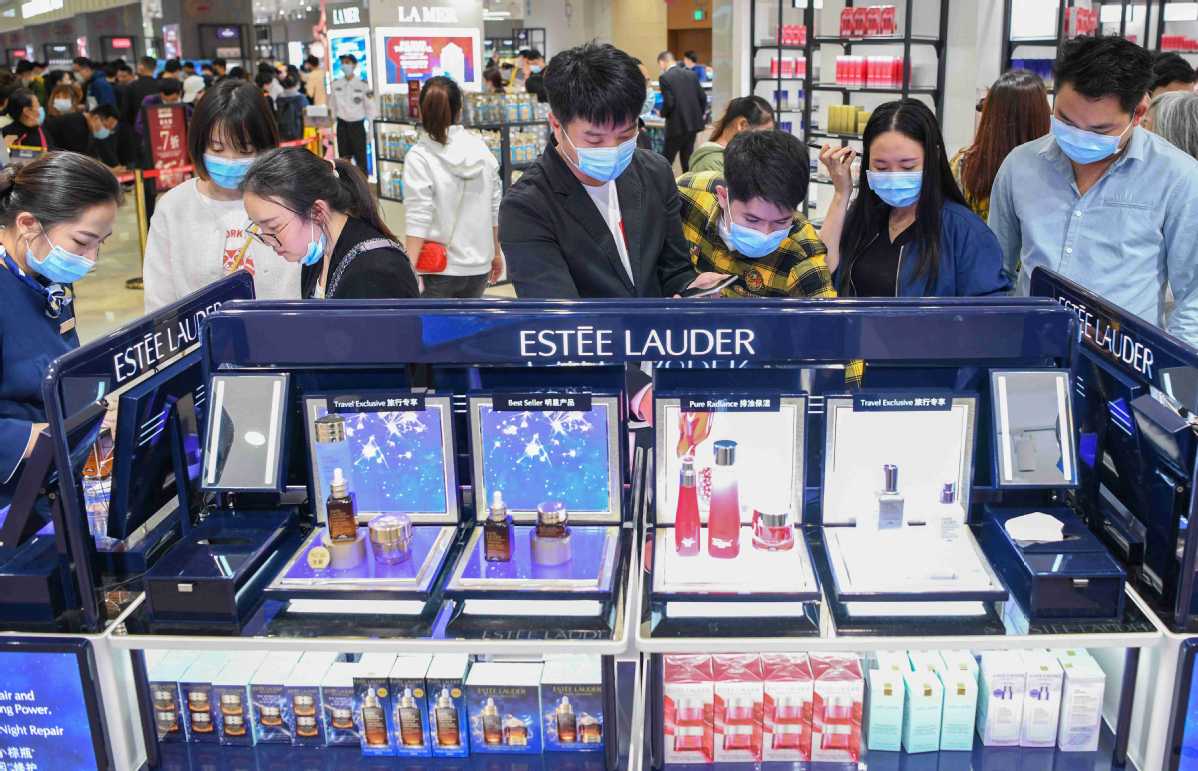
Due to the novel coronavirus pandemic, theluxury market last year inevitably encountered a slowdown. But the Chinesemarket has surfaced as a bright spot. After an understandably rocky start,China's luxury goods market finished out 2020 with double and even triple-digitgrowth rates for some brands. Bucking global forecasts of a 23 percentdrop in the luxury market, the country is forecast by consultancy Bain & Coto enjoy a robust 48 percent growth in luxury spending in 2020, totaling almost346 billion yuan ($53.5 billion). Such trends have nearly doubled China'sshare of global luxury goods from 11 percent to 20 percent, and will put it onpath to become the biggest market worldwide by 2025, even after the globalluxury market returns to pre-COVID-19 levels. Bruno Lannes, a partner at Bain, attributedsuch robustness to fiscal policies, growing purchasing power of youngershoppers, ongoing digitalization and duty-free enterprises in Hainan province. "China's luxury market has experiencedincreasing repatriation since 2015 thanks to a reduction in import duties,stricter control over gray markets and brand price harmonization (between Chinaand overseas)," Lannes said. "With the addition of COVID-19-relatedtravel restrictions, the Chinese mainland's portion of Chinese global luxurypurchases last year reached a peak of about 70 percent to 75 percent." Increased wealth, driven by capital gainsand the government's encouragement of shopping, also played a part. Plaza 66, a high-end shopping mall locatedon West Nanjing Road in Shanghai, held an invitation-only year-end shoppingextravaganza offering luxury spenders an exclusive experience. Dubbed "Home to Luxury", theevent only invited so-called Very Important Person consumers whose spendingamount at the mall complex reached a certain threshold during the past year,the company said in a statement. A number of brands from Bottega Veneta,Chaumet to Gucci unveiled some 100 new products or limited-edition items toattract the attention of novelty-seeking and deep-pocketed buyers. Customers were able to skip traditionallong lines seen at luxury boutiques and were pampered with a number of treats,interactive game-plays and personalized services. Riding such a boom, Italian luxury jewelrybrand Pomellato Group opened its third store in Shanghai's Plaza 66 inDecember, a move the group's CEO Sabina Belli called "strategic". "Shanghai is one of the most importantcities in the world … and Plaza 66 hosts the most prestigious luxury brandsfrom the world," she said. "Despite the pandemic, China has resumed arelatively normal and almost dynamic environment for those to continueexperiencing luxury without needing to travel overseas." Offering a bevy of iconic pendants andrings, Belli recognized Pomellato as a "relatively young brand and laterentrant to this market". But that also means opportunities for thecompany, as local consumers and their mindsets are fast-changing demandexpanding to different products. "Chinese consumers are verysophisticated and open minded. They are looking for newness, uniqueness andexclusivity. Their attention focuses on brands that are distinctive," shesaid. Belli noted that compared withtraditionally conservative luxury jewelry, the brand allows precious jewels tobe suitable for everyday wear, and allows the combination of understatement andplayfulness with sophistication. "So we have … a lot of confidence toappeal to Chinese looking for an alternative Italian brand, authentic, genuineand a distinctive positioning," Belli added. This constant thirst for novelty in luxuryitems could be better understood through the unique composition of luxuryspending profiles in the Chinese market. Bain found that China's Generation Zconsumers (born after 1995 and making up about 80 million people) are now anemerging source of market growth in their own right, as well as possessing apowerful influence on increased digitalization. A joint survey by Bain and Alibaba's retailmarketplaces Tmall and Taobao suggests that surveyed Gen Z respondentstypically make their first luxury purchase at the age of 20. They tend to value"the pursuit of fashion" as purchase impulses, favor cross-brandcollaborations and use only digital channels to research brands. For Belli, omnichannel penetration isdefinitely key to providing important means for reaching and appealing to botha broader and a younger audience. Efforts include social digital platforms suchas WeChat's mini program, which supports information searching and orderplacement. "We are also committed to includingnew technological innovations which include augmented reality technology whichechoes with the digital savvy luxury clients in China," she said. Digitalization efforts are also paying offfor British luxury brand Burberry. The Chinese mainland excelled versus othermarkets in leading full-price sales growth in the triple digits on digitalchannels, the company said in its latest quarterly report in December. Full-price sales in the fourth quarterincreased at an even stronger pace and strengthened over the prior quarter,which was driven by both new and existing customers while markdowns werematerially lower. Last summer, the brand opened thefirst-of-its-kind social retail store in Shenzhen, Guangdong province, claimingto blend physical and social worlds with a suite of digital technologiespowered by Chinese internet giant Tencent. Through a dedicated mini program backed byWeChat, Tencent's iconic messaging app, customers can unlock exclusive contenton the brand and personalized experiences, and then share them with theircommunities. Josie Zhang, president of Burberry China,said that with the younger Gen Z consumers shaping up to be the backbone forluxury brands, "their desire for socializing, interaction and sharing ispropelling us to delve into the realm of social retail". At the end of the day, dividends oflockdown-driven repatriation will inevitably diminish as Chinese luxury-goodconsumers begin to travel again in 2022 or 2023, said Lannes from Bain. But hebelieved brands will have at least one year and possibly two to woo shoppersand convince their consumers that domestic shopping is a better, moresustainable experience. The Bain study found that nearlythree-quarters of existing consumers in the millennials and Gen Z demographicshave said they will increase or maintain their luxury spending this year. "Also, we believe Chinese luxuryconsumers' online shopping behavior has permanently changed. Nearly 40 percentsaid they plan to increase their share of online luxury shopping over the nextfew years, and another 40 percent will maintain their share," Lannes said. Chinese consumers are expected to shop formore overseas high-end products at domestic duty-free stores, thanks to thegrowing demand for such products and the ongoing restrictions on outboundtravel, experts said. Indications that the duty-free shoppingsector in the country is ready to ride the trend are evident from the duty-freeoutlet plans of various provinces and cities. Duty-free shopping outlets enableinbound and outbound tourists to purchase duty-free goods from specificretailers in certain areas, without paying value-added tax on imports or theconsumption tax. Normally they are located at offshore locations, ports or inthe cities. Qingdao, Shandong province, is planning toset up more duty-free stores. On Dec 28, Sun Zubin, Party secretary ofQingdao Jiaodong Airport Economic Demonstration Zone, told news portalJiemian.com that the zone was planning to set up a duty-free mall for high-endproducts from abroad and will allow local residents to shop at the mall. Qingdao Cruise Terminal has also receivedindirect approval for duty-free operations after it set up a joint venture withChina Tourism Group Duty Free Corp for the purpose. China Tourism Group Duty Free Corp, aduty-free retail giant in China, operates four offshore duty-free stores inHainan province. Revenue from all the stores in Hainan doubled to 25 billionyuan ($3.87 billion) between Jan 1 and Dec 14 last year, on a yearly basis.Three new offshore duty-free shops opened in Sanya, another city on the island,to promote tax-free consumption, taking the total number of duty-free shops onthe island to seven. Sales at the offshore duty-free shops inthe province exceeded 31.58 billion yuan till now. The number of shoppers hasexceeded 3.4 million, while the number of purchases has crossed 19 millionitems, up 130 percent on a yearly basis, according to the provincial commercedepartment. According to data published by marketresearch firm Bain & Co and Tmall Luxury Division, duty-free shopping wasintroduced in Hainan over a decade ago. But the business really boomed lastyear, thanks to the COVID-19 travel restrictions and attractive shoppingincentives. Zhejiang China Commodities City Group CoLtd is another company that has sought a license to set up duty-free outlets inYiwu, Zhejiang province, according to Jiemian. Wangfujing Group, a leading departmentstore, obtained a license for duty-free business in June and is planning toexpand its reach to more cities, including Wuhan in Hubei province. It alsoplans to build a large-scale shopping complex at the upcoming Beijing UniversalResort in the nation's capital. Zeng Guang, chief analyst at GuosenSecurities, told Jiemian that the rebound in consumption from outbound tourismand the domestic economic rebound have boosted the domestic duty-free market. Spending on luxury products has reboundedin China after the slow start due to COVID-19 lockdowns, with more Chineseconsumers preferring to make the purchases at domestic outlets due to travelrestrictions. Chinese consumers are most likely to remaincautious about international travel even after the pandemic ends. As a result,most luxury brands believe that domestic growth will likely continue in 2021 atabout 30 percent. The luxury market on the mainland is likely grew by 48percent to 346 billion yuan last year, said the Bain report. |