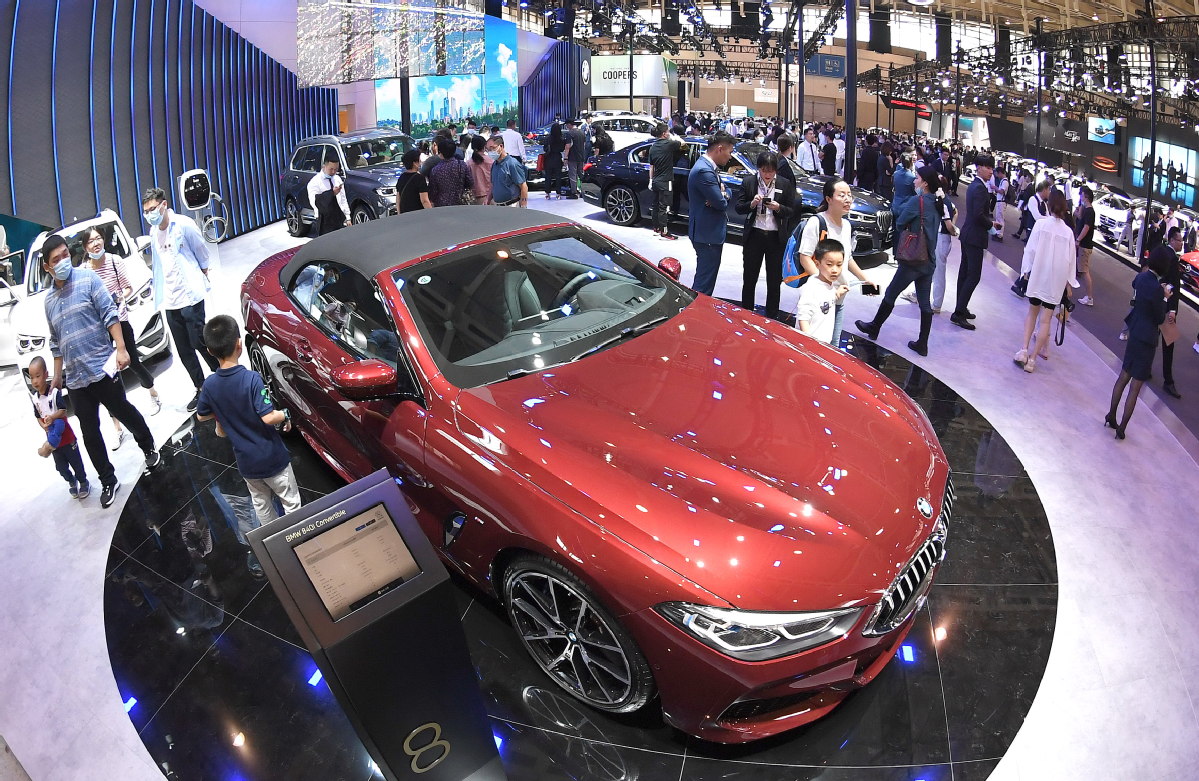
China's economy has recovered with stronggrowth momentum across diverse industries during the past National Day andMid-Autumn Festival holiday.
Statistics from the Ministry of Commerceindicate China's sales volume for key retail and catering enterprises reached1.6 trillion yuan ($238.38 billion) from Oct 1 to 8, with the average dailysales volume increasing by 4.9 percent compared with last year's National Daygolden week.
To stimulate consumers' enthusiasm tospend, a variety of sales activities were promoted and a large amount ofsubsidies and vouchers for automotives, home appliances, and food and beverageswere released.
The recovery of consumption drives thegrowth of the express delivery business. Data from the State Post Bureau ofChina shows from Oct 1 to 8, the national postal express industry collected1.82 billion parcels, up 53.42 percent year-on-year.
With accelerated integration of online andoffline consumption, the country's postal express business has been maintainedat a high growth range of above 30 percent since February, when China's expressparcel volume grew from negative to positive, the State Post Bureau said.
As people started to leave their homesunder the managed pandemic situation, cinemas welcomed a boom during the pastholidays. As of 11:59 pm Oct 8, the 2020 National Day box office reached 3.92billion yuan, which was the second-largest National Day box office in China'sfilm industry, according to China's Box Office app of the Office of theNational Film Industry Development Special Fund Management Committee.
As COVID-19 has come under control in thecountry, more people have started to resume travel. During the eight-dayholiday, the country received a total of 637 million trips by domestictourists, with domestic tourism revenue reaching 466.56 billion yuan, accordingto the Ministry of Culture and Tourism.
On the last day of the eight-day holiday,the national railways ushered in the peak of return passenger flow. On Oct 8,the national railways expected to see 13 million passenger trips, with 1,234additional passenger trains, China Railway said. From Sept 30 to Oct 7, thenational railways have transported more than 10 million passengers for eightconsecutive days, according to China Railway.
During the eight-day holiday, South China'sHainan recorded 1.04 billion yuan in offshore duty-free shopping, 146,800tourist trips and 998,900 products, up 148.7 percent, 43.9 percent and 97.2percent year-on-year, respectively, according to the General Administration ofCustoms.
Starting from July 1, Hainan increased itsannual tax-free shopping quota from 30,000 yuan to 100,000 yuan per person, andthe range of duty-free goods has also expanded from 38 categories to 45, withthe previous tax-free limit of 8,000 yuan for a single product lifted.
Data from the Civil Aviation Administrationof China showed the country witnessed a total of 13.26 million passenger tripsin the period of Oct 1-8, with average daily passenger traffic rebounding to91.07 percent of the National Day holiday in 2019.
The number of actual flights across thecountry reached 117,327 between Oct 1 and 8, and the average daily flightvolume recovered to 89.7 percent of the 2019 National Day holiday, according tothe Civil Aviation Administration of China.
As China's first National Day holiday sincethe outbreak of COVID-19 epidemic witnessed a heightened public willingness totravel, the potential of domestic demand continued to be unleashed, serving asan important force for sustaining the economic recovery.
Among all industries, tourism is regardedas among the first to be affected by COVID-19 and the last to recover. Giventhis prognosis, its momentum is a good indicator of the country's recovery fromthe epidemic.
China saw 425 million domestic touristvisits in the first four days of the eight-day holiday that consists of theGolden Week and the Mid-Autumn Festival starting from Thursday, with totaltourism revenue hitting 312 billion yuan ($45.8 billion). Consumption attourist attractions nationwide during the holiday is expected to rebound toaround 90 percent of that in the same period last year, according to an earlierreport issued by the Meituan Research Institute.
As the tourism industry is closely related tomany service sectors such as catering and transportation, the tourism boom willbe conducive for the recovery of the service industry and promote more balancedeconomic development.
However, challenges posed by mountingexternal uncertainties and the impact of the epidemic still persist amid theeconomic recovery. There is no excuse to let the guard down. To strike abalance between epidemic control and economic and social development, touristattractions across the country have been required to cap their visitor flows at75 percent of full capacity. They were also encouraged to adoptreservation-only or staggered admission policies.
China has recently vowed to establish a"dual circulation" development pattern, in which domestic and foreignmarkets complement and reinforce each another, with the domestic market as themainstay, aiming to build up resilience with better domestic development andwider opening up against headwinds in the external environment. The country'senormous market is pivotal to this development pattern, with the booming"holiday economy" being a manifestation of the strategy.
As the flourishing consumption market willdrive imports and investment from other countries, China's economic vitalitycan also offer a strong boost to global trade and the world economy.
According to a recent report from the WorldBank, China's economy is expected to grow by 2 percent in 2020, up from the1-percent growth projection released in June. China will continue to be one ofthe main engines of world economic growth. If other countries can seize theopportunities presented by China's economic bounce, it will help accelerate therecovery of the world economy.
East China's Jiangsu province received46.63 million visitors during the National Day holiday from October 1 to 8,bringing in tourism revenue of 51.26 billion yuan (about $7.6 billion), saidthe provincial department of culture and tourism.
The tourist numbers bounced back to about81 percent of the level during the same period last year, while the tourismrevenue recovered about 71 percent.
During the holiday, the coastal provincelaunched 4,300 cultural and tourism activities for tourists to discover andenjoy its charm. "Visitors not only enjoy the beautiful scenery in Jiangsubut also have a better understanding of its abundant culture," said YangZhichun, director of the Jiangsu provincial department of culture and tourism.
To further boost the recovery of thetourism industry, the province also released several travel routes, including50 for upgrading rural tourism and 10 on the Grand Canal, the world's longestartificial waterway with a history of more than 2,500 years and inscribed onthe World Heritage list in 2014.
A surge in spending over China’s “goldenweek” holiday has highlighted an encouraging rebound in consumption after thecoronavirus pandemic ravaged the economy early in the year. During this year’seight-day holiday, which combined National Day and the Mid-Autumn Festival,retail and restaurant sales reached 1.6 trillion yuan (US$235.5 billion), withdaily sales up 4.9 per cent compared to last year’s seven-day holiday,according to a survey conducted by the Ministry of Commerce.
China UnionPay, the country’s largestpayment processing scheme, reported that transactions during the first sevendays of the holiday rose 6.3 per cent from a year earlier to 2.16 trillionyuan. On October 1, daily transactions surpassed 330 billion yuan, up 16 percent from a year earlier. In the southern province of Hainan, sales induty-free shops reached 1.04 billion yuan, more than doubling from a yearearlier.
More than 146,800 tourists flocked to thetropical island’s stores over the holiday after the government raised theannual duty-free shopping allowance from 30,000 yuan to 100,000 yuan earlierthis year.
China’s strong holiday spending indicatedthat retail sales could rise by 3 to 4 per cent in October from a year earlier,said Larry Hu, chief China economist from Macquarie Group, after sales hitpositive territory for the first time in August, growing 0.5 per cent innominal terms. September’s retail sales data will be released later this month.
The rebound in spending will be aconfidence booster for the world’s second largest economy, which is rolling outa new “dual circulation” economic strategy that focuses on bolstering domesticdemand to offset an increasingly uncertain international environment.
China’s recovery from the pandemic hasuntil recently been supported by state-led investment in infrastructure andproperty. “The message from golden week is important because the recovery inthe coming months has to be driven by consumption,” Hu said. The V-shapedrecovery so far has been largely driven by property, infrastructure andexports, which are 50 per cent of the economy. Given the recent policy turns,their growth rates might peak soon, or have already peaked.
“It’s encouraging that the other half of the economy, includingconsumption and manufacturing investment, is catching up.” Domestic tourismalso picked up over the holiday, albeit at a level below last year. Some 637million people travelled across the country, generating tourism revenue of466.5 billion yuan. Tourist numbers were down nearly 21 per cent from a yearearlier, with spending down 30 per cent, according to the Ministry of Cultureand Tourism.
The daily number of people travelling byroad over the holiday period plunged 31 per cent from a year earlier to 47.3million, while the volume of daily airline passengers fell 9 per cent year onyear, data from transport ministry showed. “The encouraging numbers are biasedby the fact people can’t travel abroad,” Hu said. “That said, it’s clear thatconsumption, especially service consumption, is on the mend.”
The consumption rebound was helped bystrong box office sales during golden week, with theatres grossing 3.9 billionyuan in eight days, the second highest total during the October holiday periodin history. Meituan Dianping, one of China’s largest food delivery platforms,reported that over the first four days of this month, in-store orders atrestaurants increased by 78.4 per cent compared to the first four days ofLabour Day in May, while hotel bookings doubled. |