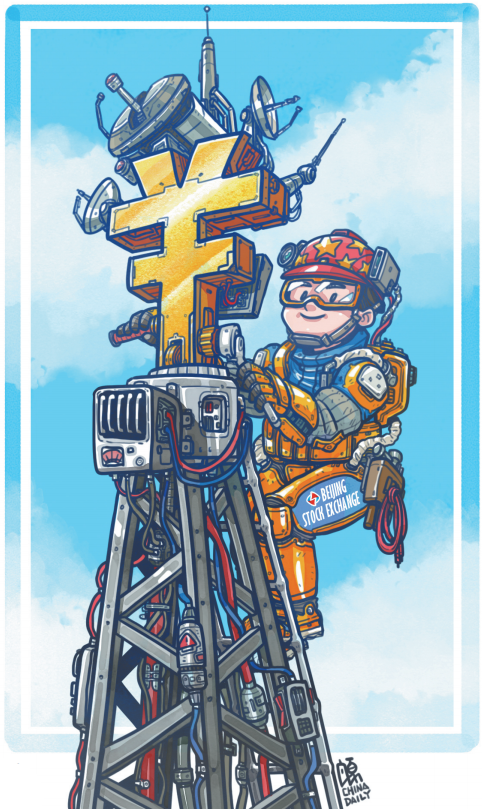
The establishment of the Beijing StockExchange will help perfect China's capital market system and improve itsfunction of serving the real economy, paralleling the importance of the launch ofthe STAR Market in Shanghai. President Xi Jinping announced on Sept 2that China will set up a stock exchange in Beijing and build it into a majorbase for serving innovative small and medium-sized enterprises, or SMEs. This came after Xi announced in November2018 that the country would launch the sci-tech innovation board, or the STARMarket, in Shanghai and pilot the registration-based system. The establishment of the Beijing StockExchange will mark a major breakthrough in the reform of the National EquitiesExchange and Quotations (NEEQ) system, thus strengthening the ability ofcapital markets to support the real economy and powering China's economictransformation into an innovation-driven growth mode. Since its debut in 2013, the NEEQ system,also called the new third board, has served as a main platform of the capitalmarket system to meet the financing needs of SMEs. The board offers SMEs notqualified to become listed companies on bourses in Shanghai and Shenzhen aplatform to sell their shares. In its early development stage, however,the new third board faced difficulties in fully playing its financing andinvestment functions and suffered from lukewarm liquidity as well as voluntaryexits of firms from the platform. This predicament could be attributed to thevariance in the quality of the firms traded on the board, some of which hadpoor fundamentals, as well as the stringent standards of investors qualified totrade on the board that restricted the scale of funds available for trading. Market order has been gradually rebuilt onthe new third board as a series of reform measures were taken since 2019, suchas easing standards for qualified investors and setting up the NEEQ Select, thehighest tier of the board. As of Sept 2, there were 7,304 firms thatare traded on the new third board, whose total market capitalization amountedto nearly 2 trillion yuan ($309.8 billion). The 1,278 firms from theinformation technology sector contributed about one-third of the marketcapitalization, followed by the 1,170 industrials that accounted for more thana quarter of the market capitalization. More than 1.7 million qualified investorshave been registered on the system, 7.3 times the number seen as of the end of2019. Despite some reform successes, there isstill room for the new third board to better serve innovative SMEs. During the 14th Five-Year Plan period(2021-25), China aims to nurture about 10,000 SMEs into "little giantcompanies". The term refers to leading SMEs that specialize in nichesectors, command a high market share, and boast strong innovative capacity andcore technologies. There are more than 4,700 "little giant companies"so far in China, said the Ministry of Industry and Information Technology. Incomplete statistics show that nearly 800enterprises now traded or previously traded on the new third board are includedin the MIIT's list of "little giant companies". The establishment of the Beijing StockExchange will mark a leap forward in the reform of the new third board, liftingits status to the third national securities exchange equal to establishedbourses in Shanghai and Shenzhen. A set of fundamental rules coveringlisting, trading, delisting, continued supervision and investor qualificationwill be formulated for the exchange and all will cater to the features ofinnovative SMEs, strengthening the capital market's function of supportinginnovative SMEs and elevating the efficiency of resource allocation. Needless to say, promoting the developmentof innovative SMEs is critical for China's high-quality economic development asthey contribute greatly to the nation's pursuit of boosting the manufacturingsector, addressing bottlenecks in core technologies and promoting aninnovation-driven growth mode. From a different perspective, the BeijingStock Exchange is also expected to serve as a game-changer of China's financialsystem, which is now dominated by the banking sector. Widely used among East Asian developingeconomies, such a structure features an advantage of efficiently funnelingresources into the development of key industries and has enabled China's greatachievement of reform and opening-up over more than four decades. The strong banking sector has also enabledcapital accumulation at a rapid pace, addressing the shortage in funds, whichused to be a key hurdle facing the Chinese economy. But looking ahead, capital markets shouldplay a bigger role in empowering China's innovation-driven economic development. Several studies have found that capitalmarket development will encourage the innovation of high-tech companies andenterprises reliant on external financing. The financing mode of overrelianceon bank loans, instead, will affect innovative activities of those companies. Innovation is a high-risk activity with thepotential for high returns and asymmetric information. Asymmetric informationresults when one party in a transaction is in possession of more informationthan the other. Therefore, innovative enterprises insectors like the internet, artificial intelligence and big data have moredifficulty accessing bank loans and other types of debt financing in theirearly development stages. They rely on the capital market as theirmain financing channel where failures can be tolerated in the short term forthe sake of major long-term returns. The establishment of the Beijing StockExchange will mark another milestone in the development of China's multilayeredcapital market system, following the launch of the STAR Market and theregistration-based reform of the ChiNext board. The new exchange will serve as a major basefor facilitating the growth of "little giant companies "andcomplement the functioning of the Shanghai and Shenzhen exchanges, which mainlymeet the financing needs of more mature enterprises of a larger scale. All this will help transform China'sfinancial system into one that is more supportive of China's economic upgradethat eyes an innovation-driven growth mode. The construction of systemic infrastructurefor the highly anticipated Beijing stock exchange, which is planned as thevenue to boost innovation among China's small and medium-sized enterprises, orSMEs, picked up speed on September 5 with the first batch of draft businessrules released to solicit public opinion. The three sets of business rules, releasedby the National Equities Exchange and Quotations (NEEQ) that owns 100 percentstake in the bourse, cover listing, trading and the management of the exchangemembers. Rules will conform to the currentregulatory arrangements for listed companies to ensure the consistency ofregulatory standards among all bourses in China, according to the draft. The NEEQ Select, the highest tier of theNEEQ system, will be upgraded to cover the Beijing stock exchange. Therefore,the listing rules adopted at the NEEQ Select will be applied as the stocklisting rules at the planned Beijing bourse. Meanwhile, qualified companies traded onthe NEEQ Innovation, the NEEQ's second-highest tier, can apply to list on theBeijing bourse as long as they stay listed on the NEEQ Innovation for 12consecutive months. There is no compulsory regulation regardingcash dividend ratio for companies that list on the Beijing stock exchange. Thepurpose is to strike a balance between cost and profit among SMEs, the draftrules state. The daily price fluctuation limit is set at30 percent, which is higher than the 10 percent limit for the A-share mainboard and the 20 percent limit for the STAR Market and the ChiNext board. Thepurpose of changing the bar for the Beijing bourse is to provide enough leewayfor the market to ensure it remains efficient in price discovery, the draftrules state. Suspended trading will be scrutinized morestrictly at the Beijing bourse. There should be no misuse of suspensionmechanism, and public companies cannot resort to suspended trading forconcealing any information. Continuity in trading should be secured to protectinvestors' rights, the draft trading rules state. Therefore, trading suspension should be nomore than 10 trading days for scenarios such as major asset restructuring orsecondary offering for the purpose of asset acquisition. The ceiling is set atthree months at the other A-share boards for similar scenarios. A maximum five trading days of suspensionwill be allowed for other major issues for companies listed on the Beijingbourse. If there is a special reason to postpone the date to resume trading,the suspension period should be no more than 25 trading days in total. The NEEQ system, which debuted in 2013 andis also known as the "new third board", has been originally designedas an equity trading system for SMEs. The planned upgrade will provide a directfinancing channel-equity financing-for innovative SMEs, said Jiang Qijia, a senior analyst with NoahHoldings Ltd, a Shanghai-based financial services provider. In the indirect financing model which haslong been dominated by banks, SMEs usually face great difficulty in receivingfunding as they cannot provide the collateral required by banks, he said. Together with the STAR Market at theShanghai bourse and the ChiNext in Shenzhen, the Beijing stock exchange willbetter serve the real economy by fulfilling their respective responsibilities,said Dong Zhongyun, chief economist of Avic Securities. The STAR Market will feature "hardtechnology" and serve national strategies. The ChiNext will stress theintegration of traditional industries and new technologies, industries, as wellas business models. The Beijing bourse will mainly serve innovative SMEs, hesaid. |