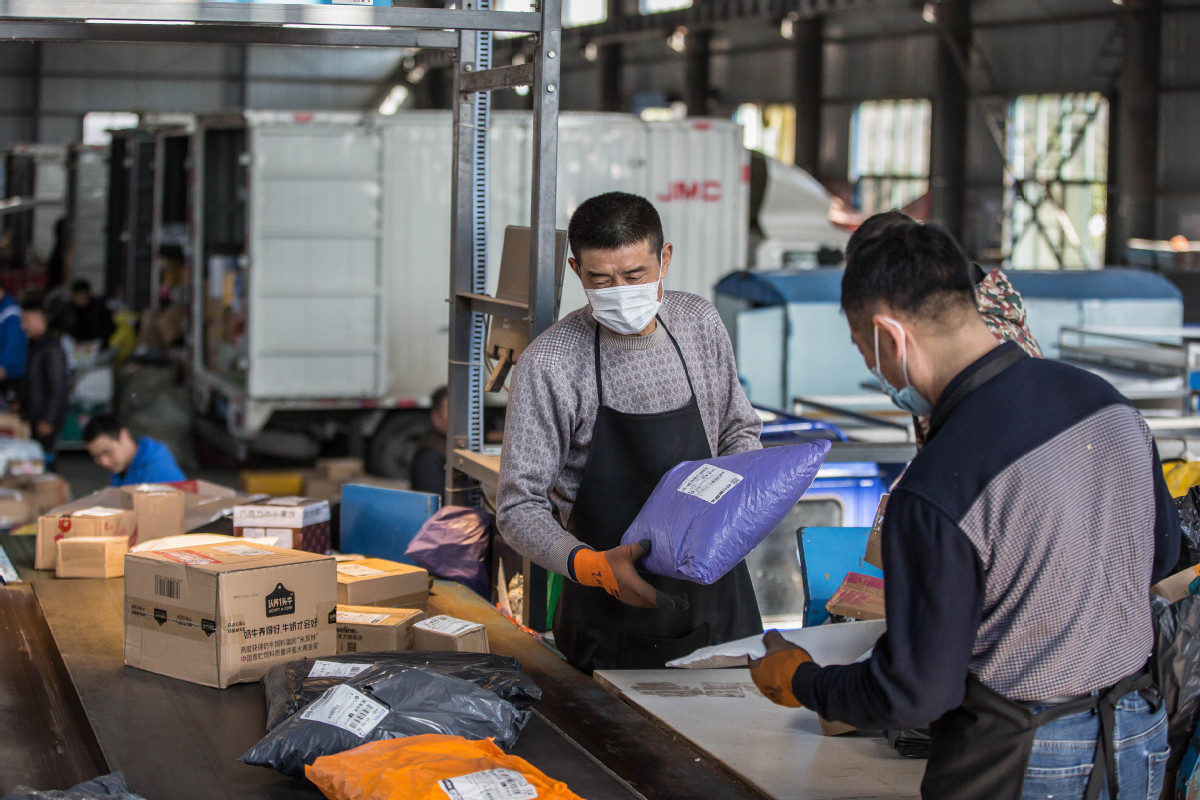
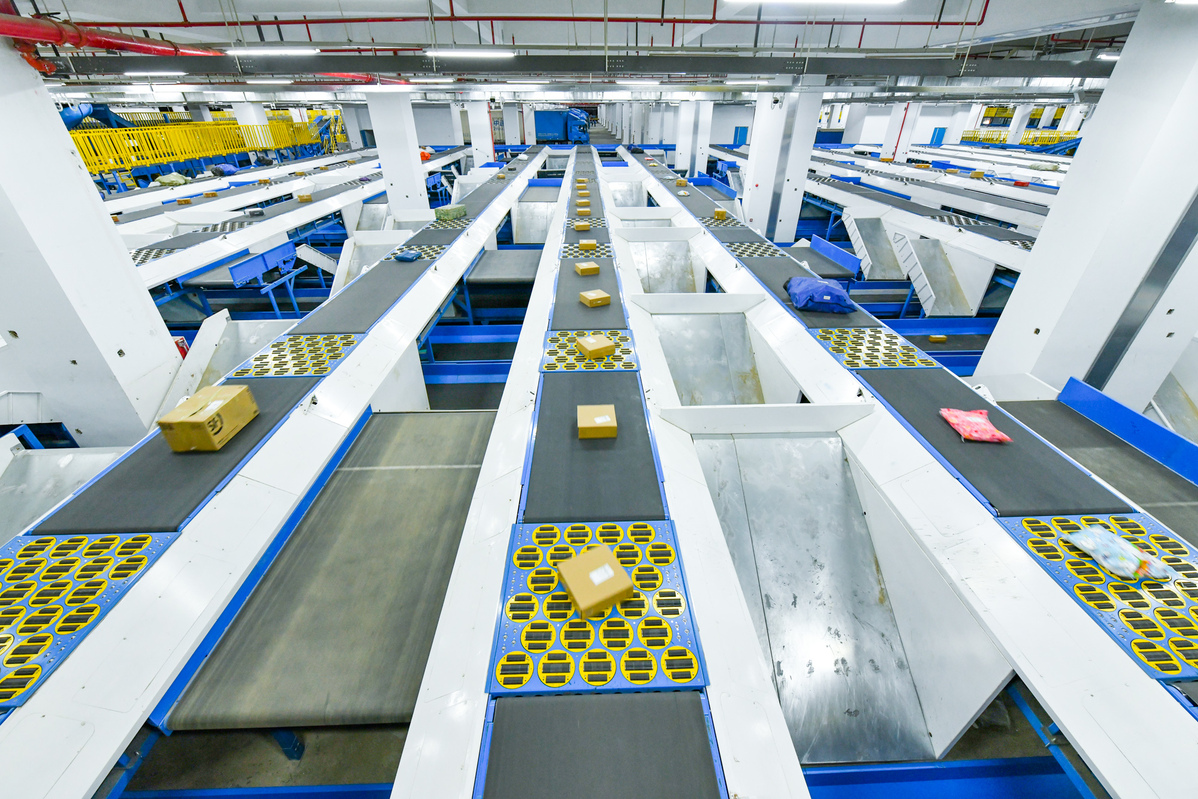
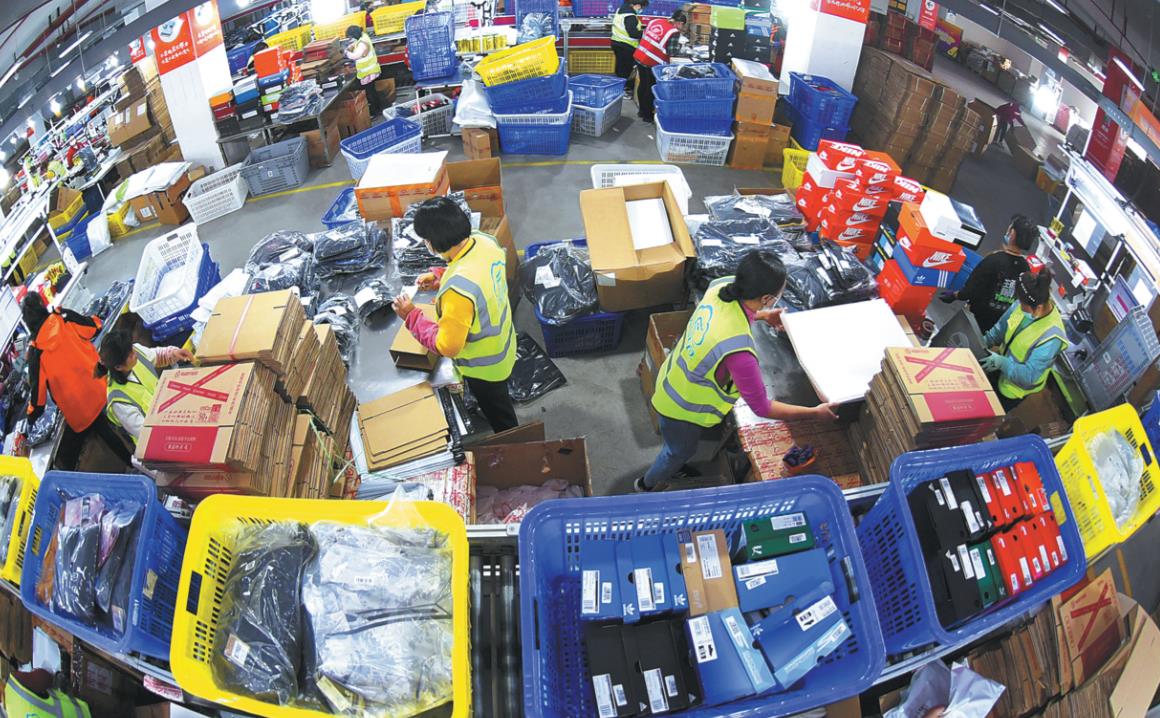
This year's rosy Singles Day sales figuresindicate the resilience and vitality of the domestic consumer market. China's major e-commerce platforms set newrecords in this year's Singles Day sales gala that stretched from about onemonth earlier to Nov 11, during which the total volume of business transactionsof Tmall.com was 540.3 billion yuan ($84.72 billion), up 8.45 percentyear-on-year, and JD.com 349.1 billion yuan, soaring 28.6 percent year-on-year. Thanks to the scale and potential ofChina's consumer market and the robust development of the e-commerce andlogistics industries, since it was launched 13 years ago, Singles Day has grownto be the world's largest consumer festival and attracted widespread attentionfrom all over the world. But it was not just foreign brands thatappealed to domestic consumers, many national brands ranging from clothes andelectronic products to services such as tourism, leisure and entertainmentperformed well in the sales gala this year, partly thanks to livestreaming,social networking and short video sharing platforms that have becomeindispensable sales promotional channels in the Chinese market. Statistics also show that the consumptiongap between different age groups and villages and cities are also becomingsmaller, as more elderly people and rural residents, particularly those livingin the western parts of the country, have begun using e-commerce, thanks to thepenetration of the mobile internet and the expansion of the logistics network. Also heartening was the moreenvironmentally conscious buying and selling. Consumption is often regarded asincreasing carbon emissions and thus one of the important causes of globalwarming. However, this year's Singles Day promoted green and low-carbonconsumption as part of a green lifestyle, with the e-commerce companies payingspecial attention to promoting energy-efficient household appliances and thelogistics companies reducing the use of packing materials and trying their bestto increase the use of recyclable packing materials. Also notable was the effect of thestrengthened supervision on the e-commerce industry and the enforcement of thePersonal Information Protection Law on Nov 1, which prompted companies to behavethemselves in the sales gala and attach more importance to attracting consumerswith better services rather than unveracious low prices based on discounttricks. In a well-regulated market environment, notonly are consumers more rational, but more small and micro businesses can enjoytheir share of the booming consumer market. Singles Day should serve to redouble theworld's confidence in the prospects of the Chinese economy and the resolve ofthe policymakers to improve the business environment in China. Localand global brands shine as 11-11 breaks sales records Despite an unusually lukewarm start andlow-key character, this year's "Double-11"-the 11-11shopping carnival-still proved outstanding as it showcased China's immense consumptionpotential and the economy's resilience. What's more, this year's edition confirmedthe festival has evolved into the world's biggest shopping event from itshumble beginnings in 2009, when it was conceptualized by Alibaba Group HoldingLtd as an occasion for singles to splurge (hence the Nov 11 date containing allfour single numerals-"Singles Day"). The festival also got longer, spread over11 days in offline and online formats, and rode latest technologies likelivestreaming and online brand debuts to record sales (889.4 billion yuan or$139.2 billion from Alibaba and JD alone, up 15.6 percent year-on-year). Overthe years, sales records have become part and parcel of 11-11, and this yearproved to be no different, although sales growth of major e-commerce platforms slowed,industry insiders said. That was somewhat offset by a refreshingdevelopment this year: e-commerce platforms utilized 11-11 to underlineinclusive growth, eco-friendliness and the need to empower small andmedium-sized brands. With its customary steep discounts andshopping coupons, Singles Day reinforced an incontrovertible fact: China is theworld's preeminent go-to market for products, brands, service providers, technologies,manufacturers and traders. A vibrant market that packs hugeconsumption punch also means a fertile ground for economic growth, marked byrising per capita disposable incomes of consumers who are well served byconvenient and efficient supply chain components like e-commerce channels. All this ensured that presales for thisyear's Singles Day shopping carnival kicked off at 8 pm on Oct 20, four hoursearlier than the previous years, to better cater to the growing demand fromconsumers. On the first day of the presales, Li Jiaqi,a top livestreaming host also known as "king of lipstick", generated250 million views and a staggering 10.6 billion yuan ($1.66 billion) intransactions in his 12-hour livestreaming marathon on Alibaba's Taobao Live.Viya, another top-tier livestreamer, sold about 8.3 billion yuan worth of goodson the same day, in a live sale that lasted-wait for it-14 hours. According to a report from globalconsulting firm AlixPartners, shopping via livestreaming continued to gain inpopularity during this year's shopping spree. Singles Day continues to be thepivotal event that retailers around the world wait for to capitalize on, withthe prerequisite that they must harness live-streaming to get consumers'attention and set the stage for new products. The report said that most consumers uselivestreaming for the specific goal of researching a product prior to buying.However, the most popular content involves personalized discount offerspromoted in corresponding social groups or free gifts and other exclusiveoffers during livestreaming. In the first hour after the clock struckmidnight on Nov 1 when official 11-11 sales began, the turnover of more than2,600 brands exceeded that of the entire day last year, said Tmall, which isthe business-to-customer e-marketplace operated by Alibaba. Sales of Apple's iPhones surpassed that ofthe entire day last year in the first four minutes on Nov 1. Domestic brands,including sportswear company Erke and electric car startup Xpeng, witnessedhigh demand during this period, Tmall said. E-commerce giant JD said it sold more than190 million products in the first four hours of its promotion gala, whichstarted at 8 pm on Oct 31. Sales of Apple's products on JD surged 200percent year-on-year in the first four hours of the gala, while the transactionvolume of mobile phones including brands such as Xiaomi, Oppo, Vivo and Honorincreased over 300 percent on a yearly basis in the first 10 minutes of thepromotion, according to JD. It is noteworthy that imported productsgained traction among consumers during this year's shopping festival. In thefirst 10 minutes of the promotion, the transaction volume of JD WorldwideImport Supermarket was 39 times that of last year. In addition, more young people tended tobuy sports shoes and clothing of homegrown brands, and Anta, Qiaodan and Peakhave become the most popular domestic sports brands, JD said. Zhao Ping, deputy head of the Beijing-basedAcademy of China Council for the Promotion of International Trade, said thisyear's shopping festival has unleashed consumption potential, stimulatedconsumers' massive purchasing power and shored up the confidence of shoppers. "E-commerce platforms were doublingdown on the shopping carnival and introducing new products and new brands tolure consumers and satisfy their diversified demand," Zhao said. Online marketplaces have become asignificant channel for foreign merchants to invigorate their business and tapinto the Chinese consumer market as COVID-19 has hindered transnational travel,she said, adding sales of imported products have witnessed explosive growthduring the promotion gala. "Shopping via livestreaming servicesis a fast-growing new business model, which could offer detailed andcomprehensive information about products to consumers. In addition, buyerscould interact with livestreamers in a timely way and receive more discountsand coupons," she said. "Chinese consumers have become moreconscious about price and quality after the COVID-19 pandemic. Livestreaming isa key channel for them to get a full download of product information beforemaking shopping decisions, and we are also seeing a similar trend emerging inother countries, but China is leading," said Britton Russell, who leadsthe consumer and retail practice at AlixPartners in China. The total transaction volume of China'se-commerce segment is expected to reach 46 trillion yuan by 2025, with onlineretail sales amounting to 17 trillion yuan, according to the e-commercedevelopment plan for the 14th Five-Year Plan period (2021-25). The plan was jointly issued by the Ministryof Commerce, the Cyberspace Administration of China and the NationalDevelopment and Reform Commission last month. The plan said e-commerce will become animportant driving force for boosting the nation's economic power, technologicalprowess and comprehensive national strength by 2035. According to data from the National Bureauof Statistics, national online retail sales reached 9.19 trillion yuan in thefirst three quarters of this year, expanding 18.5 percent year-on-year. Consultancy Bain & Co said in a reportreleased before 11-11 that overall sales revenue is expected to rise duringthis year's Singles Day shopping extravaganza, and the number of consumers fromlower-tier cities who participate in the shopping gala for the first time mightsurpass that of first- and second-tier cities. A COVID-19 pandemic-related surge inspending on wellness category is likely to continue this year, especially incosmetics and personal care, the report said. In addition, 95 percent of respondents saidbefore the gala that they intended to take part in this year's shoppingcarnival. About 52 percent of interviewees said they planned to increase theirspending and the average spending of each consumer was 2,104 yuan last year. Women were more likely than men to beanticipating a bigger outlay during the shopping spree this year. Furthermore,more than 50 percent of surveyed consumers said they planned to shop on threeor more platforms. The report is based on a survey of 3,000 Chinese consumersand done in conjunction with technology company Toluna. "For many consumers, Singles Day discountshaven't fostered loyalty to a single platform; spoiled for choice, they preferto shop around," said Jonathan Cheng, a Bain & Co partner who leadsChina retail practice. "However, retailers that dig deeperare likely to find a subset of users that count as genuine fans. Thesecustomers can be the bedrock of renewed strategic differentiation. Our surveysuggests that a retailer who captures and delights new customers on Singles Daytends to keep them as loyal customers throughout the year." Kenny Yao, a director at AlixPartnersShanghai, said younger Chinese shoppers are gradually growing a sense ofnational pride, and the Gen Z, or people born between the mid-1990s and theearly 2010s, are no longer seeking high-end foreign brand names purely forsocial status. "They are looking for products thatcan truly represent their identity, meaning it is more challenging than ever tomaintain brand loyalty among this group," Yao said. With the transformation and upgrading ofChina's manufacturing industry and changes in consumption concept, the guochao-a trendrepresenting the rise of homegrown brands that weave Chinese cultural elementsinto their design or branding-is gaining popularity among young Chinese consumers, said MoDaiqing, a senior analyst at the Internet Economy Institute, a domesticconsultancy. Mo said the Singles Day shopping gala alsoprovides an important opportunity for domestic brands to tap into the market,expand influence and boost their sales. JDLogistics said it will invest $156 million to build a green supply chain This year's Singles Day shopping festivalhas become a new battlefield for major e-commerce platforms, which have beefedup efforts to harness cutting-edge technologies to enhance logisticsefficiency, lower delivery costs as well as gain an edge in the fiercelycompetitive marketplace. JD Logistics, the delivery arm ofe-commerce giant JD, now operates over 1,200 warehouses, including 39 Asia No 1intelligent logistics parks nationwide. The company said the smart logisticsnetwork provides strong support for stable service during the Singles Day promotionin November every year. Smart technologies, ranging from automatedsorting to unmanned warehousing and robots, are employed in the highlyautomated warehouses. The parks are expected to enhance logistics capacity andhelp handle the surging number of parcels in the country. The warehouses deeply integratestate-of-the-art technologies, such as deep learning, big data, operationsresearch and machine vision system recognition, which enable them to deal withmillions of stock keeping units covering hundreds of categories. Through algorithms and supply chainplanning, JD is able to place products at the place that is nearest tocustomers. This model enables customers in over 300 cities that buy presaleproducts to have the chance to receive orders within hours or even minutes. JD Logistics announced last month it willinvest 1 billion yuan ($156 million) to establish a green supply chain systemso its carbon efficiency can rise 35 percent within the next five years. Itwill continue to expand its investment in cutting-edge supply chain technologyto improve operational efficiency, cut costs and reconstruct its business model,said JD Logistics CEO Yu Rui. Yu said they will apply thousands ofautonomous delivery vehicles in the next two to three years. So far, JDLogistics' autonomous delivery vehicles have been used in 25 cities across thenation, with about 2 million orders filled. "The digital transformation oflogistics, which includes the application of artificial intelligence, robotics,cloud computing and blockchain technologies, will make a huge contribution tothe industry and society," said Wu Hequan, an academician with the ChineseAcademy of Engineering. Cainiao Network, the logistics arm ofAlibaba Group, together with Alibaba's Damo Academy, announced that a total of350 unmanned delivery vehicles named Xiaomanlv were put into operation in morethan 200 universities in over 70 cities across the nation to deliver parcelsduring the Singles Day shopping festival period. The unmanned vehicles can automaticallycalculate optimal routes and avoid obstacles. More than 1 million parcels havebeen delivered by the unmanned vehicles during the shopping spree, the companysaid. The vehicle has Level 4 autonomous drivingcapability and industry-leading competitiveness in intelligence, safety andmass production, said Wang Gang, head of the autonomous driving laboratory atDamo Academy. Cainiao Network also announced a series ofsteps to boost its overseas logistics capabilities for the Singles Day shoppinggala, which include chartering more than 300 flights with cargo capacity ofover 30,000 metric tons to expedite delivery of goods from China to overseasconsumers. To enhance cross-border shipping efficiencyin Europe, Cainiao launched seven overseas distribution centers in Spain,France, Germany, Italy, Belgium, Russia and Hungary ahead of the promotiongala. For instance, the distribution center inFrance is located in Paris and covers an area of nearly 20,000 square meters.The center is equipped with fully automated sorting equipment and other smartlogistics system to reduce operational costs by over 50 percent. Moreover, chartered flights in places likeSouth America were recently raised to seven flights per week from three flightsa week last year. This number is expected to increase dramatically during theshopping festival. Delivery giants are aware of thesignificance of intelligent logistics, said Lu Zhenwang, CEO of WanqingConsultancy in Shanghai, adding they have invested heavily in the intelligentlogistics sector on things like drones, robots and driverless cars to gain theupper hand in the fiercely competitive market. Lu said, however, that it will take a longtime for unmanned delivery services to become commercialized on a large scale. |