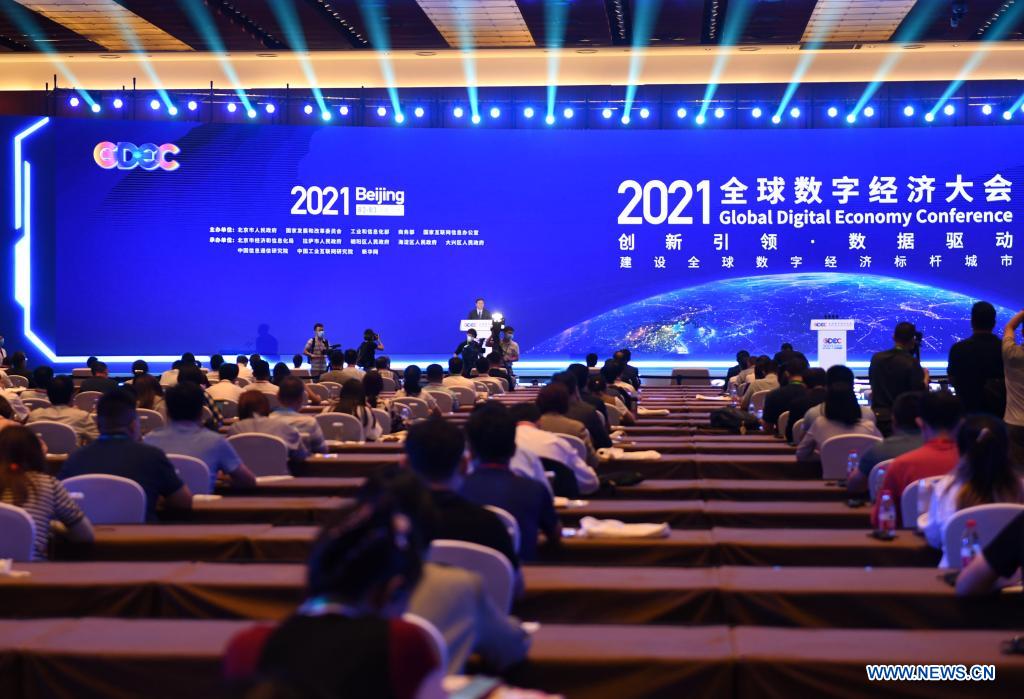
According to a white paper issued by theChina Academy of Information and Communication Technology in April, China'sdigital economy maintained a high growth rate of 9.7 percent in 2020 amid thepandemic and the global economic downturn. The scale of China's digital economyreached 39.2 trillion yuan (about $6.1 trillion) last year, accounting for 38.6percent of the GDP. With its digital economy ranking second in the world, Chinahas highlighted the digital economy development in its 14th Five-Year Plan (2021-2025)to build a digital China. China's digital economy hit $5.4 trillionlast year in terms of market size, which ranked second worldwide behind theUnited States. The market size of China's digital economy surged 9.6 percentyear-on-year last year, the fastest worldwide, as the country bets big on thedigital economy to drive its economic growth amid the COVID-19 pandemic,industry experts and officials said on Aug. 3. Despite the fragile global economicrecovery, the digital economy has played an important role in driving theeconomic recovery and sustainable economic development for economies around theworld, the report said. For the 47 economies surveyed, the digitaleconomy accounted for 43.7 percent of the gross domestic product on average. Developedcountries have a higher proportion, accounting for 54.3 percent of GDP onaverage. According to Hu Jianbo, chief engineer ofCAICT, up to 80 percent of the country's digital economy development involvesthe digitalization of various industries with manufacturing being a mainsector. However, Hu said that more efforts areneeded for China to first build a new type of digital infrastructure, likeelectricity, water and transportation managements that the country previouslybuilt up during its industrial era. "The new type of digitalinfrastructure includes network facilities like data centers and intelligentcomputing power facilities, as well as assessing and maximizing the value ofdata from artificial intelligence facilities," he added. To develop the digital economy, Huang Wei,an academician at the Chinese Academy of Sciences, said at the conference thatdeveloping independent bottleneck technologies like flexible electronics shouldbe a priority. Lately, China has set out key economicpolicy directions for the second half, highlighting that the resilience ofscientific and technological innovation-as well as industryand supply chains-must be further harnessed, and fundamental research should be strengthened. "Flexible electronics represent a coretechnology in the intelligent era. In this sector, the country has gained somemomentum in key basic technologies and has good potential to gain the leadglobally," Huang said. Liu Yulin, deputy head of information andcommunications technology development at the Ministry of Industry andInformation Technology, said that superfast 5G technology will be another newengine of the digital economy over the next few years. As of the end of June, more than 961,000 5Gbase stations had been built in China, covering all prefecture-level and abovecities. The number of 5G mobile terminal connections has reached 365 millionunits, accounting for more than 80 percent of connections globally, Liu said. "In this increasingly digital era ofglobalization, countries led by the US are striving to seize the high ground indigital trade," said Liu Yingkui, head of international trade at theAcademy of China Council for the Promotion of International Trade. According to a report published by globalconsultancy firm McKinsey & Co, large gaps exist between a handful ofleading countries and the rest of the world. The report ranked 139 countries onthe basis of inflows and outflows of goods, services, finance, people and data.Singapore led the rankings, followed by the Netherlands, the US and Germany. China has grown more connected, reachingseventh place globally, but advanced economies in general remain more connectedthan developing countries. Liu said China has accumulated a hugeamount of data and data streams in a group of areas, including cross-bordere-commerce and superfast 5G development. These are valuable foundations for thedevelopment of the digital economy. "Once more companies join, theplatform can leverage data and artificial intelligence to optimize industrialsoftware and fill the gaps in industrial development with developedcountries," Liu said. The growth rate of digital economy wasannounced at the 2021 Global Digital Economy Conference, which is underway inBeijing, and co-hosted by the Beijing municipal government, the NationalDevelopment and Reform Commission, the Ministry of Industry and InformationTechnology, the Ministry of Commerce, and the Cyberspace Administration ofChina. According to the global digital economywhite paper released by the China Academy of Information and CommunicationsTechnology at the conference, last year, the value added for the digitaleconomy reached $32.6 trillion in 47 nations, with a nominal growth rate of 3percent on a yearly basis. At the conference, more policy signals werereleased to further speed up the development of the digital economy, includingR&D breakthroughs and iterative applications in high-end chips and keybasic software, green smart data and computing facility layouts, and promotingdigital transformation in the manufacturing sector. In the wake of the fragile global economicrecovery, the digital economy has become a key to realizing economic recoveryand promoting sustainable development, as well as a new driver to boosthigh-quality development, said Zhuang Rongwen, director of the CyberspaceAdministration of China. Developing the digital economy has enormoussignificance, said Xiao Yaqing, minister of Industry and InformationTechnology. Next, the country will strengthen efforts to tackle key problems incore technologies, strengthen areas of weakness and build an independent,controllable, safe and reliable information technology system. The government will put more efforts intoadvancing digital transformation in the manufacturing sector, and also promoteimplementation of the "5G plus industrial internet" innovationdevelopment project and smart manufacturing project, Xiao said. Digital technologies should better empowersmall, medium and large enterprises to fully support industrial upgrading, Xiaosaid, adding that an open, fair and nondiscriminatory development environmentshould be built up for the digital economy. Local governments are also actively planninga new round of measures to speed up the construction of a highland for thedigital economy. According to a document published by the government of theBeijing municipality, after continual efforts over about 10 years, Beijing aimsto become a leader in city digital smart transformation, global data deploymenthubs, emerging digital industry incubators, global digital technologyinnovation, digital governance in China and digital economy opening-up. The country should build new, quality andreliable bases for the digital economy, promote the popularization ofinformation infrastructure, and explore new and innovative space for thedigital economy, said Yu Xiaohui, vice president of the China Academy ofInformation and Communications Technology. China aims to advance internationalcooperation in digital economy and technology. The Chinese authorities on July23 released a guideline on overseas investment and cooperation in the digitaleconomy, detailing major tasks to actively engage in the global development ofdigital technology. The guideline, jointly released by severalgovernment departments including the Ministry of Commerce, pledged activeintegration with the global industrial chain of the digital economy. More efforts will be made to enable digitaleconomy enterprises to accelerate the deployment of overseas research anddevelopment centers and product design centers, and strengthen cooperation withoverseas technology companies in fields such as big data, 5G, artificialintelligence, and blockchain for joint development of cutting-edgetechnologies, according to the guideline. Domestic companies will also be encouragedto tap opportunities in the overseas digital market to invest in smartinfrastructure. The guideline called for improvingmechanisms concerning the "going out" process of the digital economyand stepping up regulations on new business models of the sector's overseasinvestment and cooperation. China’s government has proposed encouragingdigital enterprises to speed up construction of overseas research anddevelopment centers and strengthen cooperation with tech firms abroad in areassuch as big data, artificial intelligence and blockchain, according to a noticeposted on the commerce ministry’s website on July 23. Companies will be encouraged to seizeopportunities in the overseas digital infrastructure market and constructcommunications network infrastructure such as land and sea optical cables andbroadband networks, per new guidelines. They should also build satellitecommunications, big data centers, fifth-generation mobile and cloud computinginfrastructure, to provide digital services globally. The Guidelines for Outward InvestmentCooperation in Digital Economy were jointly issued by the ministries ofcommerce and industry and the cyberspace regulator. China's digital economy has developedrapidly in recent years, reaching CNY39.2 trillion (USD6.1 trillion) last yearand accounting for 38.6 percent of gross domestic product, a year-on-yearnominal rise of 9.7 percent, much higher than the national GDP growth rate of2.3 percent, according to the White Paper on China's Digital EconomyDevelopment previously released by the China Academy of Information andCommunications Technology. But the proportion of digital trade isstill low around the world, offering potential for China's future development,said Li Daokui, dean of the Institute for Chinese Economic Practice andThinking at Tsinghua University. The new guidelines also encouragemanufacturers to take part in the digitization and automation process of theglobal manufacturing industrial chain, and to accelerate cooperation in thesharing economy, electronic payments and telemedicine. Digital enterprises with internationalcompetitiveness need to be developed and private companies should enteroverseas markets to carry out localized operations, according to theguidelines. The guidelines also propose improvements tothe outward investment filing and reporting system, strengthening monitoringand analysis, improving the digital management of foreign investment andcooperation, and enhancing information sharing and cooperative supervisionamong departments. In addition, companies will be encouragedto build overseas digital economic and trade cooperation zones, as well asestablish tech innovation platforms abroad and promote cross-border e-commerce. Facing challenges brought by the COVID-19pandemic, major economies have accelerated their efforts to develop the digitaleconomy, which is seen as a key momentum for them to restore economic growth,reshape competitive advantages, and improve governance. The U.S. continued to lead the world interms of the scale of digital economy, which hit $13.6 trillion in 2020,followed by China ($5.4 trillion), Germany ($2.54 trillion), Japan ($2.48trillion) and the UK ($1.79 trillion), the white paper showed. The digital economy accounted for over 60percent in GDP in the U.S., Germany and the UK, the CAICT said, while China'sdigital economy made up nearly 40 percent of the country's GDP in 2020, up 2.4percentage points above 2019 levels. In terms of strategies in developingdigital economy, the CAICT made comparisons among China, the U.S., EuropeanUnion (EU), Germany and the UK. China's approach is based on its industrialfoundation and the exertion of its market vitality, the CAICT added, citing 5Gand mobile payment as examples. The U.S. relies on its leadingtechnological innovation which creates a global advantage in the digitaleconomy, while the EU is leading the exploration of digital governance and thecreation of a strong and unified digital economy ecology, the CAICT said. Enjoying the manufacturing advantages,Germany is leading to create a benchmark for the digital transformation of theglobal manufacturing industry, and the UK is improving the overall layout ofthe digital economy and leading its digital transformation with the digitalgovernment strategy, the institute added. |