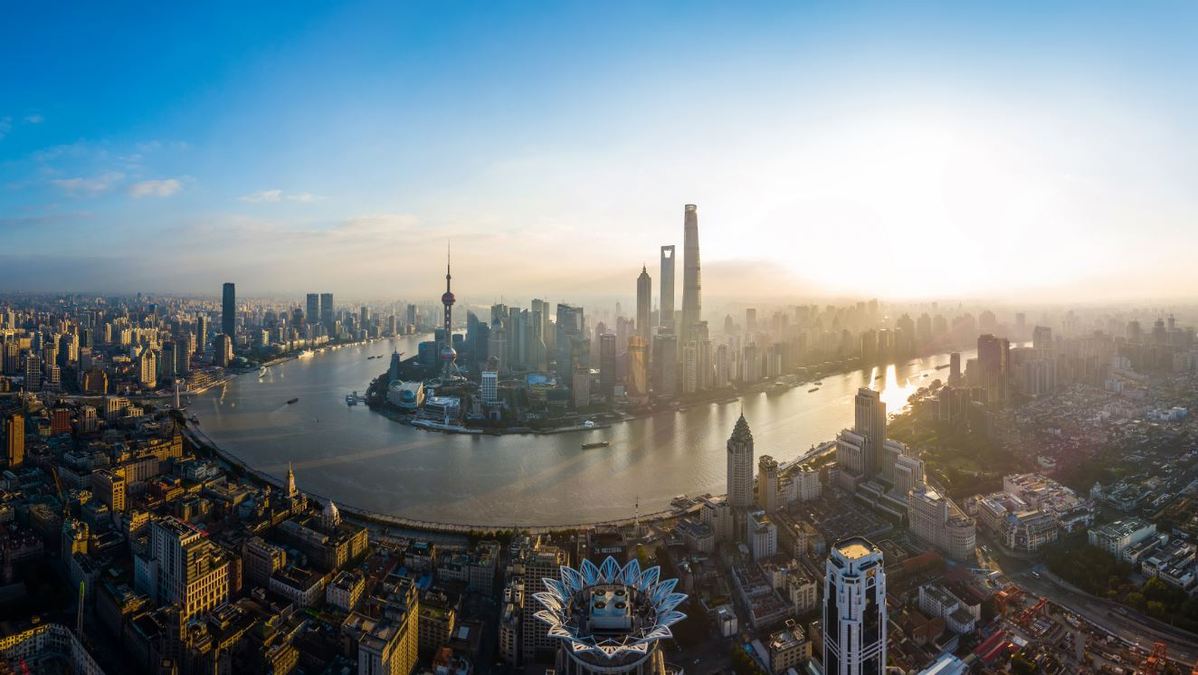
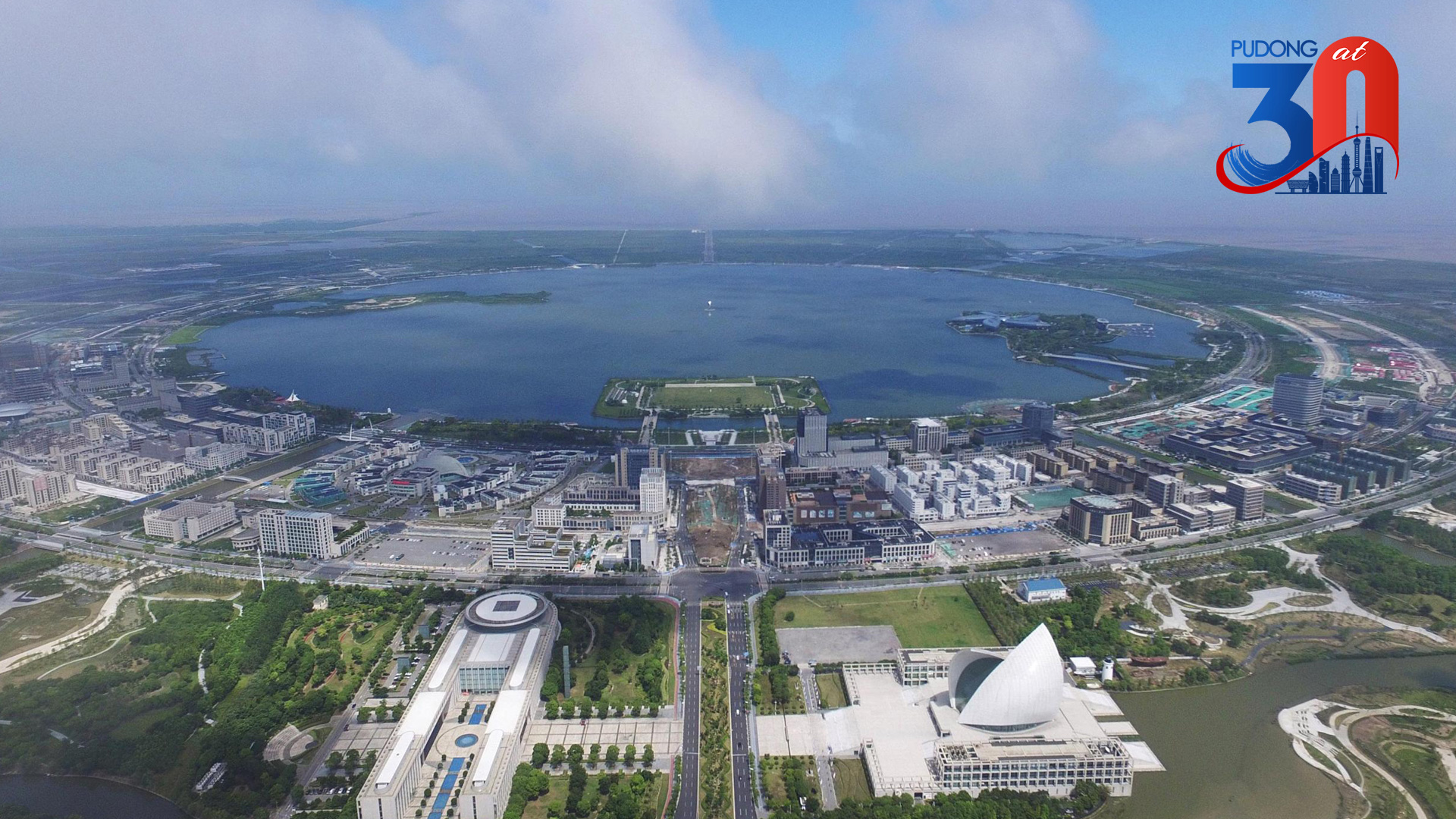
Pudong, a district east of the HuangpuRiver in Shanghai, has been transformed from desolate farmland to a majorgrowth engine of the east China metropolis and an embodiment of China'smodernization and opening-up. It has become a model for the rest of the countryon how to launch reforms and achieve high-quality development in a new era. Having been supported by the continuedreforms and experiments over the past 30 years, Pudong, though it accounts foronly 1/8000 of China's total land area, is a powerhouse contributing 1/80 ofthe country's GDP and 1/15 of total imports and exports. The area's GDP surged 211 times from 6billion yuan ($900 million) in 1990 to over 1.2 trillion yuan in 2019. Itstotal foreign investment has reached $103 billion and it has gathered over36,000 foreign-funded enterprises and headquarters of 350 multinationalcompanies from 170 countries and regions, data from the Pudong governmentshowed. Displaying financial strength Shanghai is China's financial hub and aninternational financial center, while Pudong is the core area showcasing thecity's financial strength. Lujiazui, a world-renowned financialcenter, was developed shortly after the opening-up of Pudong. LujiazuiFinancial Zone is a testament to the development and reform of China'sfinancial sector over the past 30 years. More than 860 financial institutionslicensed by China's banking, securities and insurance regulators, as well astheir subsidiaries and branches, have offices in the zone. The growth of Shanghai's Pudong New Area isinseparable from the growth of the city's finance industry. The past threedecades have seen local firms set up to serve development needs and the arrivalof foreign companies anxious to take part in opportunities available there. DBS Bank, a Singaporean multinationalfinancial services group, set up its first representative office in China 27years ago and was among the first group of foreign-funded banks in China withheadquarters in Lujiazui. One of the financial institutions thatplayed a major role in the rapid expansion of the Pudong New Area has been theShanghai Pudong Development Bank. Opened in 1933, the bank sits with pride onthe Bund and right across from the Lujiazui skyline, three years after theChinese central government announced its plans for Pudong's development. A far cry from its current grand setting,Shanghai Pudong Development Bank started small, with two branches in theShanghai Petroleum Exchange and the Waigaoqiao Bonded warehouse zone. Thereweren't all that many banks around at the time. "We set up our first branches with twoiconic industries and areas, which made our financial pattern very clear,"noted Cao Jiangtao, head of corporate banking at the Shanghai PudongDevelopment Bank. "Most of the banks in the market atthat time were state-owned banks –just a few foreign firms like HSBC andStandard Chartered," said Cao. By calling itself the Shanghai PudongDevelopment Bank, its mission was clear. Over the past 30 years, the bank hasissued loans to most major projects in the area, including the construction ofPudong International Airport, the building of China's first modern commercialaircraft the C919, and many others, including the Shanghai Tower, the DisneyResort and Tesla's auto factory in Lingang. The bank is now looking at moreinternational business as well. "We have served more than 4,000clients with a highly efficient integrated free trade account service ofdomestic and foreign currency, and have set up more than 260 cross-border cashpools. We also served nearly 200 clients with convenient services to facilitatetheir foreign trade. These companies are in industries including the Internet,bio-medicines, integrated circuits, and artificial intelligence," saidCao. The finance industry has been crucial toPudong's development over the past few decades. And while domestic financialinstitutions were first to set up, foreign firms are now playing a bigger andbigger role. Pioneer of reform and opening-up In 2005, China approved Pudong as acomprehensive supporting reform pilot area to carry out comprehensive reformand set an example for the rest of the country. In 2013, the China (Shanghai) Pilot FreeTrade Zone (FTZ) was established. Then, China first piloted the negative listin the Shanghai FTZ with 190 items listed that set out those off-limits sectorsto foreign investors. Later, the country kept shortening the list to make itmore adaptable to the business environment. With strong policy support, Pudong is anideal place for attracting foreign investment. In June 2019, Shanghai'smunicipal government issued Opinions on Supporting the Reform and Opening-up ofPudong New Area in a bid for attracting more high-quality foreign capital. The document also set the goal of takingPudong's GDP beyond two trillion yuan in seven years, through a set of 20measures covering system innovation, economic growth, local governance andgreen ecology. In August last year, China issued anoverall plan for the Lingang area, newly carved out of Shanghai's Pilot FTZ.The plan said Lingang is aimed at building a relatively mature institutionalsystem of investment and trade liberalization and facilitation by 2025, and aspecial economic function zone with strong global market influence andcompetitiveness by 2035. The new area provides a number of open andfunctional platforms for enterprises doing business in China. U.S. electric vehiclemaker Tesla, for example, built its first gigafactory outside the United Stateslast year in the new Lingang area, with a designated annual production capacityof 500,000 units. Tesla Shanghai gigafactory is on course toproduce 150,000 cars a year this year alone, Grace Tao, Tesla China's globalvice president, told CGTN during the International Fair for Trade in Servicesin September. Contributing to technology and innovation Pudong set out to become a major financialcenter 30 years ago, but in recent years it's also investing billions in tech,including a plan to develop six tech-oriented core industries, namelyintegrated circuits, medicine, aviation, future cars, big data, and smartmanufacturing. The authorities expect them to generate at least $14 billion by2025. These policies have attracted a largenumber of high-tech giants. In 2012, Microsoft became the first multinationaltech company to launch its public cloud service for China in Shanghai, whenthere was no clear cloud leader in the country. Its technology was licensed todomestic tech company 21Vianet. Now, cloud computing has become one of themain sectors of growth in Pudong, but Microsoft has been introducing newbusinesses there as well. In 2013, Microsoft's joint venture withlocal, new media firm BesTV became the first enterprise to be registered in theShanghai free-trade zone. Just one year after that, it launched theXbox One gaming console, the first new one available in China since the year2000. And last year, the company opened itslargest Artificial Intelligence and Internet of Things lab in the world inPudong's Zhangjiang High-tech City. The lab has a history of working with 90local firms on new manufacturing, retail, medicine, finance, and urbandevelopment applications. Many other companies have the same idea,including IBM, Infineon, and Alibaba, which are among several dozen other techgiants that have set up regional headquarters or major research centers inPudong. By 2025, the area is then projected to have10 large science facilities, working on breakthroughs in fields like photonics,quantum research, brain science, structural biology, and astrophysics.High-tech companies are anticipated to reach 8,000 in total by then. In addition, Pudong has played an importantrole in Shanghai's latest goal of becoming a technology and innovation center. In 2017, the municipal government approveda plan to turn the Zhangjiang Hi-Tech Park into a science city with about700,000 residents, including scientists, professionals and entrepreneurs. In March this year, Pudong announced anaction plan to build ten large scientific facilities, six "100billion-level" core industrial clusters and one national laboratory by2025. |