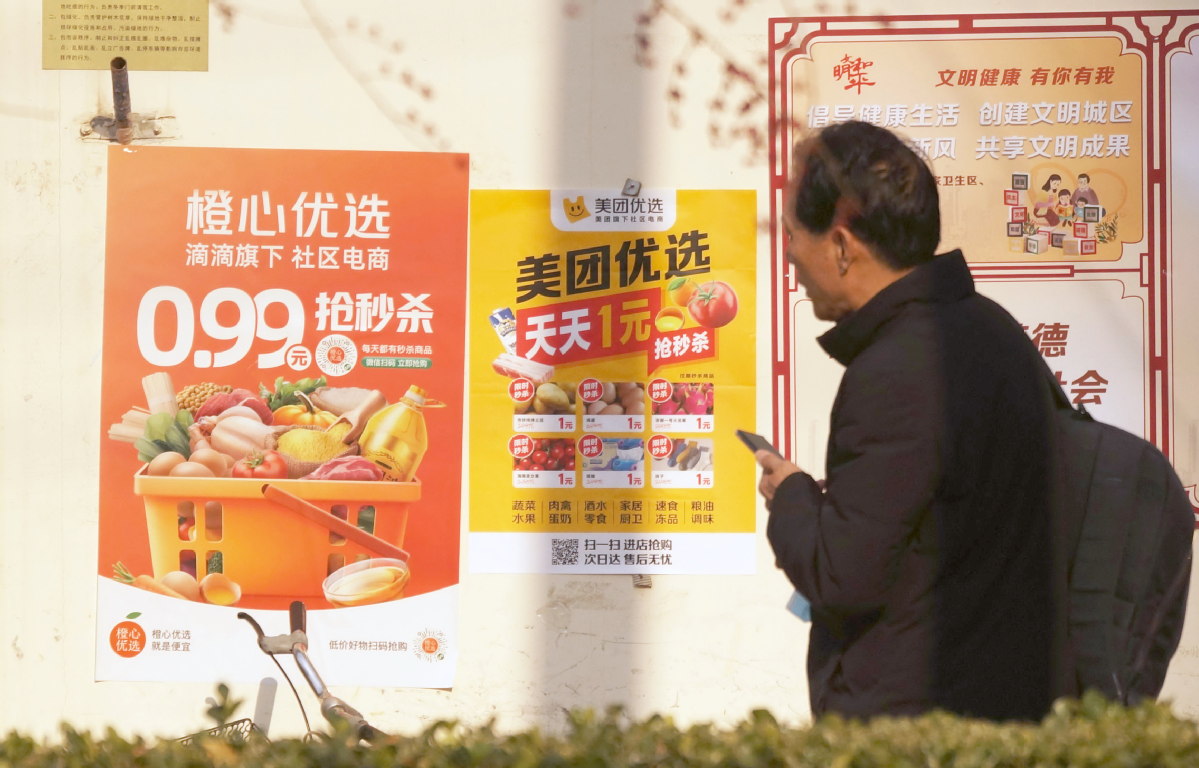
China's market regulator on December 22issued a list of restrictions on community group-buying operations, tighteningoversight on low-price competition emerging in the sector. China's State Administration for MarketRegulation (SAMR) vows to maintain a fair market competition environment, whilepointing out that the current price war has squeezed employment and causedother issues. It also emphasized the protection of consumer information. Representatives from China's internet giantAlibaba Group, Tencent Holdings, JD.Com Inc, Meituan, Pinduoduo Inc and DidiChuxing participated in a meeting held by the SAMR on December 22. Community group-buying offers localresidents discounts when they make purchases in bulk. The approach has grown inpopularity among Chinese buyers. Neighboring residents would usually create asocial media account to place orders together, most often groceries, fordelivery to one location. The popularity of community group-buying,in which neighborhood residents receive discounts on bulk buying online, isincreasing among China's tech-savvy consumers. But the emerging sector needs todeal with certain challenges, besides playing a responsible role in society,industry experts said. Group-buyingfaces challenges Given the experience of the COVID-19 pandemic,many consumers prefer the convenience of e-commerce as it helps reduce visitsto shops and supermarkets, cut down exposure to public places and minimizephysical contact with others and objects. Industry experts said group-buying is seenmostly in scenarios where demand is steady, like high-frequency groceryconsumption. It is set to become a new battlefield for technology titans.E-commerce behemoths are constantly seeking new growth engines likegroup-buying. But, in early stock-market trading on December21 in China, shares of listed companies that offer group-buying plummeted. Market mavens attributed the fall to anarticle in Chinese-language People's Daily on December 12 noting thatinternet-based companies should not just think in terms of boosting sales of afew bundles of cabbage or a few crates of fruit, but undertake moreresponsibility for promoting scientific and technological innovation. The group-buying model faces manychallenges. Logistics capacity, profitability and the need to ensure goodquality of products are key to growing the number of new users, experts said. "More efforts are needed for theseonline platforms to improve the construction of supply chains and ensure thequality of the products strictly, while taking control of the costs, as thegross profit margin of this model is relatively low," said Zhao Yue, ananalyst at Beijing-based internet consultancy Analysys. These internet giants should also providedifferentiated goods and strengthen the professional training for communityleaders, whose loyalty and operational capacity might be low, Zhao said. Pan Helin, executive director of theDigital Economy Academy of the Zhongnan University of Economics and Law, alsosaid as the penetration rate of the internet is increasing and the number ofpeople that use location-based online services for daily essentials continuesto expand, community group-purchase will be a very critical consumptionscenario. About 60 percent of community group-buyingplatform users are from the country's lower-tier cities and rural areas,according to data from market consultancy Quest Mobile. "Compared with traditionalbrick-and-mortar stores, these online platforms have gained an upper hand inobtaining massive user traffic and their requirements for commodities,"said Zhang Shule, an independent commentator in the IT and video game industry. He also said the platforms should utilizebig data technology to produce community-level portraits and accurately predictand satisfy users' needs. Alibaba,Pinduoduo and Meituan Deny Group-Buying Many of the prohibitions point to relevantprovisions in the China's draft Anti-Monopoly Law. The draft rules was unveiledin November relating to the country's online economy. The State Council then approved theestablishment of an inter-ministerial committee, aiming to enhance efforts tocombat unfair competition.It reiterated prohibition of the abuse of market dominance,like predatory pricing. "It is strictly forbidden to dumpgoods at prices below cost for the purpose of squeezing out competitors ormonopolizing the market," SAMR wrote in a note published on its website. The regulator added that service agreementson platforms cannot be used to impose "unreasonable" restrictions onthe transactions, such as on transaction prices, transactions among operators,and charge unreasonable fees from operators on the platform. Alibaba Group Holding, Pinduoduo, and Meituansaid they will continue to offer bulk-buying services, refuting speculation tothe contrary among China’s netizens, after a leading newspaper criticized thebusiness model. Alibaba’s grocery store chain Hema Freshdismissed conjecture it would quit the group-purchase business as a “rumor” ina Dec. 12 statement, while Pinduoduo said that it had no knowledge of theclaims. Meituan labeled it speculation. Group-purchasing has become popular inChina, particularly during the Covid-19 epidemic early this year, as consumerscould order groceries from home -- made cheaper by the large quantity purchased-- with delivery to their neighborhoods. China’s tech giants have embraced the modelone after another. Ride-hailing services provider Didi Chuxing debuted itsfresh produce service Chengxin Youxuan in June followed by Meituan setting upits own Youxuan division in July. Pinduoduo launched Duoduo Maicai, avegetable-buying channel, in August. Alibaba set up Hema Youxuan in October andstarted recruiting group leaders after it was reported that the unit receivedUSD4 billion from its parent company. In the same month, Suning.Com inauguratedSuning Food Market in Beijing, and on Dec. 22 JD.Com said it would investUSD700 million in grocery platform Xingsheng. China'santitrust protection efforts to strengthen economy China's efforts to strengthen antitrust andconsumer protection will protect and stimulate the vitality of market players,and will help create a stronger domestic market, Economic Daily reported on December22. The country will intensify anti-monopolysupervision and prevent disorderly capital expansion next year, according tothe annual Central Economic Work Conference held in Beijing last week. In January, the State Administration forMarket Regulation published the Anti-Monopoly Law amendment draft to solicitpublic opinion, which involves articles to identify the dominant marketposition of internet platforms. Last month, the administration alsoreleased a draft for comment with regard to anti-monopoly measures for theplatform economy, curbing behavior such as either-or choices for merchantsbetween e-commerce platforms, and price gouging on regular customers via bigdata. China supports innovation and developmentof platform enterprises and enhancing their international competitiveness, aswell as the common development of public- and private-owned economies. But at the same time, companies shouldoperate in accordance with the law and improve their digital rules, said LiuJunhai, a law professor at Renmin University of China who was quoted in thereport. At a practical antitrust level, the basicmarket system should be improved to form a highly efficient and standardizedunified domestic market with fair competition. Small, medium-sized and micro enterprisesshould be encouraged to stand out, and emerging companies in various sectorscan have a place to thrive. Besides, a consumer-friendly administrativesupervision system, judicial relief system, and coordinated governance systemshould be established and improved, while enhancing consumer self-protectioneducation, Liu said. On the other hand, strengtheninganti-monopoly supervision has become a global trend, Economic Daily reported onMonday. Antitrust law enforcement agencies in countries and economies in theworld have taken tough regulatory stances and restrictive measures on onlineplatforms. According to incomplete statistics, thereport said, technology behemoths like Google, Apple, Facebook and Amazon havebeen deeply involved in antitrust investigations in the world during the pastfour years. Among them, Google faced 27 cases, Amazon and Apple both 22 cases,and Facebook 13 cases. |