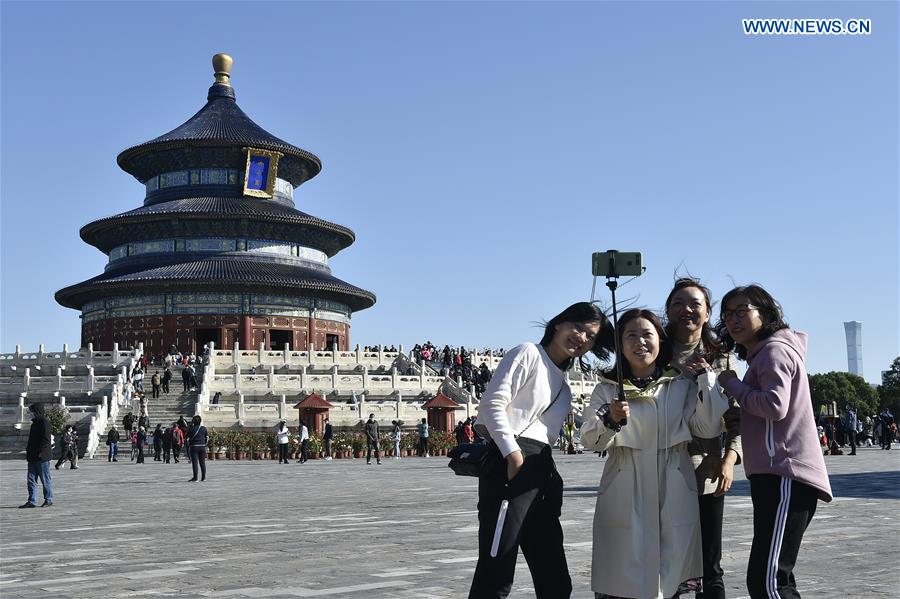
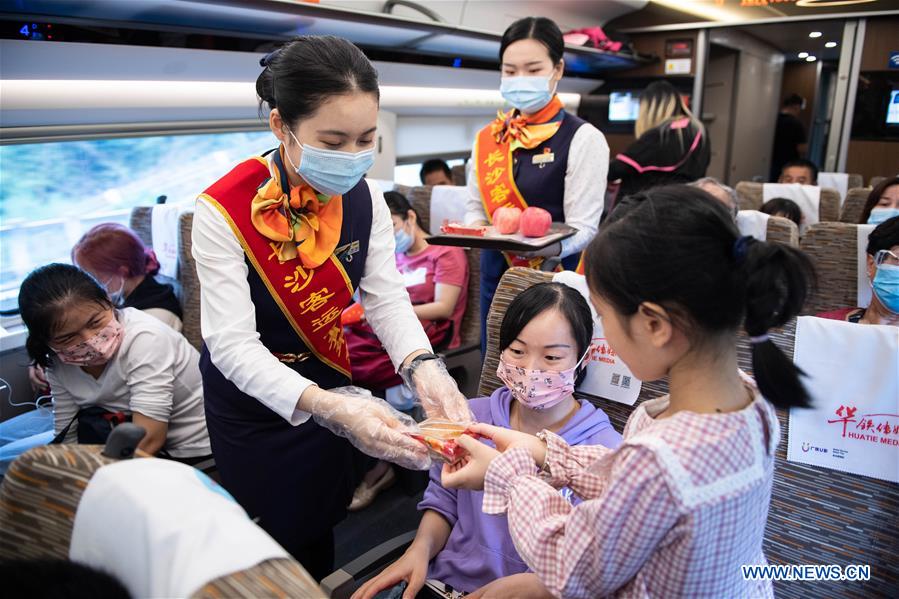
China's eight-day Golden Week holiday has reflected the country's impressive recovery and its economic bounce back from the COVID-19 epidemic, with more than half a billion people on the move for a long-awaited vacation China's National Day holiday, or the Golden Week holiday, this year has emerged from the shadow of COVID-19 as more than 600 million tourists made domestic trips, showing China's strong rebound from the pandemic, which will give global economic recovery a leg up. Train tickets were sold out, hotel reservations hard to make, and highways crawling with vehicles: millions of Chinese people could finally enjoy a week-long holiday without worrying about quarantines, tests and other restrictions on their movements. China's successful containment of the virus reassures the people that it is safe to travel domestically in the long-awaited holiday, which provides plenty of opportunities for their pent-up demand to be met. The Golden Week is sure to help boost consumer confidence and facilitate economic recovery. Booming tourism Among all industries, tourism is regarded as among the first to be affected by COVID-19 and the last to recover. Given this prognosis, its momentum is a good indicator of the country's recovery from the epidemic. Amid regular epidemic control, the peak season of tourism-driven consumption boom for National Day celebration that coincides with the traditional Mid-Autumn Festival this year was also a test field for China's new economic development pattern of "dual circulation". The total number of domestic tourists nationwide is previously expected to reach 550 million during the holiday, while statistics from the Ministry of Culture and Tourism showed that a sizable 618 million domestic tourist visits were made in the first seven days, generating overall tourism revenue of 454 billion yuan (about $66.9 billion). In Wuhan, the heroic city once hard hit by coronavirus but has restored its vigor, visitors ambled by the Yellow Crane Tower as the historic building launched night tours for the first time since its opening to the public in 1985 after reconstruction. The landmark topped the "country's hottest scenic spots" rankings by China's largest online travel agency Trip.com Group,with the number of visitors who made reservations reaching the daily limit of 25,000 in the week. Notably, Wuhan this year stood among the top 10 tourist destinations and sources in the Golden Week, according to data from Fliggy, a popular online travel platform. In Beijing, chilly drizzle did not drench the enthusiasm of more than 90,000 people, who gathered at Tian'anmen Square in the early morning of Oct 1 to watch flag-raising ceremony to celebrate the 71st National Day. The crowd burst into cheers when the Five-starred Red Flag was hoisted to the top of the flagpole amid the national anthem. As the tourism industry is closely related to many service sectors such as catering and transportation, the tourism boom will be conducive for the recovery of the service industry and promote more balanced economic development. "In any year, the outlay of the weeklong holiday is a closely watched barometer of the country's economic health," The New York Times reported, noting that this year's holiday offered "the clearest measure yet of China's recovery from the pandemic." Economic rebound China's economy has recovered with strong growth momentum across diverse industries during the past National Day and Mid-Autumn Festival holiday. Statistics from the Ministry of Commerce indicate China's sales volume for key retail and catering enterprises reached 1.6 trillion yuan ($238.38 billion) from Oct 1 to 8, with the average daily sales volume increasing by 4.9 percent compared with last year's National Day golden week. To stimulate consumers' enthusiasm to spend, a variety of sales activities were promoted and a large amount of subsidies and vouchers for automotives, home appliances, and food and beverages were released. The recovery of consumption drives the growth of the express delivery business. Data from the State Post Bureau of China shows from Oct 1 to 8, the national postal express industry collected 1.82 billion parcels, up 53.42 percent year-on-year. With accelerated integration of online and offline consumption, the country's postal express business has been maintained at a high growth range of above 30 percent since February, when China's express parcel volume grew from negative to positive, the State Post Bureau said. China's consumption has started to recover as its total volume of retail sales re-achieved positive growth this August, said Nicholas Lardy, a senior fellow at the Peterson Institute for International Economics, a Washington DC-based think tank, adding that retail sales are expected to speed up recovery due to stimulus by "revenge spending" in the Golden Week. In a recent written interview with Xinhua, Ding Jia, general manager of Germany's tour operator Kaytrip in China, said that the Chinese government has taken efficient and powerful control measures against the epidemic, ensuring the safety of people's travel and boosting their confidence. The current round of long holidays is believed to lead a new wave of holiday spending boom, thus adding strong impetus to China's economic recovery, Ding added. "China's success in containing the coronavirus and reviving economic activity has been notable," said R. N. Bhaskar, consulting editor of Asia Converge and guest faculty at several institutes in India and overseas, noting that a recent official report on manufacturing showed the Chinese economy is recovering better than expected. With the epidemic largely under control in China, the Golden Week holiday is putting on display the country's confidence in its economic rebound and its public health measures, Bloomberg said. Growth driver The huge consumption potential during the Golden Week will not only accelerate the recovery of China's domestic economy but also drive imports and investment from other countries, as the booming "holiday economy" fuels internal circulation and promotes external circulation at the meantime, offering a strong boost to global trade and the world economy. Gu Qingyang, an associate professor at the Lee Kuan Yew School of Public Policy at the National University of Singapore, noted that holiday consumption will help boost the service sector and promote more balanced development between other industries that bore the brunt of the epidemic. China's economic recovery continued to gather steam with improving major economic indicators including retail sales of consumer goods, industrial output, the export of goods and the purchasing managers' index for the manufacturing sector. The country has become the only major economy projected by the World Bank to achieve positive growth in 2020, up from the 1-percent growth projection released in June. China will continue to be one of the main engines of world economic growth. If other countries can seize the opportunities presented by China's economic bounce, it will help accelerate the recovery of the world economy, Gu said. Four offshore duty-free shops in Hainan, an island in southern China, were busy receiving "big spenders" in the Golden Week, with their retail sales surging by 167 percent, according to statistics from the Ministry of Commerce. Inside a duty-free shopping mall in the resort city of Sanya, Shao Kehui, a tourist from East China's Zhejiang province, lined up for more than 20 minutes before entering the Gucci store for a handbag worth about 14,000 yuan (about $2,082). "Due to the pandemic, we cannot go abroad, but it's a good choice to travel in Hainan and enjoy duty-free shopping here," said Shao. Tommy Wu, a senior economist at Oxford Economics, said that "holiday economy" will undoubtedly stimulate China's domestic consumption, benefiting home and international brands and hotel groups. Many economies are still struggling to recover from the pandemic, while China's huge demand indicates the need for substantial imports, contributing to global economic recovery, Wu added. Mikhail Morozov, deputy editor-in-chief of Russia's Trud newspaper, said that China's economy will remain a major growth driver for the global economy, noting that countries across the world will speed up economic recovery if they "hoist their sails catching China's wind." |