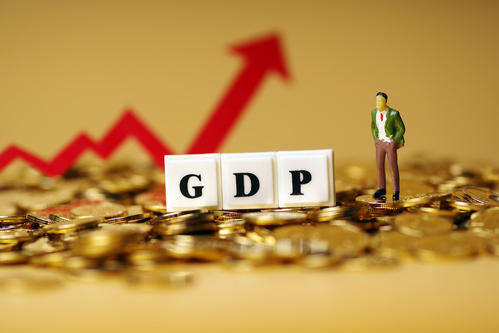
China's economic indicators for the firstquarter of 2021 have been released. At an annualized rate, the economy grew18.3% from January through to April, facilitating a complete economic recoveryas the world deals with the disruption of COVID-19, and consumption reassertsitself, registering the highest tally since 1993. In line with the GDP figures, industrialoutput increased 24.5% from last year, exports by 38.7%, imports 29.2%, retailsales of consumer goods 33.9%, and fixed-asset investment by 25.6%, allpositive indicators showing a healthy and resilient economy, which is forecastto end the year up around 8.4% as a whole. The impressive resurgence of China'seconomy is the product of a stable internal environment facilitated by rapidand sustained containment of the COVID-19 pandemic, supply chain resilience andother matching rebound of other major economies. Irrespective of geopolitical uncertainties,China continues to remain an engine of global growth and subsequently anintegral part of the world recovery. This illustrates why it must continue topromote the country's economic and development strategies, as well as setting afirm example in how to recuperate one's economy in the midst of crisis. First of all, China's recovery must bepremised on its absolutist and strident pandemic prevention and controlstrategy, one which has protected national stability and prevented a massiveresurgence of the virus. This has certainly paid off. A year ago, China suffered a temporaryeconomic hit of 6.8% following the first national lockdown, but throughwholesale population spanning testing, strict quarantining and uncompromisingtransport curbs, the outbreak was quashed and normal life was enabled toresume. Since that time, there have been small newpockets of new virus cases in some provinces, but by aggressively enforcingthis strategy on a localized scale, China has completely prevented a"second wave" altogether unlike other countries that have been besetagain and again. This has produced a climate of consistentstability, and given China a head start over the rest of the world on reopeningits economy. This, in turn, has allowed China-based supply chains to remainresilient and stable, providing the rest of the world with medical supplies,equipment and now vaccines. These circumstances allowed China to rideout a global recession in achieving 2.3% GDP growth in 2020, being the onlymajor economy in the world to do so. Of course, the global economy isinterdependent and, in line with this, the recovery in some other countriessubsequently drags up China's growth faster as demand for consumer goods pushesup exports. This has been particularly true in nationssuch as the United States where, despite geopolitical tensions, mutual tradehas nonetheless surged. In line with this, a facilitation of normal economiccircumstances within China itself also has produced a rebound in local consumerdemand and thus a surge in imports, promoting international recovery. A rolling cycle of global recovery has emerged,with China is at the center adding to its momentum. This sets China's economyon an incredible pace for 2021. Of course, this is not without its risks.Things are slightly positive right now, but there is no absolute guarantee theCOVID-19 pandemic will completely disappear. While the scenarios in somecountries look positive, others continue to be rocked by their highest evertallies of cases, plunging recovery into uncertainty. Likewise, constant new mutations of thevirus are going to be an ongoing problem for emergent vaccines to keep up with.This will make the global exit from the pandemic not black and white, butpatchy and sometimes inconsistent. In this case, while the picture isoptimistic, the struggle is far from over. However, one thing is certain, andthat is China's recovery is simply a scale of "how high?" – asopposed to any fear of falling backwards. China will continue to use proactivemeasures to support economic growth with an eye on fiscal sustainability, whileleaving enough policy room to address challenges and promote reforms, a topgovernment official said in a written article. Finance Minister Liu Kun said in hisarticle, published in People's Daily, that the efforts would be focused atkeeping fiscal deficit, gross debt and government expenditure at reasonablelevels, without any sharp shifts in policies. The minister's comments came ahead of therelease of the major economic indicators for the first quarter. Many economistshad projected a robust recovery as manufacturing activity and services gatheredspeed, largely due to the successful containment of COVID-19 and fastvaccination. Liu called for strengthening research andanalysis of the macroeconomic situation, and using more policies to hedgepotential challenges. In this regard, the minister highlighted the need toinject more funds in sectors like technology innovation and improving the taxincome system for local governments. Consumption tax collection reforms will bestepped up to further expand the income avenues for local governments. Stamptax and tariff legislation will also get due attention from the country alongwith an expansion of the tax management rights of provincial-level governments,said Liu. In order to mitigate the pandemic impact,China has made greater use of public investment, in addition to providingrelief for households and businesses, to support the recovery soon after theepidemic was brought under better control. Yi Gang, governor of the People's Bank ofChina, the central bank, welcomed the re-establishment of the SustainableFinance Study Group, which was upgraded to a working group co-chaired by thePBOC and the US Department of the Treasury, according to a statement releasedon the bank website. The PBOC governor also expressed hissupport for the new allocation of SDRs and urged G20 members to channel theinstruments to benefit low-income countries in an appropriate manner. Yi alsocalled for IMF governance reform under the 16th General Review of Quotas. The group is expected to develop a G20sustainable finance roadmap, as well as improve sustainability reporting,identify sustainable investments, and align international financialinstitutions' efforts with the Paris Agreement. The G20 finance ministers and central bankgovernors are also expected to hear from the Financial Stability Board abouthow regulatory, supervisory and oversight frameworks address the so-called"global stablecoins", and have broad discussions on the cross-borderuse of central bank digital currencies and their wider implications for theinternational monetary system, the communique said. Industrial production in China has returnedto pre-COVID-19 levels amid efforts to revive economic activity and the renewedconfidence of enterprises, the Ministry of Industry and Information Technologysaid. Huang Libin, a spokesman for the ministry,said that during the first three months of this year, the utilization rate ofindustrial capacity in the nation reached 77.2 percent, the highest for thesame period since 2013. According to Huang, industrial outputincreased 24.5 percent on a yearly basis in the first quarter, while profits ofindustrial enterprises jumped 1.79 times on a yearly basis in January andFebruary, with the vitality of enterprises getting a further boost. "As the economy continues seeing asteady recovery, major industries are gradually overcoming the impacts of theepidemic, and the scope of recovery continues to expand," Huang said. In the first quarter, 40 of the 41 majorindustrial sectors achieved year-on-year growth, the spokesman said. Huang said rising commodity prices had animpact on the manufacturing industry, but the effect has been controllable.Joint efforts with relevant departments will be made to stabilize the prices ofraw materials and prevent panic purchases or stockpiling. The strong data came after China took aseries of measures to revive industrial production and encourage consumption. Liu Wenqiang, deputy head of the ChinaCenter for Information Industry Development, a Beijing-based think tank, saidthough there have been increases in international commodity prices, its impacton China's sprawling industries will be limited, given the nation's strongindustrial capacity and relatively sound industrial system. According to him, more efforts are neededto fuel the recovery of the services sector and small enterprises, as they arestill facing difficulties while employment pressure persists for some ruralmigrant workers and young job seekers. The ministry said it is drafting themanufacturing development plan for the 14th Five-Year Plan period (2021-25),which will include goals for the overall development of the manufacturingindustry, efforts to boost industrial fundamental technological innovation andinitiatives for cultivating strategic industries such as raw materials of majortechnical equipment. The ministry said it will carry out aspecial plan to fight unfair competition in the internet industry, with a focuson rectifying malicious blocking, traffic hijacking and other behaviors thatdisrupt market competition. China's foreign trade will maintain upwardmomentum in the first half of 2021 after experiencing strong export performancebetween January and March, officials and experts said on Tuesday. Driven by robust demand due to the rapidrecovery in major economies, China's foreign trade amounted to 8.47 trillionyuan ($1.29 trillion) in the first quarter of this year, up 29.2 percentyear-on-year, according to the latest data released by the GeneralAdministration of Customs. The substantial trade figures are partlydue to the low base from the first quarter of last year, when China's foreigntrade was hit by the COVID-19 pandemic, Customs spokesman Li Kuiwen said. "Yet even compared with the sameperiod in 2018 and 2019, the country's foreign trade in the first quarter stillsaw an increase of 25.3 percent and 20.5 percent, respectively," he said. With the manufacturing purchasing managersindex in major economies further improving in March, the official predictedthat overseas economic recoveries will continue to accelerate and supportChina's exports. The country's exports soared 38.7 percenton a yearly basis to 4.61 trillion yuan in the first quarter, while its importsjumped 19.3 percent year-on-year to 3.86 trillion yuan. Its trade surplussurged 690.6 percent year-on-year to 759.29 billion yuan, Customs data showed. Since the second quarter of last year,China's innovative foreign trade policies, in the face of the impact ofpandemic, have continued to work. The government policies have played a vitalrole in cutting costs, preventing risks and expanding the market for itsexport-oriented companies, said Yu Yi, a spokesman for the Beijing-based ChinaCouncil for the Promotion of International Trade. Thanks in part to the soaring demand forgoods in markets in the European Union and the United States-boosted bytheir governments' fiscal stimulus measures-there wassignificant growth in China's exports in the first quarter of 2021, with thoseto the EU rising 36.4 percent year-on-year and exports to the US surging 61.3percent on a yearly basis. The outlook for China's exports, advancedby vaccine availability and stimulus policies globally, will remain positivethis year, with new business models such as cross-border e-commerce emerging asa new engine of the country's foreign trade, said Mei Xinyu, a researcher atthe Chinese Academy of International Trade and Economic Cooperation in Beijing. Foreign trade through cross-bordere-commerce channels surged 46.5 percent on a yearly basis to 419.5 billion yuanin the first quarter, Customs data showed. Experts said that while China's foreigntrade will continue to climb in the second quarter, its overall growth ratescould slow down. The recovery of overseas manufacturers, together with highglobal commodity and material prices, and the lagging effect of yuanappreciation, will put pressure on China's exports in the second quarter ofthis year. With the easing of the pandemic andvaccinations becoming the norm throughout the world, overseas demand formedical supplies, daily necessities and work-at-home goods, such as laptops,will fall, while the recovery of other emerging economies' supply capacity willalso affect China's exports and some orders may be diverted to other countries,said Zhang Yongjun, a researcher at the Beijing-based China Center forInternational Economic Exchanges. China's trade with the Association ofSoutheast Asian Nations-its largest trading partner, jumped 26.1 percent year-on-year to1.24 trillion yuan from January to March, while its exports and imports with 14trade partners of the Regional Comprehensive Economic Partnership grew 22.9percent year-on-year to 2.67 trillion yuan, accounting for 31.5 percent of itstotal foreign trade volume. |