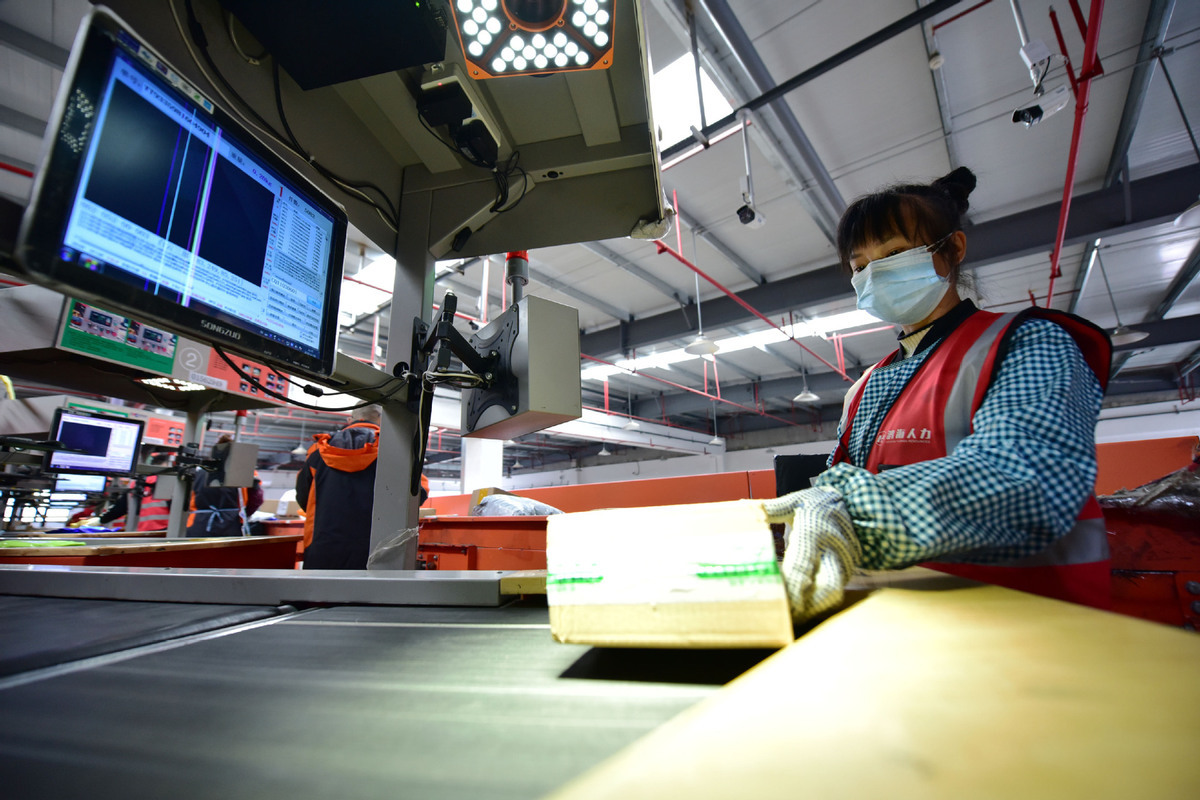
China's economy continued to gather steamduring the Spring Festival period despite millions of people staying put forthe weeklong holiday which started on Feb 11, which usually sees mass migrationacross the country. China's major coastal ports were busyduring the Spring Festival holiday amid the strong recovery of the Chineseeconomy, with the container throughput of major hub ports growing rapidly,according to the latest data from the China Ports & Harbours Association(CPHA). During the Spring Festival holiday, whichran from Feb 11 to 17, the container throughput at Shanghai Port increased bymore than 20 percent compared with the figure from 2020, while the containerthroughput at Ningbo Zhoushan Port increased by 28.85 percent. As a barometer for the economy, the busyports indicate the strong recovery of the Chinese economy. In January thisyear, the container throughput of China's top eight hub ports increased by 9.6percent year-on-year. The growth of Tianjin Port, Shanghai Port, NingboZhoushan Port, Guangzhou Port and Shenzhen Port all exceeded 10 percent. In themeantime, cargo throughput of the three key ports along the Yangtze Riverincreased by 21.3 percent year-on-year. The purchasing managers' index (PMI) forChina's manufacturing sector came in at 51.3 in January, staying in theexpansion zone for the 11th consecutive month, data from the National Bureau ofStatistics showed. The CPHA predicted the container throughputof Chinese ports would continue to enjoy robust growth in the first quarter ofthis year, as factories have been resuming production after the holiday. Chinasaw soaring overseas cargo flights during this year's Spring Festival holiday,according to the country's civil aviation authority. The country's civil aviation sector handleda total of 2,553 overseas cargo flights during the seven-day holiday betweenFeb 11 and Feb 17, showed statistics from the Civil Aviation Administration ofChina. The number rose by 212.48 percent year onyear from that for the Spring Festival holiday in 2020, and by 258.57 percentcompared with that for the same period in 2019. Notably, the peak travel dayFeb 17 saw the sector handling up to 302 overseas cargo flights, a 221.28percent year-on-year increase. China's civil aviation authorities andindustry players at home and abroad have made concerted efforts to boostrecovery and sustain the growth of the sector, which was hit hard by thepandemic. The CAAC has introduced comprehensivemeasures to support the growth of the aviation logistics sector by simplifyingapproval procedures, offering more flight timetable choices and optimizingresource allocation. All entities of the country's civilaviation industry followed the requirements of COVID-19 pandemic prevention andcontrol, thus ensuring safe and smooth operation during the Spring Festivalholiday, said the CAAC. During the seven-day holiday this year, thecountry's civil aviation industry handled a total of 47,088 flights, with theon-time performance reaching 96.17 percent. Meanwhile, the sector served 3.57million passengers during the Spring Festival holiday. It represented a 45.16percent and 71.64 percent year-on-year plunge compared with the volumes in thecorresponding period in 2020 and 2019, respectively. A surge in cross-city sales and a spike inorders for local specialties, imported goods, healthy lifestyle items andhome-based entertainment products characterized this year's Spring Festival onlineshopping trend as Chinese consumers stayed put during the holiday to curb the spreadof the COVID-19 pandemic. As many people did not travel to theirhometowns for holidays, sales generated from inter-city orders were double thatof last year, according to statistics from JJDJ, a leading on-demand deliveryand retail platform. This trend was most evident in first-tier cities such asShenzhen and Guangzhou in South China's Guangdong province. According to Cainiao Smart LogisticsNetwork, a consortium of over 10 leading Chinese delivery firms, the averagenumber of parcels sent from smaller counties to bigger cities increased 20percent compared to 2019. This trend is consistent with the broaderconsumption spree seen during the festive season. The Ministry of Commerceannounced on Wednesday that the total revenue of key companies in the retailand catering sectors rose 28.7 percent year-on-year during the weeklong holidayfrom Feb 11 to 17, reaching around 821 billion yuan ($127.1 billion). The travel restrictions caused by thepandemic have also amplified the demand for imported goods. E-commerce siteTmall, for example, saw the gross merchandise volume of imported wine spiketenfold year-on-year from Feb 4 to 15, whereas sales of rum and pasta increased8.8 times and 2.4 times respectively on JDDJ during the festival period. In addition, some 190 tonnes of dragonfruit were shipped to China from Vietnam's northern province of Lao Cai on thefirst day of the Lunar New Year, the Vietnam News Agency reported on Feb 12.The Lao Cai Border Gate Customs Sub-Department said that the shipment, thefirst exports to China in the Lunar New Year, was worth around $121,512. Air New Zealand also operated three returnservices to Guangzhou in early February to support the export and import ofpremium goods over the Chinese New Year period. From the week starting on Feb8, the airline has been operating two multi-stop services a week, using itsBoeing 787-9 fleet to pick up goods in Auckland and Christchurch before flyingthem Guangzhou, according to the airline's Feb 4 press release. Flights to Guangzhou will carry localpremium export goods including seafood and milk powder, and flights to NewZealand would carry personal protective equipment, electronics and othergeneral cargo, the airline said. China handled 660 million packages duringthe weeklong Spring Festival holiday starting Feb 11, an increase of 260percent over the same period last year according to the country's State PostBureau on Thursday. Parcel collection in the whole delivery network was aboutthree times that of the same period last year, and delivery volume was three tofour times as much. The central region of China had the fastestyear-on-year growth both in package collection and delivery, with a surge of359 percent and 260 percent respectively. Provinces like Henan, Jiangxi,Guangdong and Zhejiang all reported over 300 percent yearly increases in parcelpickup and delivery, according to the bureau. Over 1 million couriers workedduring the Spring Festival holiday to ensure the sector's operation. The proportion of e-commerce parcelsincreased significantly compared with the same period last year, according tothe bureau. The business volume of large-size goods saw rapid growth, and majorcities showed a stronger demand for parcel delivery. Most of the packagesduring the holiday were food, agricultural products and specialties as well asgifts sent to relatives and friends, said Wang Feng, a director at State PostBureau. Staycationing Chinese consumers spent905.76 billion yuan (about $140.16 billion) on a month-long online SpringFestival shopping spree that concluded Thursday, official data shows. The 30-day period of online shopping, whichran from Jan 20 to Feb 18, saw online catering sales skyrocket by 48.5 percentcompared with the same period in 2020, according to the Ministry of Commerce. Products and services related to Lunar NewYear's Eve dinner surged 78.8 percent from the Spring Festival holiday in 2020,while online sales of movie tickets spiked 412.7 percent on yearly basis tosurpass 9 billion yuan, the data shows. Many Chinese people opted to stay putduring the Spring Festival holiday this year in response to the government'scall for avoiding unnecessary gatherings as part of anti-epidemic measures. Retailers and restaurants in Shanghai sawsurging sales during the Spring Festival holiday as many people stayed put toprevent the spread of COVID-19. The sales revenue of the city's 390 majorretailers reached 7.61 billion yuan (about $1.18 billion), 2.2 times the valuereaped during last year's holiday, according to the Shanghai municipalcommission of commerce. A total of 107 selected catering andbeverage businesses saw their sales revenue reach 29.33 million yuan during thesame period, up 79 percent year-on-year. From Feb 11 to 16, the number ofmovie-goers reached 5.21 million, 2.2 times the number during the SpringFestival holiday in 2019, according to the movie-ticketing and film dataplatform Maoyan. A bumper Lunar New Year holiday week offershope and positive energy to the world, and analysts expect China's economicrecovery will herald a stronger Year of the Ox, media reported. Chinese cinemas were back in business andselling even more tickets than before the pandemic. Local box office earningsduring the weeklong holiday have surpassed 8 billion yuan ($1.24 billion) as ofWednesday, Beijing Daily reported. By contrast, total ticket sales last yearin the United States, where many theaters are hanging on for survival, totaled$2.2 billion, according to the New York Times. The increase gives China another lift afterits box office revenue totaled $3.13 billion and overtook the United States tobecome the world's largest movie market last year. China's box office is off to a"surprisingly strong start," CNN said quoting the Citi analysts'research note, adding that the uptick showed that "demand for movies inphysical theaters remains healthy, especially considering the restriction ofoccupancy rate at 75 percent still persists (in some cities)." The Spring Festival, or the Chinese LunarNew Year, is the most important holiday in the Chinese calendar — theequivalent of Thanksgiving, Christmas and New Year's Eve combined. Typically,people take the opportunity to travel long distances for family reunions.During this year's Spring Festival, which falls on Feb 12, many places acrossChina encouraged residents and migrant workers to stay put for the festival toreduce the flow of personnel and curb the spread of the COVID-19 pandemic. As many people chose to stay put duringSpring Festival in response to the government's call, the number of people whochose to send Spring Festival goods and local specialties to express theirfeelings increased significantly during this year's festival. According to data from the State PostBureau, the Chinese courier sector has delivered 365 million parcels in thefirst five days of the weeklong Spring Festival holiday, up by 224 percent overthe same period last year. The combined sales of retail and cateringenterprises in China rose 28.7 percent year-on-year to 821 billion yuan ($127.5billion) during the Spring Festival golden week, data from the Ministry ofCommerce showed. China' economic recovery will herald astronger 2021, Reuters said and analysts expected China's economic growth to reboundto 8-9 percent this year. Apart from boisterous producing activities,construction of new projects continued or started during the holiday across thecountry, injecting new impetus to China's economy. On Feb 18, the first workday after theholiday, Anhui announced that a total of 272 projects started construction inthe province, with a total investment of over 133 billion yuan, of which 45.3billion yuan is expected to be implemented this year, according to the provincialdevelopment and reform commission. The bustling construction scene can also beseen at the High-tech Zone of Xi'an, capital of Shaanxi province, wheremanufacturers and engineers were busy moving in and installing the equipment tomake final preparations for a new Samsung semiconductor memory chip productionline. The first phase of the project was put intoproduction in 2014, with an investment of more than $10 billion. Constructionof the second phase of the project started in 2018, with an investment ofapproximately $15 billion. "More than 1,000 equipmentmanufacturers and engineers are adjusting equipment on site every day toprepare for the operation," said Sang Hyun Yi, vice-president of SamsungChina Semiconductor Co Ltd. With the help of the Chinese government,Samsung's memory chip project has withstood the test of the epidemic, achievingan output value of 73.6 billion yuan in 2020, an increase of 43 percent from2019. During the epidemic, in order to ensure thesmooth construction of the second phase of Samsung's memory chip project,Shaanxi province specially opened up a "green channel" forinternational chartered flights to receive more than 3,000 equipmentinstallation engineers for Samsung. Since the beginning of this year, the firstphase of the project has been operating smoothly. The second stage of thesecond phase is advancing steadily, which will come into mass production withinthe year. At present, all Chinese employees and foreign technical personnelhave returned to their posts, Yi said. |