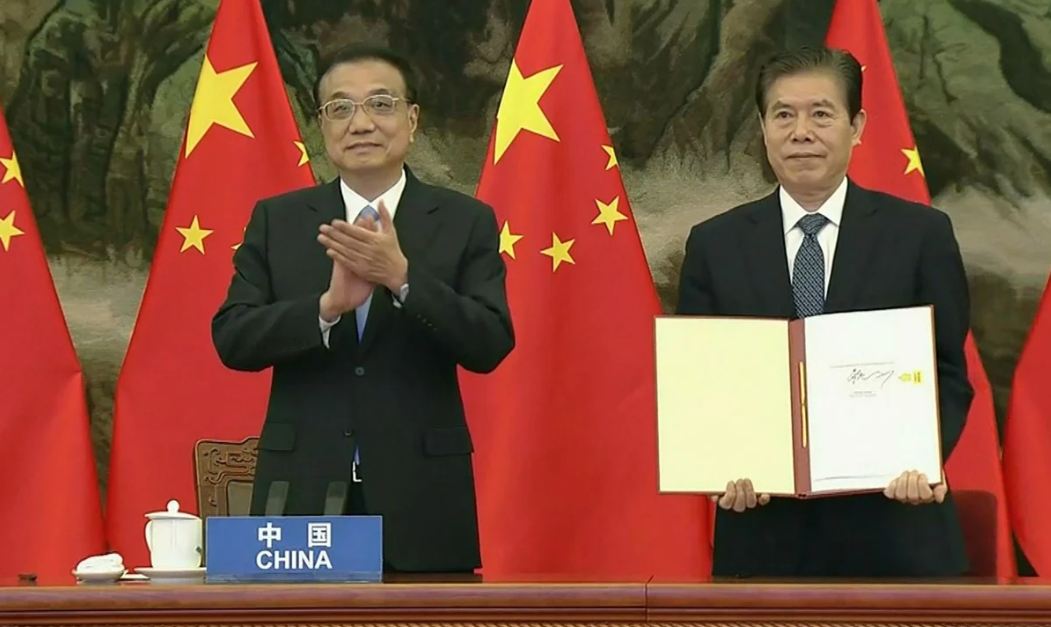
China will intensify domestic efforts forthe Regional Comprehensive Economic Partnership (RCEP) to take effect and getimplemented, so as to uphold free trade and expand win-win cooperation, theState Council executive meeting decided December 2, 2020.. The RCEP, recently inked at the leaders'meetings on East Asian cooperation, is of great significance for participatingcountries to jointly tackle the uncertainties in the international landscape,increase intra-regional trade, stabilize industrial and supply chains, enhancepeople's well-being and facilitate China's high-level opening-up, according tothe meeting chaired by Premier Li Keqiang. "The RCEP, as the world's largest freetrade agreement, brings benefits to all participating countries and serves asthe most effective way to guard against uncertainties," Li said. The meetingrequired competent departments to fulfill due responsibilities in specifyingtask division and time frames in accordance with the agreement, andaccelerating domestic ratification procedures. Openness will be stepped up in areasincluding trade in goods, trade in services, investment and flow of naturalpersons, and higher standards will be applied in terms of trade and investmentliberalization and facilitation, intellectual property rights protection, traderemedy, e-commerce, government procurement, small and medium-sized enterprises,and economic and technical cooperation. As much as 90 percent of intra-regionaltrade in goods will be made tariff free when the agreement get implemented.Policy measures will be swiftly formulated in terms of tariff concessions,simplified custom clearance procedures, technical preparations for rules oforigin and harmonization and mutual recognition of product standards. Customclearance within six hours will be made possible for express delivery andperishable goods. The overall openness of trade in servicespledged in the agreement is significantly higher than that in any otherexisting free trade agreements among the participating countries. Opening-upmeasures in various service sectors will be drafted and implemented step bystep in line with the new commitments, including research and development,management and consulting, manufacturing-related services, elderly careservice, specialized design and construction. A negative list on foreign investment willbe delivered as pledged, and no additional restrictions outside the list shallbe imposed. Comprehensive protection of intellectual property rights, the firstsuch commitment in a free trade agreement, will be fulfilled with copyrights,trademarks, geographical indications, patents, genetic resources fullyincorporated in the scope of protection. Provisions involving electronicauthentication and signature, online personal information protection,cybersecurity and cross-border electronic information transmission will beexecuted. "As a participating country, China must make active efforts forthe agreement to come into effect. This will demonstrate China's support foropenness, multilateralism and free trade," Li said. Rules and regulationsrelated to RCEP implementation will be sorted out expeditiously. The meeting also decided on steps tostrengthen publicity and training for localities, business associations andenterprises to familiarize them with the rules of the agreement, and shapedeeper understanding of the opportunities and challenges brought by opening-upand competition at a larger scale and with higher standards. "China takesthe signing of the RCEP as a major step to further expand opening-up. We willmake all preparations and take concrete actions to deliver on ourcommitments," Li said. After eight years of tough negotiations,November 15 saw a breakthrough for regional cooperation as 15 Asia-Pacificnations signed the biggest free-trade deal in history. Comprising the 10 Aseanmembers, Australia, China, Japan, New Zealand and South Korea, the RegionalComprehensive Economic Partnership (RCEP) will reduce trade barriers across athird of the world’s population and economic output area. Economists at JohnsHopkins University estimate the pact could add US$186 billion to the globaleconomy – a welcome boost as we face the worst recession in a century. Perhaps more significantly, the RCEP willcatalyse Asia’s long-term integration and is a major milestone in the openingup of China, providing a foundation for membership in more advanced tradeagreements such as the Comprehensive and Progressive Agreement for Trans-PacificPartnership (CPTPP). In its 14th five-year plan (2021-2025),China must adapt to a post-pandemic world shaped by economic uncertainty andthe splintering of global value chains. As China’s first multilateral tradedeal – and the first to include Japan and South Korea – the RCEP, which willremove around 90 per cent of tariffs eventually, meshes powerfully with China’sdual circulation strategy, which aims to boost self-sufficiency whilediversifying integration into global markets. In “international circulation” – foreigntrade and investment – the RCEP’s common rules of origin will make cross-bordertrade simpler and cheaper, allowing Chinese firms to optimise resourceallocation between the domestic market and the rest of the region. RCEPmembership will also anchor higher value-added growth points in China asmultinationals shift some production processes to elsewhere in Asia due torising mainland costs and a desire to insulate supply chains from tradefrictions. Links between China and RCEP supply-chainpartners such as Vietnam and Malaysia are already deepening in sectors such aselectronic manufacturing. China’s imports of integrated circuits from theAssociation of Southeast Asian Nations grew by 23.8 per cent in the first halfof this year, while its exports of the same to Asean grew 29.1 per cent. Aseanhas surpassed the European Union to become China’s largest trading partner. The RCEP also dovetails with China’s plansto internationalise the yuan and develop Hainan into the world’s largestfree-trade port. Just as importantly, the RCEP aligns with another core thrustof China’s dual circulation strategy: boosting domestic consumption. The rise of the Chinese consumer is alreadyone of the most promising growth stories for the post-pandemic world. In its14th five-year plan, the Chinese government will further increase consumerspending by raising productivity and wages, strengthening the social safety netand expanding economic opportunities in smaller towns and rural areas. Earlier this month, President Xi Jinpingprojected that China would import US$22 trillion of goods in the next decade.Firms, workers and farmers in RCEP economies are well-placed to tap thisbounty. China’s role as the RCEP’s main magnet forimports will offset its status as an export powerhouse, and help to balancetrade dynamics within the pact. This is important as tensions could emerge ifthe RCEP were to seriously exacerbate trade deficits in member countries – aconcern that saw India drop out of the agreement last year. Over time, cross-border trade andinvestment will expand the synergies between China’s dual circulation strategyand the RCEP, reinforcing the pact’s cohesion and viability as a vehicle fordeeper regional integration. Like fine wine, Asean agreements tend to improvewith time. For China, the RCEP could be a steppingstone for more trade agreements, as the Asia-Pacific becomes a coherent tradingzone like Europe or North America, albeit on a grander scale. For example, theRCEP boosts China’s prospects of sealing the trilateral free-trade agreementwith Japan and South Korea that has been bogged down by spats between Seoul andTokyo. It also weakens obstacles to China joining the CPTPP, an idea gainingtraction among Beijing’s policymakers. Previously, some voices at home had raiseddoubts over China joining the RCEP, let alone the less flexible CPTPP, seen asa forerunner of even higher-standard trade agreements. Success in the RCEP willhelp quell this domestic opposition while reforms take China’s economy closerto CPTPP rules on issues such as intellectual property, market access andforeign investment. The two regional agreements are by no meansmutually exclusive – seven countries are members of both. In fact, they couldform complementary tracks to regional integration: the rigorous CPTPP for moreadvanced economies and the less-demanding RCEP for developing Asian countries.And China could eventually help to bridge the two projects – under the FreeTrade Area of the Asia-Pacific or some other mechanism. Given that US President-elect Joe Biden isopen to renegotiating the pact his predecessor abandoned, the world’s twolargest economies could one day come under its common umbrella of trade rules.Not only would this help to stabilise relations between China and the UnitedStates, it could also provide a template for World Trade Organisation reforms. International trade and cooperation havesuffered in recent years under the weight of populism, protectionism and nowthe pandemic. Encouraging news on vaccine development and Biden’s electionvictory have raised hopes that the world can turn a page in 2021. As a catalystfor Asian integration and China’s continued opening-up, the RCEP is yet anotherreason to be optimistic. RCEP is a symbol of Asian nations comingtogether to take their rightful place among the architects of the globaltrading system of the future, a system they are doing so much to sustain andwhich their growing economic power will continue to define. The fact theagreement brought competitors including China, Japan and South Korea to thesame table confirms that when it comes to free trade, the issues dividing Asiaare less important than those that unite it. India dropped out of negotiations,but it is encouraging that the RCEP partners left the door open for New Delhito join at a later date. Although RCEP has limitations, it is animportant step in the right direction. A 2018 International Monetary Fund paperestimated that getting rid of barriers to trade and foreign direct investmentwithin Asia could boost regional GDP by as much as 15 per cent. Research byHSBC and Boston Consulting Group indicates that if the world embraced theprinciples of open and free trade, it could boost global GDP by US$10 trillionby 2025. Even if RCEP generates only a few percentage points of that, it willhelp put Asia back on its pre-pandemic growth trajectory. Trade in services is likely to play a keyrole in the recovery. Services trade grew 27 per cent faster than merchandisetrade between 2005 and 2018. Covid-19 likely has amplified the shift asinternational services vendors take advantage of the global shift to digitalworking. The partnership will accelerate regionalintegration. Asia is emerging from the pandemic faster and less damaged thanEurope and North America, the traditional markets for much of its trade output.Asian manufacturers are already looking to develop new markets within theregion, and consumers seem to be responding. The new standardisation of rulesof origin will make intraregional trade easier and strengthen Asia’s positionin global supply chains. As local investors search for yields, theyare increasingly looking to benefit from the early economic recovery within theregion. This means the three requirements for self-sustaining Asian growth –consumption, manufacturing and investment – are starting to fall into place. Despite the achievement of the deal,though, we need to see RCEP as a beginning rather than an end. If intra-Asiantrade is to fulfil its long-term potential to improve lives and drive growthwithin the region and beyond, we need to keep building on the foundations ithas laid. There are two areas in particular thatmerit further attention. There needs to be more work on curbing theproliferation of non-tariff barriers. The Association of Southeast AsianNations and other regional groups have made progress in cutting import duties,but in many cases they were replaced by non-tariff barriers such as importquotas, customs inspections or quality controls. The EU-Asean Business Councilestimates there are now some 6,000 separate non-tariff barriers to trade withthe 10 Asean members alone. The second is extending the harmonisationof technical standards and regulations to create a cohesive, borderless digitalecosystem that spans the region. RCEP addresses some of these issues, but ifdigital technology is to achieve its full potential to play a key role indriving the development of new industries and new growth, national standardsneed to converge on a regional standard. Like non-tariff barriers, the differentdigital regulatory regimes across Asia limit the ability of local andmultinational firms to reap the full benefits of economies of scale, weakeningits attraction as an investment destination. RCEP’s signing has accelerated regionalintegration and established a benchmark that will pay lasting dividendsglobally and regionally. We need to build on that momentum, using the habits ofcooperation built during the past nine years to continue the work of tradeliberalisation. |