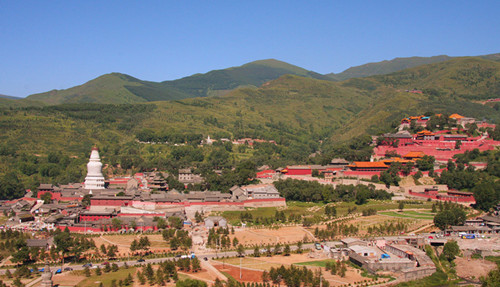
Mount Wutai is in Wutai county, near thecity of Xinzhou in the northeastern part of Shanxi province, 230 kilometersfrom Taiyuan, Shanxi's capital, 78 km from the Wutai county seat, and 150 kmfrom the city of Xinzhou, and is one of China's four sacred Buddhist mountains,the others being Putuo in Zhejiang province, Jiuhua in Anhui, and Emei inSichuan. It was designated a national forest park bythe Agriculture Ministry, in 1992, the first national AAAA tourist attractionsby the National Tourism Administration in January 2001, a national geopark, inSeptember 2005, a national AAAAA tourist attraction by the National TourismAdministration in August 2007, and added to UNESCO's World Heritage List by theWorld Heritage Committee in Seville, Spain, on June 26, 2009. It is also a popular summer resort with thevegetation mainly consisting of grass and meadows, which are excellent pasturesin summer. The average annual temperatures of -4℃. Its hottest periodis July to August, when average temperatures run around 8.5 - 9.5℃. January isthe coldest month, with average temperatures of -18.8℃. Springcomes to the Taihuai area a month earlier than up on the top of the mountains,and autumn a month later. Average annual temperatures in the Taihuai area are 2- 3℃, with the lowest being -30℃ and the highest 30℃, with theclouds comparatively low and full of moisture, and rainy days. BeautifulScenery Mount Wutai is glutted with wonderful peaksand cliffs, including 50 most famous peaks and cliffs. The Writing Cliff willshow seal characters and official scripts when watering the cliff and wipingaway the water with handkerchief. Removing the surface of the rock, the cliffremains to show Chinese characters. The cliff bears Chinese characters at eachlayer, with different characters. According to historical records, the cliffshowed a long couplet reading "The three treasures of Heaven are the sun,moon and stars. The three treasures of the Earth are water, fire and wind. Thethree treasures of man are essence, energy and spirit." Mount Wutai coversan area of 320 square kilometers. It was named after five peaks that resemblefive giant columns rising straight from the ground. The peak tops are plat like platforms.Since the mountain is largely cold in climate, and in midsummer days it remainscool, Mount Wutai is also known as the Cool Mountain. It is a tourismdestination integrating natural scenery, ancient architecture, historical heritage,Buddhism culture, folk customs, and summer resort. In 1982, Mount Wutai, in thename of Mount Wutai scenic spot, was listed by State Council into the firstgroup of national level scenic areas. Over the years, it has been reputed as anational key scenic area, China’s top 10 famous mountains, national geologicalpark, national natural and cultural heritages, national AAAAA tourism scenicspot, and world heritage. Wutai Mountains launched its SpringFestival celebrations program back in 2002. It provides an escape for urbaniteswho want to celebrate the holiday in the traditional ways, according to thescenic area's website. In recent years, hundreds of thousands ofvisitors have spent their Spring Festival holiday at Wutai Mountains annually,which local hotel owner Bian Zhiguo described as "a land enfolded inBuddha's light". The name "Wutai", literallymeaning five terraces, stems from the fact that each of the five mountains thatconstitute Wutai has a flat peak. The North Terrace is the highest of the five,with an altitude of 3,061 meters. The mountains make an ideal habitat forflora and fauna, home to 661 varieties of plants and almost 350 species ofanimals. They include beech martens, leopards, foxes and black-browed reedwarblers, according to the scenic area's website. In summer and autumn, cattle and horses canbe seen grazing on the slopes and terraces. Every year, a fair is heldthroughout the sixth lunar month to trade cattle, horses, mules and donkeys. Wutai is also a rich repository of humanlegacies. For more than 1,600 years, it has been one of the most importantBuddhist sites in China. The attraction receives some 3 million visits everyyear. Visitors get to see more than 30,000Buddhist figures at Wutai, either carved, cast, painted or embroidered. The East Hall of Foguang Temple houseslife-size clay Buddha sculptures. Shuxiang Temple features an overwhelmingcomplex of 500 colorful statues protruding from the walls, silently tellingBuddhist stories. A whole ensemble of stelae, plaques,couplets and poems catalogs the Buddhist tradition at Wutai Mountains. Among the authors, Emperor Kangxi duringthe Qing Dynasty (1644-1911) wrote 20 inscriptions. His grandson, EmperorQianlong, composed 39 poems. The imperial patronage also reflects theimportance of Wutai Mountains as a cultural and religious site. A famous Buddhist mountain Mount Wutai is one of the four famousBuddhist mountains in China, along with Mount Putuo in Zhejiang province, MountEmei in Sichuan province and Mount Jiuhua in Anhui province. Manjusri is one of the four Bodhisattva inChina and is allegedly the teacher of seven Buddha and all Bodhisattva.Manjusri has rich, profound and pithy ideas and the power to eliminate demonsand save people from trouble. The Buddhavatamsaka-Mahavaipulya-Sutra (oneof the most influential Mahayana sutras of East Asian Buddhism) from theEastern Jin Dynasty (317–420) recorded that many Buddha stopped at QingliangMountain, where Manjusri gave lectures to them. Buddhists in China never doubtSakyamuni's words and believe that Manjusri lives at Qingliang Mountain. Theybelieve that Mount Wutai is the modern incarnation of Qingliang Mountain due toits cold climate and early temple relics. Ancient Indians called China"Zhenna" which was interpreted as Zhendan in Buddhist classics.Buddhists believed that Mount Wutai was situated in Northeast China, provingthat Wutai was Manjusri's ashram (a spiritual monastery). With the spread ofthe sutra, all Buddhists in China grew to respect Manjusri in Mount Wutai. Emperor Taizong of the Tang Dynasty(618–907) approved Amoghavajra, an Indian Buddhist, to present ideas to him. Healso gave the seat of honor to Manjusri at temples nationwide. Li alsoappointed Samantabhadra and Avalokitesvara as Manjusri's servants, elevatingManjusri above all Bodhisattva. At the same time, Amoghavajra asked the royalcourt to build Jin'ge Temple at Mount Wutai, sending disciples to supervise theconstruction. Amoghavajra also asked to establish Manjusri halls and statues atfamous temples nationwide as braches of Mount Wutai Manjusri ashram, creating anetwork of temples centered on where Mount Wutai was formed to promote theManjusri belief system to the rest of the country and establish Wutai as thebirthplace of Manjusri belief. Mount Wutai was officially named Manjusriashram in 787. The Manjusri belief system developed after the Tang and Songdynasties. Wutai's Manjusri ashram became a national Buddhist temple for lamasin China. Emperors, royal officials, scholars, pilgrims, and devout men andwomen all developed their belief in Manjusri. Mount Wutai thus has become apopular holy place for Buddhists. People come here to seek protection andblessings. People have built many temples and palacesin honor of Manjusri at Mount Wutai, such as the Bodhisattva Palace at the topof the mountain and Shuxiang and Manjusri temples. Most of the temples haveManjusri palaces, their size even exceeding that of the great Buddha’s hall. Manjusri belief is a folk form of Buddhism,just like Maitreya and the Goddess of Mercy. It consists of many myths andlegends. There are dozens of relics at Mount Wutai that bear many beautiful storiesabout Manjusri. Overall, Buddhists believe that everything in Manjusri's goldenholy world was created by Manjusri. With increasing numbers of foreignBuddhists coming to Mount Wutai to pay their respects and conduct culturalexchange, the Manjusri belief system also spread to Sri Lanka, India, Nepal,the ROK, Japan, Hong Kong, the US and Thailand. The Japanese Buddhist Enninestablished a Manjusri building and statue at Mount Hiei in the fashion of theManjusri hall at Mount Wutai's Huayan Temple after he returned from China inthe Tang Dynasty. Another Japanese Buddhist named Mount Atago changed the nameof Sakya hall into Qingliang Temple after visiting Mount Wutai, hanging atablet inscribed with the new name on the gate. Even today, the temple stillpreserves the statue of Manjusri riding an animal during the 10th and 11thcentury. In addition, many Manjusri statues have been preserved at differenttemples across Japan. According to recent statistics, there are a total of 19Manjusri cultural relics that are perfectly preserved in Japan. In winter, Wutai Mountains is more thanjust a sight for sore eyes. During the weeklong Spring Festival holiday, thescenic area will put on Buddhist Music performances each day at Pusading Templeand Shuxiang Temple. Monks will perform Buddhist tunes using more than 10musical instruments including flutes and drums. The Buddhist Music of Wutai, listed amongnational-level intangible cultural heritage, has a long history. It is passeddown orally and incorporates musical pieces popular in different periods sincethe Tang Dynasty (618-907), according to a website run by China's intangibleheritage protection center. |