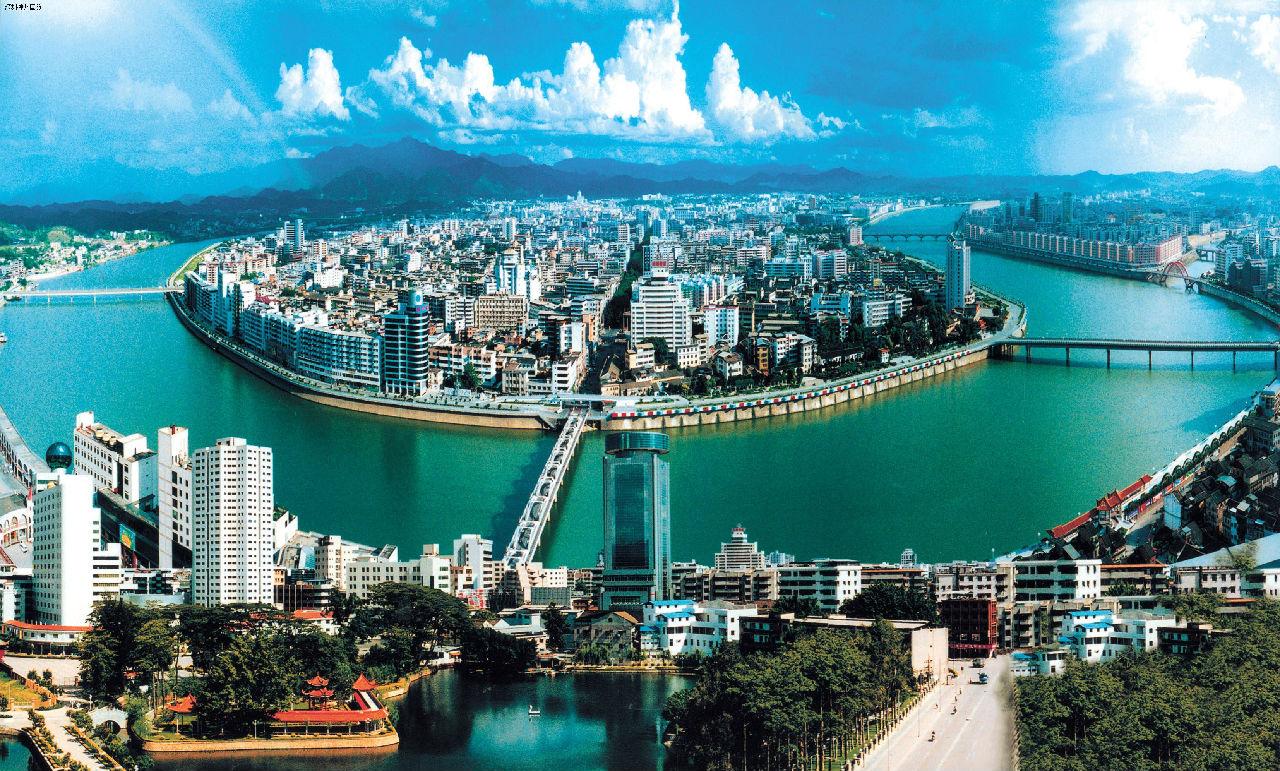
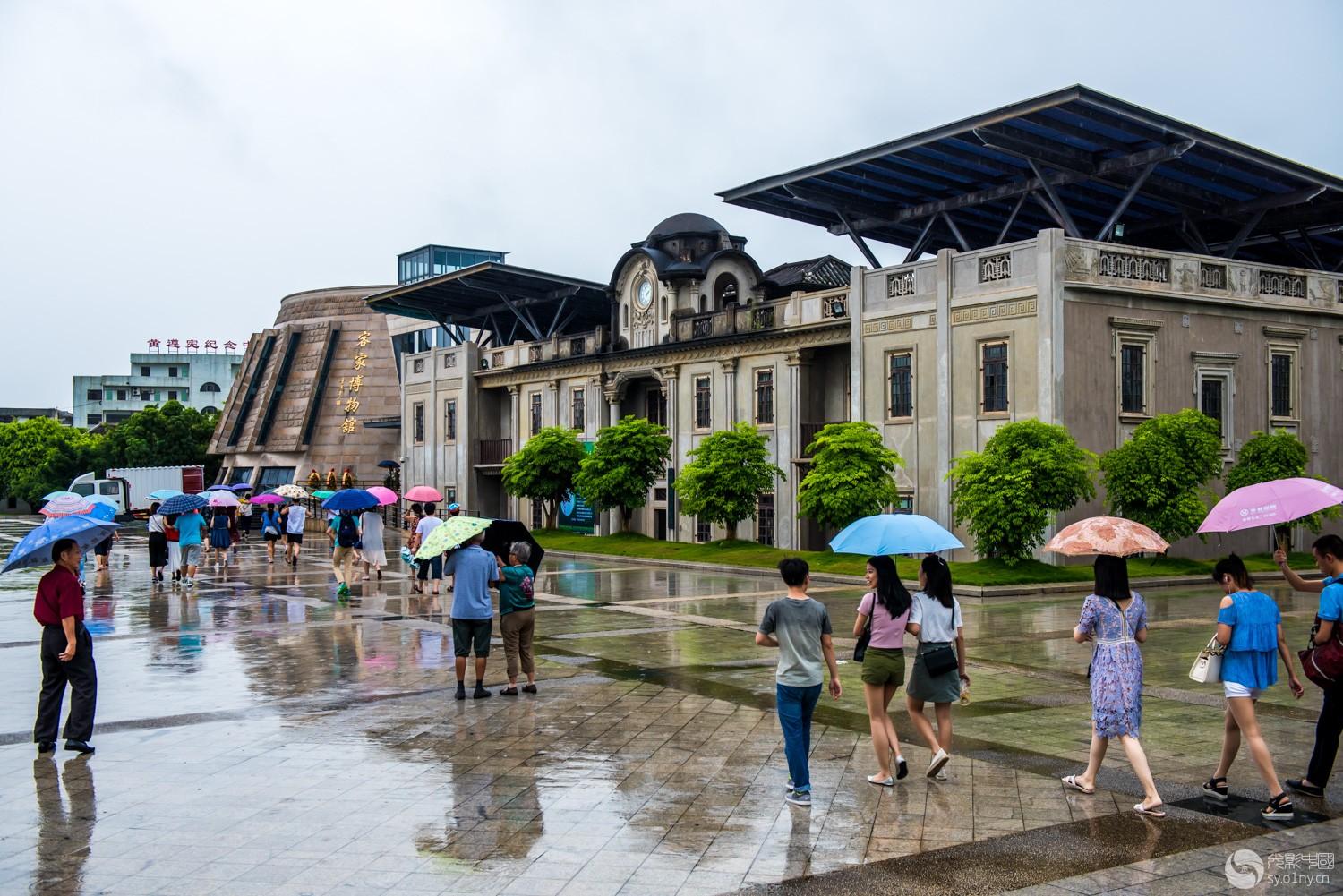
Meizhou City is situated in the northeastof Guangdong Province, at the juncture of Guangdong, Fujian and Jiangxiprovinces. It is about 380 kilometers (236 miles) from Guangzhou, 345kilometers (214 miles) from Shenzhen and 190 kilometers (118 miles) fromShantou. Meizhou is one of the main settlements of Hakka people, developing time-honoredHakka traditional culture and buildings. It has more than 20,000 completepreserved Hakka Semi-Circular Round Houses which are called one of the fivecharacteristic buildings of Chinese folk houses. Hakka folk songs and GuangdongHan opera are widely spread here. Visitors can also taste the salt and greasyHakka delicacies. HakkaMuseum of China Located in Meizhou, Guangdong, the HakkaMuseum of China is the only museum focusing on the collecting, studying,showing and inheritance of Hakka culture, and the only museum themed on anethnic culture in China. It is composed of a main hall and several surroundingbranch halls, such as Huanzuixian Memorial Hall, Meizhou Chancellors Hall andMeizhou Generals Hall. As the main immigrant group of the Hanpeople in South China, the Hakka contributed much in developing the region. InChinese, Hakka refers to guest, which shows that they are not native-born. As asaying goes, there is sunlight, there are Chinese; there are Chinese, there areHakka. They are also named 'Oriental Jewry' because of their excellent businesstalent. When you walk into the main hall of theHakka Museum of China, the first thing that captures your eyes is a big Chinesecharacter carved on a white granite wall. Actually, it's a special word withthe meaning of 'me' in Hakka culture, and it's also the one being used mostfrequently by the Hakka. Walking deeper into the main hall of theChina Hakka Museum, you will enjoy the five exhibition rooms representing thefive different time periods of the Hakka. The first one is 'Where the Hakkacame from'. In there, the history of the Hakka appears before your eyes. It canbe traced back to 319 AD. Then, they went through five great migrations. Inaddition, there are some interesting Hakka sayings shown inside, like 'the onewho pretends to understand will never understand'. The next exhibition room is about 'HakkaCustoms', showing many Hakka tools, clothes and other household wares. Somefolk scenes are recreated with the special furniture and building models. The third is 'the Landmark - Hakka RoundHouse'. Round House, also named Round-Dragon House, is a representativebuilding of the Hakka. Normally, it's built with a half-moon pool right beforethe house, making the whole an eight-diagram-shaped appetizer. A big RoundDragon model is put in the third room of the Hakka Museum of China, showing thegreat wisdom of the Hakka. Stepping into the following room -'Humanity and Culture of the Hakka', you can see the status of an old man andseveral students inside. One of the students is reciting the articles, and theold man is listening carefully with his head raised gently. The last room of the Hakka Museum of Chinais the most exciting part, describing the extraordinary Hakka people in historyand the hopes of the Hakka in the future. Huanzuixian Memorial Hall is built in honorof a famous Hakka, Huanzuixian. He was a great pioneer of Chinese reformation,an enlightenment thinker and patriotic poet. Inside the hall shows his deedsand collected books. The building also shows the Hakka's life style in the lateQing Dynasty (1644-1911). Meizhou Chancellors Hall is a traditionalHakka building built in 1940s. Inside it stores the deeds and achievements of228 Meizhou chancellors at home and abroad. The most famous one is Ye Jianying,not only a chancellor but also a famous Chinese marshal. Meizhou Generals Hall is anotherHakka-style building, showing all Hakka generals' achievements since 1911. Atotal of 13 exhibition rooms show the 545 generals, including those whocontributed much during the Sino-Japanese War, the Long March and contemporaryera. LianfangTower Lianfang Tower (Huaqiao Weiwu) is a folkdwelling which perfectly combines the traditional Hakka architecture withwestern buildings. It is located in Baigong Town, Meizhou City - a famoushometown of overseas Chinese. This building was built by overseas Chinese inthe late Qing Dynasty (1644-1911) and finished in 1934. Covering an area of about 0.3 hectare (0.74acre), it is about 100 meters (328 feet) long and 40 to 50 meters (131 to 164feet) wide. The 15-meter (49 feet) high structure above the front door took theshape of a bell tower, and the whole architecture looks like a magnificentcastle. The outer wall of Lianfang Tower was designed to be the western styleand the building is characterized by vivid and beautiful embossments of tigers,leopards and deer. The two-story brick structure has a main gate and two sidedoors; all of the gates, windows and walls were engraved with exquisitecarvings of animals, flowers and plants. Lianfang Tower can be reputed as the mostluxurious Weiwu, and to a certain degree, it is more like a museum of Chineseand western folk art. The imposing tower consists of over 100 rooms, which areperfectly constructed according to the structure of Weiwu, or "RoundHouse". Weiwu, a traditionalbesieged tower, is a kind of vernacular dwelling of the Hakkas inhabited by thewhole clan. The Weiwu of Meizhou City is considered as one of the five mostdistinctive folk dwelling houses of China along with Beijing's Courtyard andShaanxi's Cave Dwellings. Weiwu is always constructed into a square or acircular form, resembling a castle which surrounds the main residentialbuildings. Seen from a lower place, the Weiwu arose in folds, looking like agigantic dragon entwining in hillside. Therefore, Weiwu is also called 'RoundDragon House'. The Weiwu of Meizhou City is highly artistic with unique design,delicate constructions and fine decorations and paintings. Lianfang Tower serves as an elaborate workof architecture in the 1930s since the interior decorations are of highartistic workmanship. The various grand pillars, staircase and the corners ofeach room are painted with flowers, birds, dragons and phoenixes, and the giltwindows are all richly carved. The halls are separated from each other bywell-engraved Chinese screens. The spacious balcony in the center of theconstruction commands a fine view of the Lianfang Tower and the Baigong Town. YinnaMountain Marked by lofty mountains, majestic peaks,rare stones, emerald like waterfalls and drifting clouds, Yinna Mountain isconsidered as one of the three most famous mountains of Guangdong Province. Itis located in Yanyang Town, about 46 kilometers (29 miles) from downtownMeizhou. It has five main peaks that stand together, resembling five fingerssurrounded by dense mist surging up from below, with clouds wafting in the air.
Lingguang Temple otherwise known as theTemple of Divine Light sits at the foot of the Yinna Mountain. Reputed as oneof the four notable temples of Guangdong, Lingguang Temple has been inexistence for more than 1,200 years, having been built during the Tang Dynasty(618-907). In 1385 of the Ming Dynasty (1368-1644), the temple was enlarged andgot its present name. This majestic temple contains Buddhist buildings,including the Grand Hall, Arhat Hall, Kwan-yin Hall, the bell tower, the drumtower, and other subsidiary structures. Considered as a unique work, thearchitectural skill of the temple is rather distinctive. The Grand Hall has aspecial sunken panel, called a caisson used as a ceiling in traditional Chinesebuildings. It is spiral in form and is made of over 1,000 rectangular boards,taking the shape of a pineapple. It is more than three meters (9.8 feet) highwith a conical roof and an octagonally shaped base, looking much like a smallpagoda. What is a marvelous is that though the temple is a busy gathering placeof worship for Buddhists, there is no lingering incense in the hall. It is saidthat the incense spiraled up and out of the hall through the spiral caisson.This unparalleled caisson is rare in China and is considered to be anoutstanding masterpiece in the architectural field. Two ancient trees stands in front of thetemple are also an added mystery. For over 1,600 years, one tree stillflourishes with luxurious branches and prosperous leaves while the other treewhich has been dead for nearly 400 years is still as big as first tree. Moving onwards from the Lingguang Temple,you will reach the highest peak with an elevation of 1,297 meters (4,255 feet).A building has been constructed here, to provide an excellent place forwatching the fascinating sea of clouds. If you arrive here before dawn, youwill see and marvel at the spectacular view of the sunrise. YearningTea Plantation Tourist Attraction Yearning Tea Plantation Tourist Attraction,reputed as "Green Pearl", is a tourism resort in Meizhou, GuangdongProvince, featuring large tea fields and abundant natural resources. Touristscan experience the culture and customs of the local Hakka people there. What’smore, there are 16 elegant villas in the holiday village for tourists to stayovernight. Yearning Magic Stone is the first scenicspot you will encounter after entering the tourism resort and a landmark of thetea plantation, on which are carved a few words “Yearning, Emotions in thetea”. Yearning is Hakka’s longing of the north, from which they moved.“Emotions in the tea” shows that people make friends by drinking tea togetherand express feelings by making tea for others. This is one of the main roads insideYearning Tea Plantation Tourist Attraction. Banyan trees and flame-trees growat two sides of the avenue. Beneath the trees there are many seasonal flowersand big or small stones. All of these have formed a scene which makes you feellike you are in the paradise. Walking forward along Yearning Avenue, youwill reach the Tourist Centre and Tea Pavilion, a place for tourists toconsult, have a rest, taste the tea for free and buy Yearning tea and Hakkaspecialties. Because of the pollution-free natural environment, good varietiesand advanced process technology, ten different fragrant and tasty teas havebeen planted and processed in the plantation and they can all be bought her As you keep walking, Kungfu Tea Art Showwill draw your attention. It consists of traditional Kungfu Tea and modernKungfu Tea art shows. The steeping and drinking procedure has 18 steps. Thefirst 12 steps are for the Tea Art girls to perform the steeping procedure andthe last 6 steps are for you to taste, through which you can know better aboutthe tea. The Legendary Swordsman Waterfall is 550feet (168 meters) long and 16 feet (4.8 meters) high, located in the east endof Yearning Avenue. The stone tablet under the falls is carved with lots ofwell-known mottos from different celebrities. The ecological valley provides naturaloxygen-richair and has dense primary and secondary forest. Located to themiddle east of the whole scenic area, it is home to a protectedplant---spinulose tree fern and protected animals of Longna Mountain. Fairy Tea Pavilion is also a place to offerfree tea and for tourists to rest. The main construction material is bamboowhich is in coordination with Longna Mountain’s natural landscape. It sits tothe east of Longna Mountain Ecological Valley. |