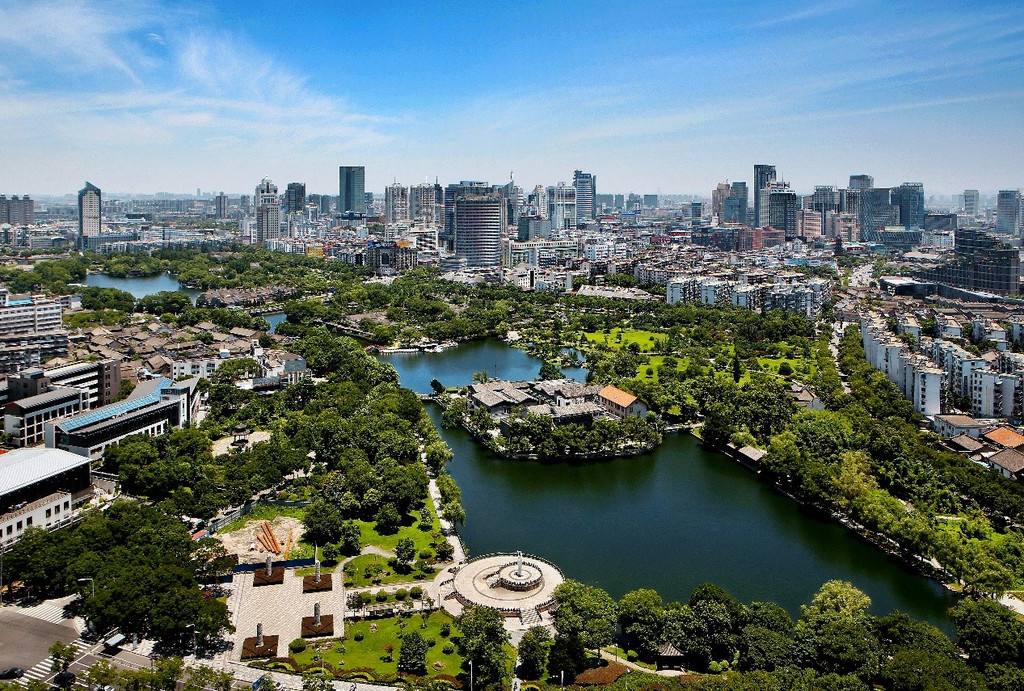
With an area of 9,365 square kilometers (3,616 square miles), Ningbo is located east of Zhejiang Province and south of the Yangtze River Delta with Hangzhou Bay to the north, Shaoxing to the west, Taizhou to the south and Zhoushan to the north-east. It is very rich in natural scenery and cultural heritages owing to its unique geographical position and historical reasons, and it’s one of the famous historical and cultural cities in China. With a long history of over 7,000 years, Ningbo is the cradle of Hemudu Culture in history, which served as one of the starting points of the Marine Silk Road along with Guangzhou during the Tang Dynasty (618-907), and it was listed as one of the three trading ports along with Guangzhou and Quanzhou during the Song Dynasty (960-1279). Ningbo was one of the five trading ports along with Guangzhou, Shanghai, Fuzhou and Xiamen after the Opium War. Now Ningbo Port has become an important part of the Shanghai International Shipping Center. Ningbo is also a famous overseas Chinese hometown in China, as over 300,000 people who were born in Ningbo now live in more than 50 countries of the world.
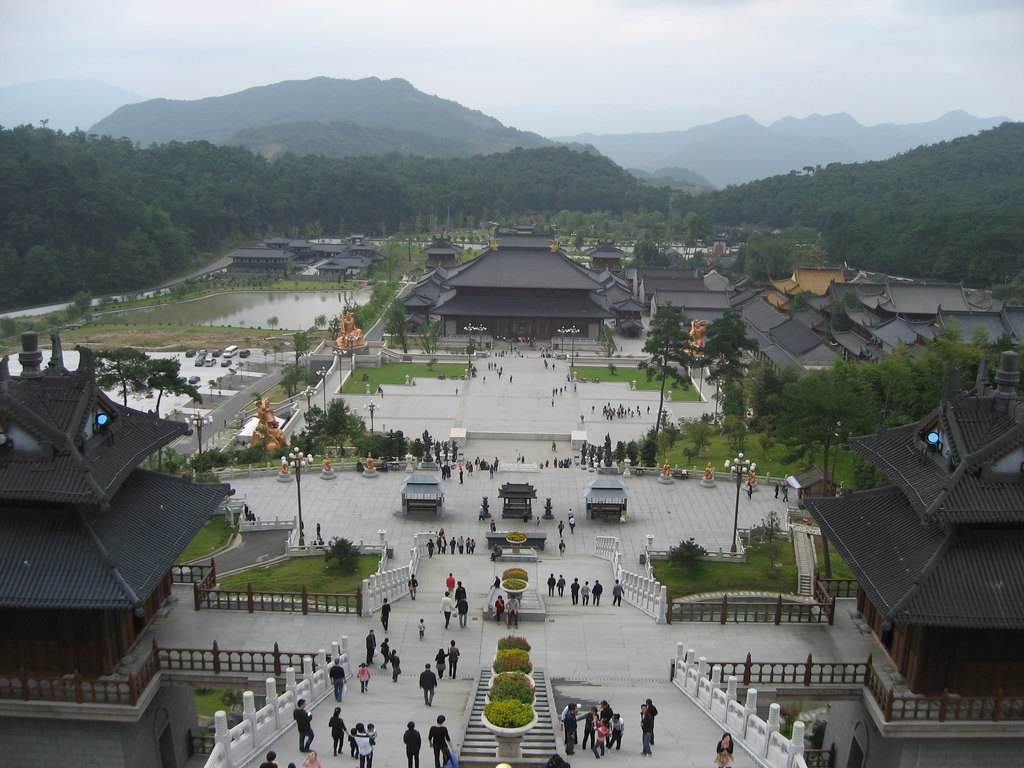
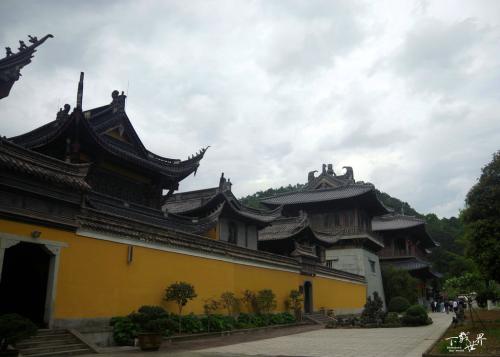
Xuedou Mountain in Xikou Xikou Town, Fenghua City of Zhejiang Province, Xuedou Mountain is 800 meters above sea level. The mountain has a milky peak, while on the peak there is a dou (meaning hollow or hole). Water flows out of the dou, and it is as white as milk, thus getting the name of the Milk Spring. Dou is also called Xuedou. As a result, the mountain got its name of Xuedou Mountain. The mountain has a total landscape area of 85 square kilometers and more than 60 attractions, among which Miaogao Platform and Qianzhang Rock are the most attractive ones. Xuedou Temple was originally founded in the Tang Dynasty. For thousands of years, it has been visited by many people, and has produced numerous eminent monks. It has a high status and is regarded by the Buddhist circle in China as one of the world’s ten most famous Buddhist temples together with the other nine temples, such as Zhongtian, Zhutianning, Wanshou, the Yongzuo Temple of Hangzhou, and the Jiangshan Taiping Xingguo Temple of Nanjing. During the Tang and Song dynasties, Xuedou Temple had received 41 imperial edicts from emperors of several generations. So far, the temple has stored 5,760 Confucian classics granted by emperors, jade seals, dragon robes, dragon pots and jade Buddhas. In the temple, the constructions are magnificent and attractive. Outside the temple, ancient trees are towering up into the sky. Among them, two ginkgo trees from the Han Dynasty can be surrounded by about five people. With exuberant leaves, the ginkgoes rise above the clouds. In front of Xuedou Temple, there is a waterfall called Xuedou Waterfall, also known as Qianzhang Rock Waterfall. The water head is in the valleys at the south and the north of Xuedou Temple. The water of the Milk Spring flows into Jinjing Pool (which is an ancient pool developed in the Southern Song Dynasty), crossing Guanshan Bridge and pouring out of the cliff mouth. The waterfall pours down from Qianzhang Rock. From the top of the rock to the pool, it is as high as 186 meters. At the half-way point, there is a huge rock. In spring and autumn, the rain falls down in a deluge but it runs into the rock at the half-way point and splashes in all directions right away. It falls like pearls and jades, and also dances like snow. Under the sunlight, it forms a rainbow, which is quite splendid. Xuedou Waterfall was well known by the whole nation as early as in the Northern Song Dynasty. Sanyin Pond Waterfall is situated at 5 li north-west of Xuedou Temple. The water flows from Dongao Village (on Xuedou Mountain, there is a village of alpine flowers. With a beautiful and clean environment, the village is an ocean of flowers and seedlings) to the cliff mouth, forming one waterfall; it continues running down the mountainside to the foot, forming three waterfalls. As a result, it is called Sanyin Pond. With a length of more than 1,600 meters, the pond can be divided into Shangyin Pond, Zhongyin Pond and Xiayin Pond respectively from the highest to the lowest. Shangyin Pond is highlighted by its quietness and danger; Zhongyin Pond stands out for its delicacy and cleanness; Xiayin Pond is well known for its superb beauty. Despite the positions of the three ponds in remote mountains and deep valleys and the difficulty of visiting them, tourists still visit in great numbers. Miaogao Platform is also known as Miaogao Peak or Tianzhu Peak. It is the main scenic spot of the Xuedou landscapes. Although it is only 396 meters above sea level, it stands out against the mountain behind it. With the middle part bulging, three steep cliffs, and a gaping abyss down its side, the platform has a precipitous terrain. In a narrow sense, Miaogao Platform refers to a platform of about 350 square meters. Standing at the front edge, you can look out on the natural sceneries of Tingxia Lake. On the periphery of Miaogao Platform, ancient trees and green bamboos are thriving so much that they keep the sunlight away. In addition, the clear breeze blows gently. It is an ideal summer resort. Located at the south of Xuedou, Tingxia Lake is 6 kilometers away from Xikou Town. It is a large artificial lake, with a surface area of 5.9 square kilometers, an equivalent of West Lake in Hangzhou. The water storage capacity is as much as 153 million cubic meters. Tingxia Lake is a good place to enjoy the landscapes of lakes, mountains, steep peaks and deep valleys. Tingxia Lake is a huge reservoir famous for its position under Yushu Pavilion of Xuedou Mountain and its location at Tingxia Village. Tingxia Lake has wonderful natural sceneries. On the basis of unique peaks, deep valleys, high mountains and water scenes, interesting and attractive landscapes of lakes and mountains come into being. With clean air and high quality water, the scenic spot is also rich in fish, fruit and forest resources. Tourists can sail on the lake, and can also go fishing, picnicking and camping. Liangzhu Culture Park The story of Liang and Zhu is one of the four folklores in our country, which people have been taking delight in talking about and has a reputation at home and abroad. In Korea, Japan and the continent of Europe and America, the story of Liang and Zhu is reputed as the oriental version of the famous play “Romeo and Juliet”. The temple of Liang Shanbo, which was built in 397, has a history of more than 1600 years. Over the years of instability, the temple experienced rise and fall. With the temple of Liang Shanbo as the main body and the story of Liang-Zhu as the main clue, the park is composed of a good many scenic spots, including Kwan-yin Hall, Spouse Bridge, Conjugal Love Pavilion, Lotus Pond, Nine Dragon Pool, Dragon Valvule Pavilion, Bailing (One Hundred Year Old) Road, the Statue of Liang and Zhu Transformed into Butterflies, the Large-scale Fountain Square, Wansong (Ten Thousand Pines) College and Sacred Gentleman Liang’s Temple. The legend of Liang and Zhu is a beautiful, doleful, and moving love story. In the East Jin Dynasty, in the village of Zhu family in the county of Shangyu in Zhejiang Province, on the bank of the Yushui (Jade Water) River, there was Yuanwai (a minister appointed outside of the usual structure of official posts) Zhu who had a daughter called Yingtai. The girl was beautiful and intelligent. She learned to write poems from her brother since a child. Envying the scholarship of Ban Zhao and Cai Wenji, and regretting lack of excellent masters at home, she was intent on visiting masters and pursuing studies in Hangzhou. Yuanwai Zhu rejected his daughter’s request, but Zhu Yingtai, who was hungry for study, dressed herself like a man. Her father saw his daughter in men’s clothes without any flaw and had no choice but consented with disinclination as he couldn’t bear to disappoint her. Yingtai was dressed up like a man and went a long way to Hangzhou for study. On her way, she was encountered with Liang Shanbo, a scholar from Kuaiji (now Shaoxing) who also went to Hangzhou for study. They felt like old friends at the first meeting and had a happy time studying together. Therefore, they gathered some soil as incense and took vows of brotherhood in the pavilion of a thatched bridge. In less than a day, they two arrived at the Wansong College of the city of Hangzhou, and learnt from masters. Hence, they read in inseparable companion. They had been classmates for three years with ocean deep love. Yingtai was in deep love with Shanbo, but Shanbo didn’t know she was a female all along, and therefore he only thought of brotherhood without special feelings. The father of Zhu missed his daughter and urged her return anxiously. Hence, Yingtai had no choice but came back to her home in a rush. The Liang and Zhu parted reluctantly. On the way of Shanbo’s seeing Yingtai off for eighteen miles, Yingtai expressed her love constantly in an explicit way with the aid of objects. Shanbo was true and simple, thus not being able to understand this. Yingtai had no choice but lie that she had a sister called “Jiumei” back at home, who looked very much like herself, and she was willing to promote a marriage for Shanbo. However, Shanbo was from a poor family and didn’t arrive as scheduled. When Shanbo went to Zhu’s house to propose a marriage, Yingtai’s father had married her to Ma Wencai, who was the son of a procurator living in Mao City (now Yin County). A perfect union had become a shadow. They two met at platform, gazed at each others’ tearful eyes and bid farewell to each other sadly. When they parted, they took a vow: even if they can’t sleep in one bed, they want to be buried in one grave! Later Liang Shanbo was appointed as the magistrate of Yin County by the Court. However, Shanbo was so depressed as to become ill and died soon. His dead body was buried in the Nine Dragon Ruins of Mao City. When Yingtai heard of Shanbo’s death, she swore to sacrifice her life. When Yingtai was forced to get married, she made a detour to hold a memorial ceremony in front of Shanbo’s grave. Under the influence of Yingtai’s lamentation, it stormed, thundered and lightened, and the grave burst. At that time, Yingtai jumped into the grave trippingly and the grave was folded again. The wind and rain stopped with a rainbow hanging high up in the sky. Liang and Zhu turned into butterflies and flied trippingly in the world. |