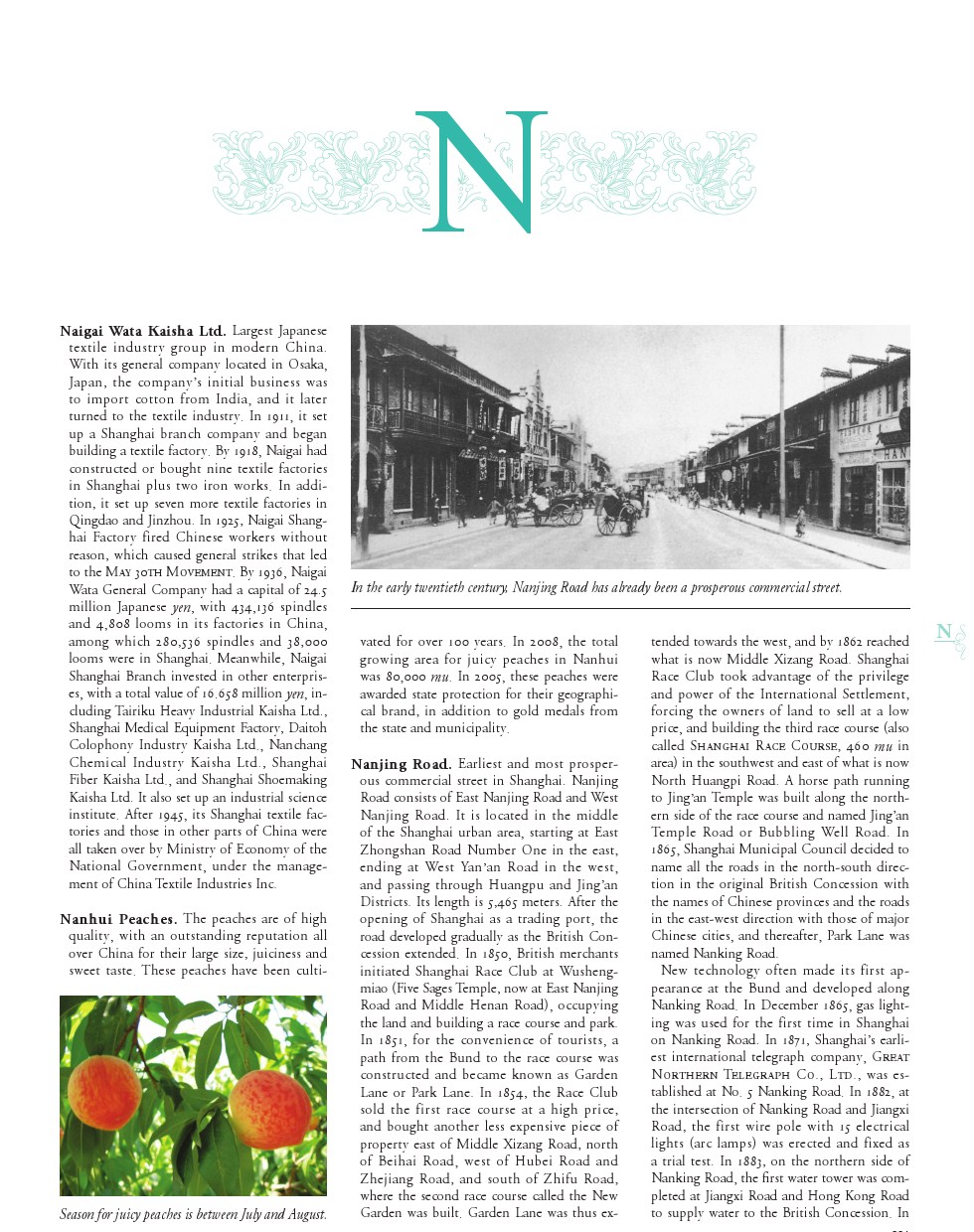
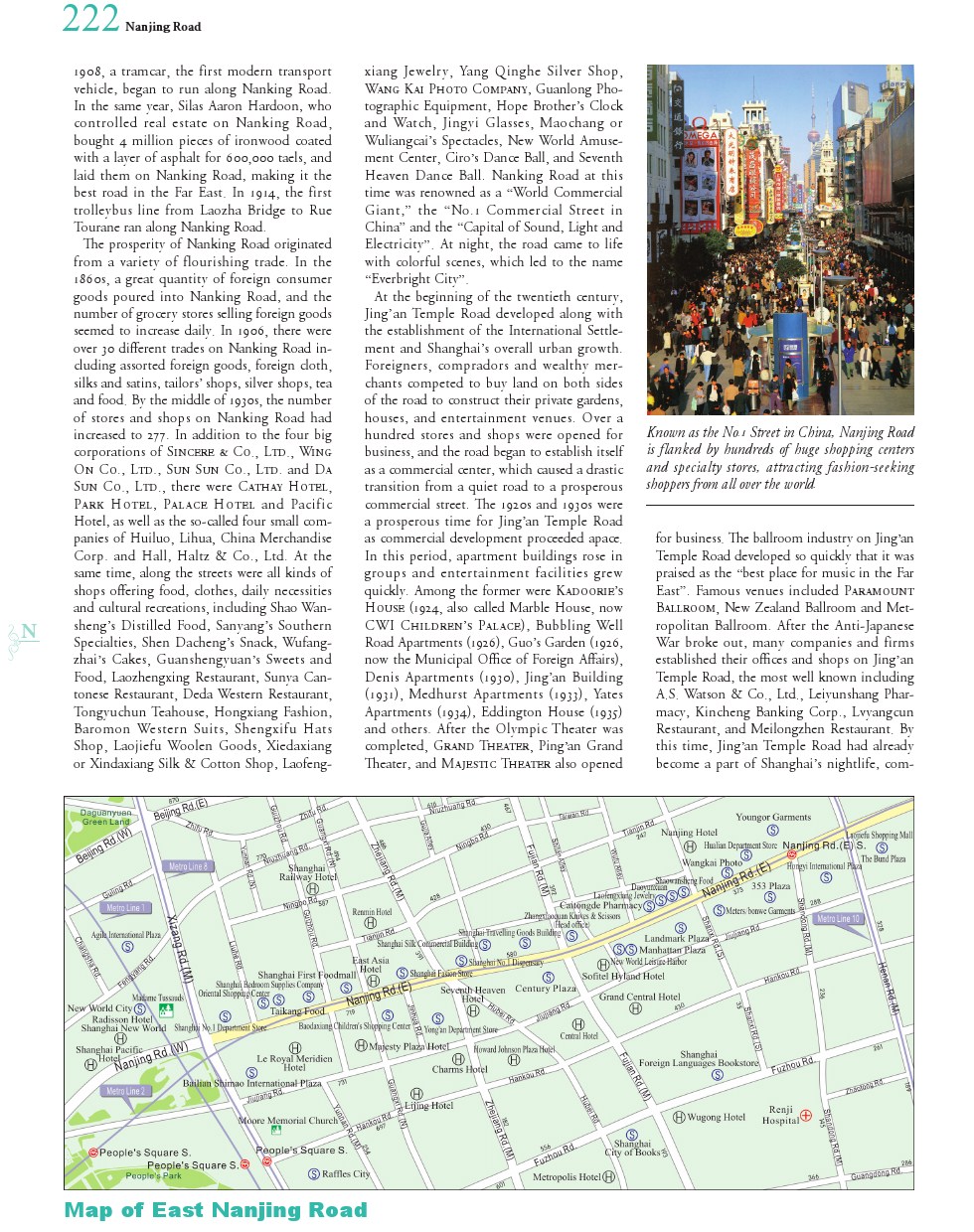
Nanjing Road is the earliest and mostprosperous commercial street in Shanghai. It consists of East Nanjing Road andWest Nanjing Road. Nanjing Road is located in the centre of the Shanghai urbanarea, extending from East Zhongshan Road in the east to West Yan'an Road in thewest, and passing through Huangpu and Jing'an Districts with a length of 5,465meters. After the opening of Shanghai as a tradingport, the road developed gradually as the British Concession expanded. In 1850,British merchants established Shanghai Race Club at the intersection of EastNanjing Road and Middle Henan Road. In 1851, for the convenience of tourists, apath from the Bund to the race course was constructed and became known asGarden Lane or Park Lane. In 1854, the Race Club sold the first race course ata high price, and bought another less expensive piece of property east ofMiddle Xizang Road, north of Beihai Road, west of Hubei Road and Zhejiang Road,and south of Fuzhou Road, where the second race course called the New Gardenwas built. Garden Lane was thus extended towards thewest, and by 1862 reached what is now Middle Xizang Road. Shanghai Race Clubtook advantage of the privilege and power of the international settlement,forcing the owners of land to sell at a low price, and building the third racecourse (also called Shanghai Race Course, 460 MU in area) in the southwest andeast of what is now North Huangpi Road. A horse path running to Jing'an Templewas built along the northern side of the race course and named Jing’an TempleRoad or Bubbling Well Road. In 1865, Shanghai Municipal Council decided to nameall the roads in the north-south direction in the original British Concessionwith the names of Chinese provinces and the roads in the east-west directionwith those of major Chinese cities, and thereafter, Park Lane was named NanjingRoad. New technology often made its firstappearance at the Bund and developed along Nanjing Road. In December 1865, gaslighting was used for the first time in Shanghai on Nanjing Road. In 1871,Shanghai's earliest international telegraph company, Great Northern TelegraphCo; Ltd. was established at No.5 Nanjing Road. In 1882, at the intersection ofNanjing Road and Jiangxi Road, the first wire pole with 15 electrical lightswas erected and fixed as a trial test. In 1883, on the northern side of NanjingRoad, the first water tower was completed at Jiangxi Road and Hong Kong Road tosupply tap water to the British Concession. In 1908, a tramcar, the first moderntransport vehicle, began to run along Nanjing Road. In the same year, SilasAaron Hardoon, who controlled real estate on Nanjing Road, bought 4 millionpieces of ironwood coated with a layer of asphalt and laid them on NanjingRoad, making it the best road in the Far East. In 1914, the first trolleybusline ran along Nanjing Road. The prosperity of Nanjing Road originatedfrom a variety of flourishing trade. In the I860s, a great quantity of foreignconsumer goods poured into Nanjing Road, and the number of grocery storesselling foreign goods seemed to increase daily. In 1906, there were over 30 differenttrades on Nanjing Road including assorted foreign goods, foreign cloth, silksand satins, tailors' shops, silver shops, tea and food. By the middle of 1930s,the number of stores and shops on Nanjing Road had increased to 277. Inaddition, there were famous hotels like Cathay Hotel, Park Hotel, Palace Hoteland Pacific Hotel. At the same time, along the streets wereall kinds of shops offering food, clothes, daily necessities and culturalrecreations, including Shao Wansheng's Distilled Food, Sanyang's Specialties,Shen Dacheng's Snack, Wu Fangzhai's Rice Dumpling, Guan Shengyuan's Sweets andFood, Laojiefu’s Woolen Goods, Xindaxiang Silk Shop, Laofeng-xiang Jewelry,Wang Kai Photo Company, Guanlong Photographic Equipment, Ho, Brother's Clockand Watch, Jingyi Glasses, Maochang Spectacles, New World Amusement Center,Ciro's Dance Ball, and Seventh Heaven Dance Hall. Nanjing Road at that time was renowned as a"World Commercial Giant," the "No.1 Commercial Street inChina" and the "Capital of Sound, Light and Electricity". Atnight, the road came to life with colorful scenes, which led to the nickname,the "Everbright City". At the beginning of the twentieth century,Jing'an Temple Road developed along with the establishment of the InternationalSettlement and Shanghai's overall urban growth. Foreigners and wealthymerchants competed to buy land on both sides of the road to construct theirprivate gardens, houses, and entertainment venues. Over a hundred stores andshops were opened for business, and the road began to establish itself as acommercial center, which caused a drastic transition from a quiet road to aprosperous commercial street. The 1920s and 1930s were a prosperous timefor Jing’an Temple Road as commercial development proceeded rapidly. In thisperiod, apartment buildings rose in groups and entertainment facilities grewquickly. Among the former were Kadoorie House(1924, also called Marble House,now CWI Children’s Palace), Bubbling Well Road Apartments (1926), Guo's Garden(1926, now the Municipal Office of Foreign Affairs), Denis Apartments (1930),Jing, Building (1931), Medhurst Apartments (1931), Yates Apartments (1934), MdingtonHouse (1939) and others. After the Olympic Theater was completed, GrandTheater, Ping'an Grand Theater, and Majestic Theater also opened for business. The ballroom industry on Jing'an TempleRoad developed so quickly that it was praised as the "best place for musicin the Far Ease". Famous venues included Paramount Ballroom, New ZealandBallroom and Metropolitan Ballroom. After outbreak of the Anti-Japanese War,many companies and firms established their offices and shops on Jing’an TempleRoad, the most well known including A.S. Watson & Co., Ad., LeiyunshangPharmacy, Kincheng Banking Corp., Lvyangcun Restaurant, and MeilongzhenRestaurant. By then, Jing'an Temple Road had already become a part ofShanghai's nightlife, complete with neon lights and bustling crowds of people. When the Anti-Japanese War ended in 1945,the names of Nanjing Road and Jing’an Temple Road were changed to East NanjingRoad and West Nanjing Road respectively. After 1949, Shanghai Race Course onWest Nanjing Road became People's Park and People’s Square. Other facilitiesincluding Sino-Soviet Friendship Building (now Shanghai Exhibition Center),Shanghai TV Station, and Shanghai Art Museum were successively built.Subsequently, a series of modern buildings were constructed, such as SofitelHyland Hotel, New World City, Tomorrow Square, Ciros Plaza, and JC MandarinHotel. After China's reform and opening in 1978,commerce on Nanjing Road took a new look and was presented with newopportunities. In the 1990s, Jing’an District began renovating older areas andinitiated a comprehensive development project on West Nanjing Road. Developmentcovered a total area of 18,000 square kilometers. In 1992, there were 457commercial shops and establishments on West Nanjing Road, and the number ofindustries increased from the original 43 to 86. In August 1993, Asia ShoppingCenter became the first project in a comprehensive redevelopment of WestNanjing Road, which included construction projects with a total investment of24.542 billion yuan and a construction area totaling 2.878 million squaremeters. West Nanjing Road has become a high-end commercial circle with WestgateMall, Citic Square, Plaza 66, and Jiuguang Department Store. Luxurious hotelssuch as New World Radisson Hotel, JW Marriott Hotel, Ritz-Carlton; andcommercial buildings such as United Plaza, and Kerry Center. More than 90percent of the world's top brands have opened specialty stores and flagshipstores on West Nanjing Road, and many international brands have gathered to makeit one of the largest international luxury consumption areas in the city. In order to promote the commercialdevelopment of East Nanjing Road and strengthen its role as a shopping,tourism, culture, exhibition and commercial street, Huangpu District Governmentbegan planning Shanghai's first pedestrian street along Nanjing Road in 1994.On September 20, 1999, Nanjing Road Pedestrian Street was opened for business. It begins from Middle Henan Road in theeast and runs to Middle Xizang Road in the west. It is 1033 meters long, 20 to28 meters wide, and covers a total area of about 30,000 square meters. Thenorthern side of the central line on the pedestrian street is a 4.2-meter-widegolden belt paved with crimson granite. On this belt, there are flowerbeds,German street lamps, telephone booths, sculptures, and seats for tourists andvisitors. On the southern side is a 7-meter-wide lane with electric sightseeingcars shuttling back and forth, and a textured path designed for the blind touse. There are 91 newly constructed and renovated lighting installationsincluding 53 neon signs, 22 places with three-dimensional floodlighting, and 10large neon advertisement signs. In the middle part of the street is the8800-square-meter Century Square. On the south of the square is an open stagethat hosts a variety of cultural activities. The commercial space on thepedestrian street covers a total area of approximately 900,000 square meters. The street's original tour largestcompanies are still present as Shanghai No.1 Department Store, Yong’anDepartment Store Co., Ltd., Shanghai Fashion Store and Shanghai First Foodmall.Nanjing Road has large, newly completed shopping malls, such as Hong YiInternational Plaza, the Landmark Plaza, Oriental Shopping Center, and BalianShimao International Plaza, as well as fashion brands, such as Nokia, Nike,Adidas, Zara, Banelo and Metersbonwe. The pedestrian street is filled with astrong commercial atmosphere and the designed scenic spots are unique andcharming. The heritage architecture epitomizes the historical development ofthe commercial street. Notable buildings include original buildings listed asnational and municipal historic sites such as Palace Hotel, Sassoon House, LizaHardoon Building, Macmillan Building, and the original locations of the fourbig department stores. Three groups of sculptures, including the OrientalPrecious Tripod, the First Clock of the Century, and the Friendship Clock areerected on the golden belt. The street also features is drain, shaftcovers cast in bronze with representative architectural designs of differenthistorical periods of Shanghai. The combination of business and culture hasmade Nanjing Road a unique and precious part of the metropolitan landscape thatreflects the magnanimous aspirations and humanistic spirit of this modemmetropolis. |