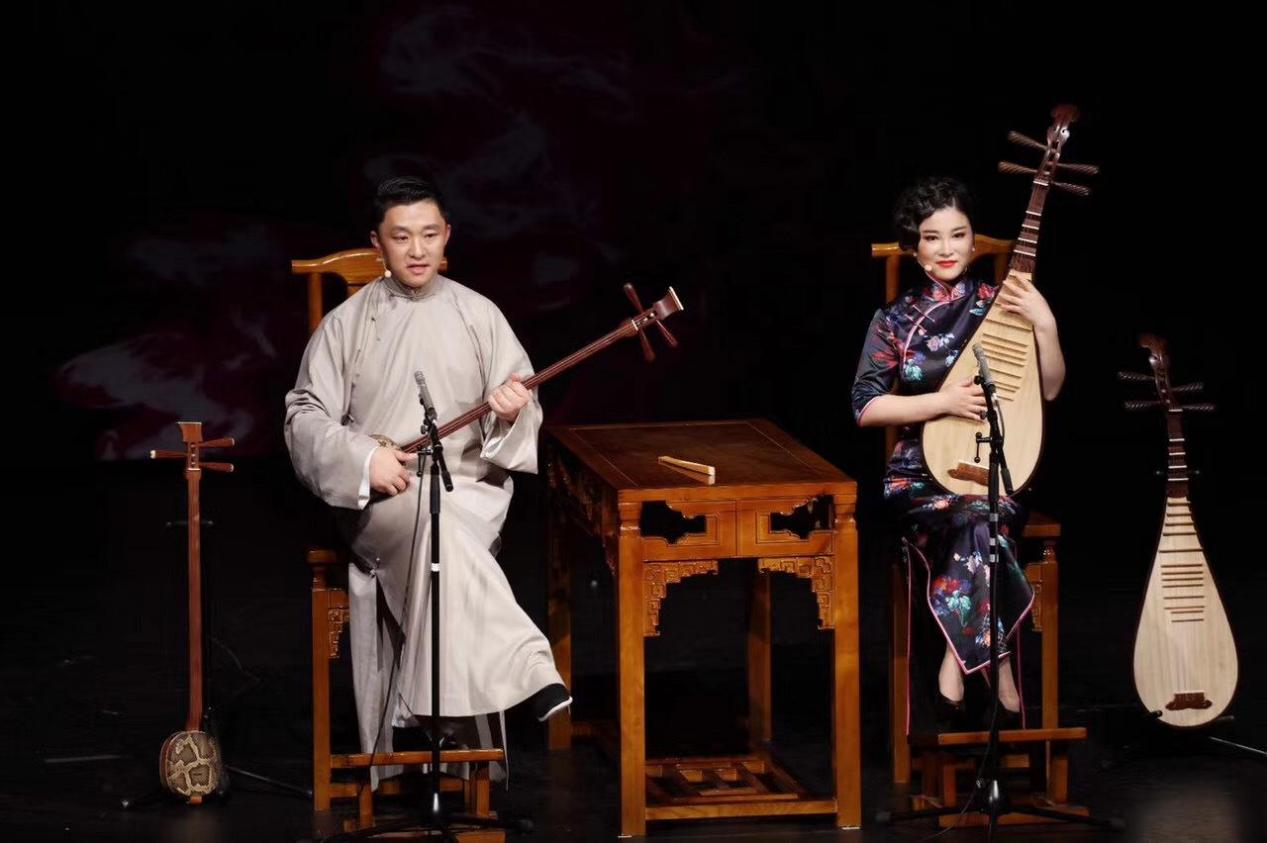
Pingtan is a unique form of storytellingcombined with ballad singing in the Suzhou dialect. It is one of the major folkoperas popular in the south of Changing River Region. Pingtan originallyreferred to two different but closely-related art forms: Suzhou Storytellingand Suzhou Lyrics. Suzhou Storytelling tells stories withoutsinging. Suzhou Lyrics fearures both storytelling and ballad-singing, in whichone, two, or even three actors speak, sing and play the three stringed pipa(also known as the Chinese lute) together. Pingtan is a combination of both. It iscomposed of speech, singing and stringed musical instrument playing. Storiesare told either in the third or first person form. Stage properties such asfolded fans, handkerchiefs, teacups, and pots are often used to representdifferent objects mentioned in the story. Sometimes vocal mimicry is performed. Pingtan was introduced into Shanghai in thefirst half of the nineteenth century and was most popular in the 1930s and the1940s, when Shanghai overtook Suzhou as the center of the art. A large numberof new Pingtan venues were opened in Shanghai's restaurants, among which wereOriental, Cangzhou, Nanjing, Central, and Great China Pingtan Houses. Inaddition, there were venues, such as MGM, Ciro's, Xinxianlin and Venus, whichwere opened in large dancing halls. Those Pingtan venues were arranged much inthe style of modern theaters and were equipped with advanced facilities. Thetheaters were mostly spacious, and offered comfortable seats, to meet the needsof the upper-class audiences. Regular Pingtan shows were also staged inamusement centers such as the Great World, the New World. Meanwhile, Pingtanshows were also broadcast on radio in Shanghai. It was estimated that, therewere only 103 Pingtan programs (40 minutes a piece and 4,120 minutes in total)broadcast on radio in 1938. As a result of its increasing popularity inShanghai, the city fostered a large number of famous Pingtan actors, includingXia Hesheng, Shen Jian'an, Zhu Yaoxiang, Jiang Yuequan, Liu Tianvun, ZhangJianting, Yan Xueting, Yang Zhenxiong, Zhang Hongsheng, Fan Xuejun and ZhaoJiaqiu. Many of them came up with new Pingtan programs featuring Shanghaiculture or representing real events in modern China, such as Zhang Wenxian’sAssassination, Yang Naiwu, Tears and Laughter in Marriage, and A Painting ofTen Beauties. A variety of Pingtan melodies were formedsuch as Jiang's, Shen-Xue's, Xu's and Zhang's melodies. During that period,Pingtan was further developed by assimilating elements of other art formsincluding Kunqu Opera, Peking Opera, movies, dramas, and songs to enrichitself. Pingtan introduced acting into its performance to enhance its realisticeffect while keeping its traditional elements of speech humor, stringedinstrument playing and singing. After the founding of the PRC, severalprofessional Pingtan troupes were established, including Shanghai People'sPingtan Working Group (now Shanghai Pingtan Troupe), Long March PingtanCompany, and Sparkle Pingtan Company. They adapted classic Pingtan ballads suchas Jade Dragonfly and Tale of the White Snake, and in the meantime created newPingtan ballads such as Tracks in the Snowy Forest, Got to Tame Huai River,Heroes on the Sea, Love True and False, and The Death of Xiao Dangui, and set Pingtanmusic to Mao Zedong's poems Butterflies over Flowers and Song for PlumBlossons. New styles of performance and new modes ofproduction were developed. New Pingtan melodies, such as Li's and Qin'smelodies, were formed. Among the most celebrated Pingtan performers since thebirth of New China are Zhu Huizhen, Xu Lixian, Zhu Xuegin, Yu Hongxian, and WuJunyu, who have frequently put on Pingtan performances in Beijing, Tianjin, andHong Kong as well as in foreign countries such as Japan, Singapore, and the US. |