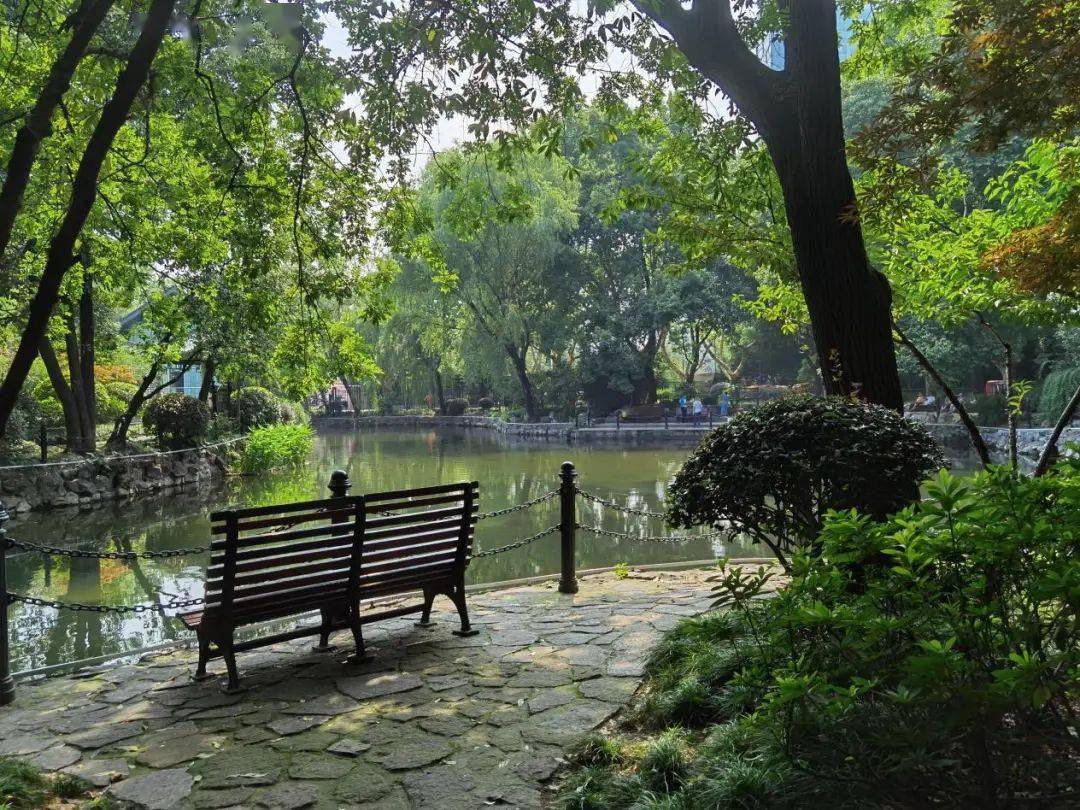
Lu Xun Park, formerly Hongkou Park, is amunicipal park in Hongkou District of Shanghai. It is located on 146 EastJiangwan Road, right behind Hongkou Football Stadium. The park is bounded byGuangzhong Road to the north, Ouyang Road to the northeast, Tian'ai Road to thesoutheast, Tian'ai Branch Road to the south, and East Jiangwan Road to thewest. Lu Xun Park is named after the Chinesewriter Lu Xun, who lived nearby in the last years of his life, and is thelocation of the tomb of Lu Xun and the Lu Xun Museum. In 1932, Koreannationalist Yun Bong-gil detonated a bomb at the park, killing or injuringseveral high-ranking figures of the Imperial Japanese military during acelebration of Emperor Hirohito's birthday. To the south of park lies Duolun Road, ahistoric street which has now become a road exclusively open to pedestrians. Itis also located near Lu Xun's former residence, a three-story Japanese-stylehouse where the author lived from 1933 until his death in 1936. Lu Xun Park contains the tomb of Lu Xun,with an inscription by Mao Zedong. On either side of the tomb are trees plantedby Zhou Enlai and Lu Xun's widow, Xu Guangping. Near the tomb is a bronzestatue of Lu Xun. The center of the park consists of a small artificial lakewhere boat rides are available. Locals often take exercises, play tai chi,dance in the park. The Te Li Ming Teahouse is located on the west side of thelake. In the southeast corner of the park is the Lu Xun Memorial Hall, whichcontains a collection of his personal belongings, papers, and publications. The park also contains a plum garden, amemorial hall dedicated to Yun Bong-gil, and a bust of the Hungarianrevolutionary poet Sándor Petőfi, some of whose works Lu Xun translated intoChinese. The bust was unveiled by Hungarian Prime Minister Ferenc Gyurcsány in2007 as part of the preparations for the Shanghai Expo. Lu Xun Park is home toseveral hundred cherry trees, some of which are Yoshino trees transplanted fromUeno Park in Tokyo. In 1896, the Bureau of Construction of theShanghai International Settlement purchased 39 acres of land in Hongkou(formerly romanized as Hongkew) just outside its boundary to use as a shootingrange for the Shanghai Volunteer Corps. The field was redesigned by Donald MacGregor as the Hongkew Sports Games Park and Shooting Field in 1905, andcompleted in 1909. The new design was based on that of a park in Glasgow, andincluded a golf course, tennis courts, swimming pool, and bowling green. Thepark was expanded in 1917, and renamed again as Hongkew Park in 1922. It wasthe second largest park in Shanghai, next to Jessfield Park (now calledZhongshan Park). Both parks, despite lying in Chinese territory outside of theInternational Settlement, were administered by the Shanghai Municipal Council,the organization that governed the Settlement on behalf of the foreigncommunity. The Shanghai Municipal Band, thepredecessor of the Shanghai Symphony Orchestra, performed summer concerts inHongkou Park and the Public Garden (now Huangpu Park). These were attended bythe foreign residents of the International Settlement, as Chinese residentswere not permitted to enter either park. Hongkou Park, along with the otherparks administered by the Shanghai Municipal Council, was opened to Chinesevisitors for the first time in 1928. The pre-1928 prohibition against Chinesevisitors in foreign-administered Shanghai parks was the subject of much debateamong Chinese intellectuals. The park regulations stated that the facilitieswere exclusively for the use of the foreign community, and also that dogs,horses, and bicycles were prohibited. Critics later paraphrased theseregulations into various fictitious versions such as "Dogs and Chinese notadmitted", juxtaposing the low status of Chinese citizens in their owncountry with that of dogs. Sun Yat-sen, founder of the Republic of China,denounced the restrictions in effect at the Garden and at Hongkou Park in aspeech in 1924. Most famously, Bruce Lee's film Fist of Fury depicted Lee'scharacter being barred from entry into the Public Garden, resulting in himkicking and breaking the sign displaying the regulations. The second and fifth Far EasternChampionship Games were held at Hongkou Park in 1915 and 1921, respectively.The 1915 games were a major priority for the Beiyang government under YuanShikai, as well as for Chinese media covering the event. Yuan had agreed toJapan's Twenty-One Demands just prior to the games, leaving the Chinese crowdsin attendance eager for victory against their Japanese opponents on the field.The 1915 games were among the earliest international sporting competitions tobe held in China. They attracted a large number of spectators to the newstadium built near the Hongkou shooting range. The 1921 games were notable for being thefirst to include female athletes, though their participation was limited toperforming group calisthenics demonstrations with movements mimicking those ofmodern sports. The closing ceremony was disrupted by six Hunanese anarchistswho fired a gun outside Hongkou Park and distributed anti-capitalist pamphlets. |