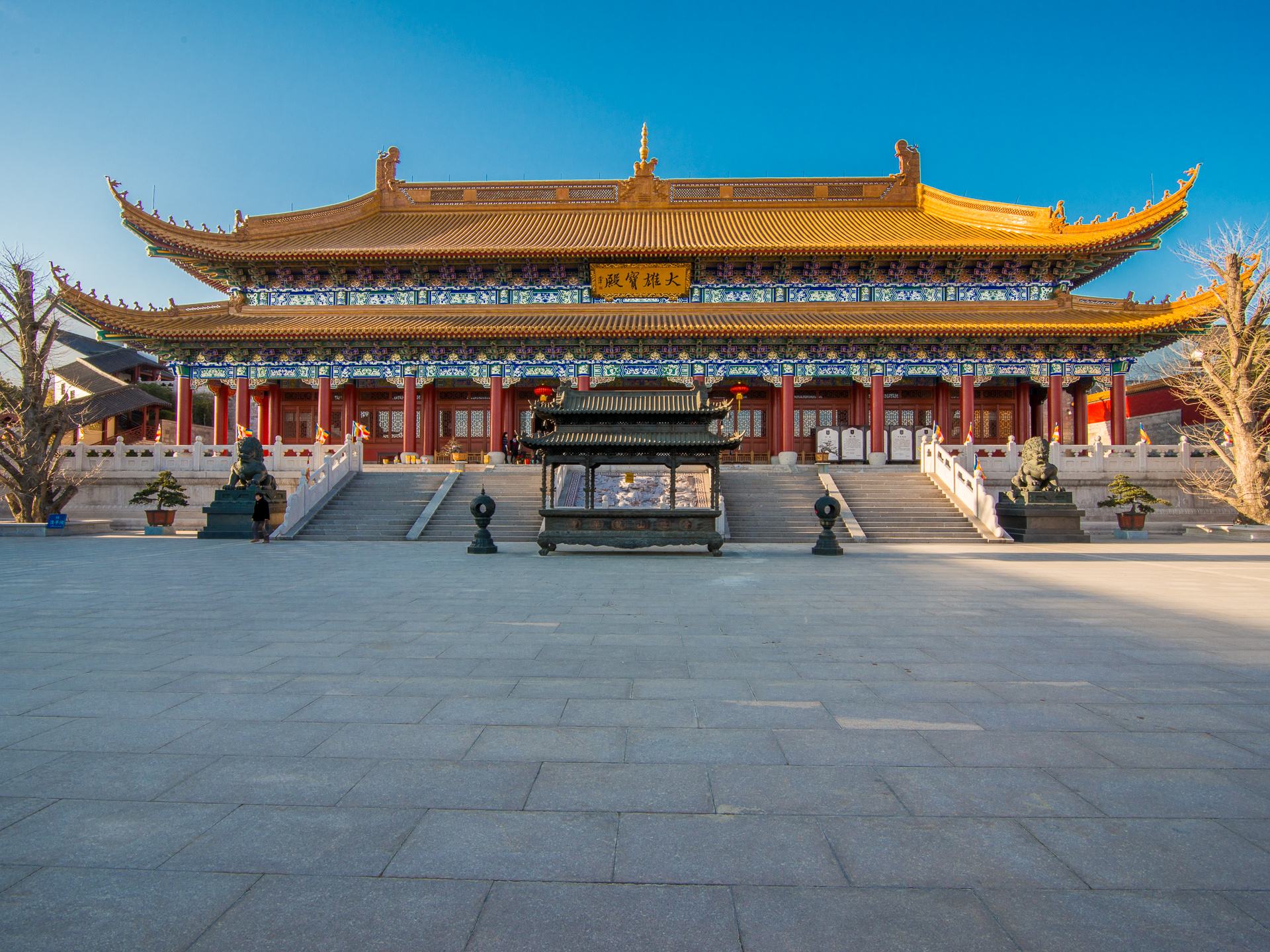
Longhua Temple (龙华寺) is anancient temple with the longest history and the biggest size in Shanghai. TheLonghua Temple is a Buddhist temple dedicated to the Maitreya Buddha inShanghai. Although most of the present day buildings date from later reconstructions,the temple preserves the architectural design of a Song dynasty (960–1279)monastery of the Chan School. It is the largest, most authentic and completeancient temple complex in the city of Shanghai. The temple was first built in 242 AD,during the Three Kingdoms Period (220–165). According to a legend, Sun Quan,King of the Kingdom of Wu (222–280), had obtained Sharira relics, which arecremated remains of the Buddha. To house these precious relics, the kingordered the construction of 13 pagodas. Longhua Pagoda ((龙华塔), part ofthe Longhua temple complex, is said to have been one of them. Like the functionof the pagoda, the name of the temple also has its origin in a local legendaccording to which a dragon once appeared on the site. It is said that during the period of ThreeKingdoms, Sunquan of East Wu built this temple in order to show his filialpiety to his mother in the 5th year of Chiwu (A.D.242), and it was named afterthe recordation of sutra that Bodhisattva Maitreya practised austerities tobecome a Buddha under the Longhua tree. Through repeated restorations, it hasbeen resumed to its former appearance nowadays. Longhua tower is located infront of Longhua Temple, and tradition has it that it was first built in the10th year of Chiwu (A.D.247). The temple was destroyed by war towards theend of the Tang dynasty (618–907) and rebuilt in 977 AD, under the autonomousKingdom of Wuyue during the Northern Song dynasty period (960–1127). (Accordingto another version of the story, as contained in Song (960–1279) andYuan dynasty (1271–1368) local histories, the temple was first built by the King ofWuyue.) Later in the Song dynasty, in 1064, it was renamed "KongxiangTemple" (空相寺), but the original name "Longhua Temple" was restored inthe Ming dynasty (1368–1644) during the reign of the Wanli Emperor (1573–1620). The present architectural design followsthe Song dynasty (960–1279) original. However, whereas the core of the presentLonghua Pagoda survives from that period, most buildings in the temple properwere rebuilt during the reigns of the Tongzhi Emperor (1862–1874) and theGuangxu Emperor (1875–1908) in the Qing dynasty (1644–1911). A modernrestoration of the entire temple complex was carried out in 1954. The current Longhua Temple was built in theyears of Emperor Guangxu in Qing Dynasty, but it basically keeps the formerappearance of Buddha Zen’s monastically seven-hall system in Song Dynasty.Moreover, it is a group of rather intact temple buildings. The temple treasuresup the Buddhist sutras, golden stamps and statues of Buddha etc. of TangDynasty, Five Dynasties, Ming Dynasty and Qing Dynasty. The palace of Longhua Temple is toweringand glittering. And the statues of Buddha are solemn and dignified. Two pointsof these statues are distinctive. One is that because Longhua Temple is therite of Buddhists, there are two Maitreya statues: the Bodhisattva statue ofMaitreya, enshrined and worshiped in the Hall of Heavenly Kingand the statue ofembodiment, enshrined and worshiped in the Hall of Maitreya as the so-called“Monk with A Cloth Bag”; the other is the Hall of Great Strength. Generally,there is whether “18 arhats” who propagandize the dharma Buddha or “20 gods”who protect the dharma of Buddha on the both sides of main statues of others’halls, but inside the Longhua Temple, the arhats and gods assemble all togetherin the same hall. The existing Longhua Tower is constructedwith bricks and woods, which is a seven-storey and eight-profile pagoda with aheight of 40.4 meters. The tower looks orange with the temple’s pole soaringinto the air, and its brick body and foundation are the protoplasts that wereused in the construction in the 2nd year of Taipingxingguo of Song Dynasty(A.D.977). Each floor of this pagoda is with upturned eaves and curlybalustrades, and its gesture is very grand and beautiful. Until now, the pagodais preserved as the most perfect tower in Shanghai prefecture. On the east and west sides of Hall ofHeavenly King in Longhua Temple, bell and drum towers were constructed there.The “Longhua Evening Bell” was ever one of the “Eight Scenes of Shanghai City”in times of Ming and Qing Dynasties. Since 1991, on Dec.31 annually, theactivity of “tolling the Longhua evening bell to usher the New Year in” has attractedmany domestic and foreign tourists. This activity has been decided as one ofthe state-class tourism items by National Tourism Administration. The temple and monastery were originallysurrounded by extensive gardens and orchards. Viewing of the peach blossom inthe Longhua gardens was an annual attraction for people in surrounding cities. The temple grounds have been used as a sitefor internment as well as for executions. Public executions were held on thesite in the 20th century. In 1927, the Kuomintang( 国民党) carriedout a purge of suspected communists in Shanghai. Thousands of victims of thispurge were brought to the temple grounds to be executed. They are commemoratedtoday by the Longhua Martyrs Cemetery behind the temple. During the SecondSino-Japanese War, the Japanese operated their largest civilian internment campin the area, where American, British, as well as nationals of other alliedcountries were held under poor conditions. The temple's extensive gardens have sincebeen almost entirely absorbed into the neighboring Longhua Martyrs' Cemeteryand have been extensively reconstructed in a contemporary monumental style. Asmall traditional garden remains immediately adjacent to the temple buildings. Architecturaldesign and artwork The Longhua Temple occupies an area of morethan 20,000 square meters (215,000 sq ft) and the main axis of the compound is194 meters (636 ft) long. The tallest structure is the Longhua Pagoda whichstands 40.4 meters (132 ft 7 in) high. The layout of the temple is that of a Songdynasty monastery of the Buddhist Chan sect, known as the Sangharama Five-HallStyle. Five main halls are arranged along a central north-south pointing axis.From the entrance or Shanmen, the buildings are: Maitreya Hall The Maitreya Hall housing a statue ofMaitreya buddha and another in his manifestation as "Budai", or Clothbag monk. Four Heavenly Kings Hall The Four Heavenly Kings Hall housingstatues of the Four Heavenly Kings. Mahavira Hall The Mahavira Hall is the main hall, housingstatues of the historical Buddha (Shakyamuni) and two disciples. At the back ofthe hall is a bas-relief carving, including a depiction of Guanyin, or theBodhisattva Avalokiteśvara in his female manifestation. Around the frontportion are arranged the twenty Guardians of Buddhist Law, and around the backthe sixteen principal arhats. The hall also features an ancient bell cast in1586, during the Wanli era of the Ming dynasty. LonghuaPagoda The Longhua Pagoda is best well-known ofthe 16 historic pagodas that still stand within the Shanghai municipality. Ithas an octagonal floor layout. The size of the seven stories decreases frombottom to top. The pagoda consists of a hollow, tube-like brick core surroundedby a wooden staircase. On the outside, it is decorated with balconies,banisters, and upturned eaves. These outer decorations have been reconstructedin keeping with the original style. Although previous pagodas existed on thesame site, the current brick base and body of the pagoda was built in 977 underthe Wuyue kingdome (907–978), with continuous renovations of its more fragilewooden components on the exterior. Because of its age, the pagoda is fragileand is not open to the public. |