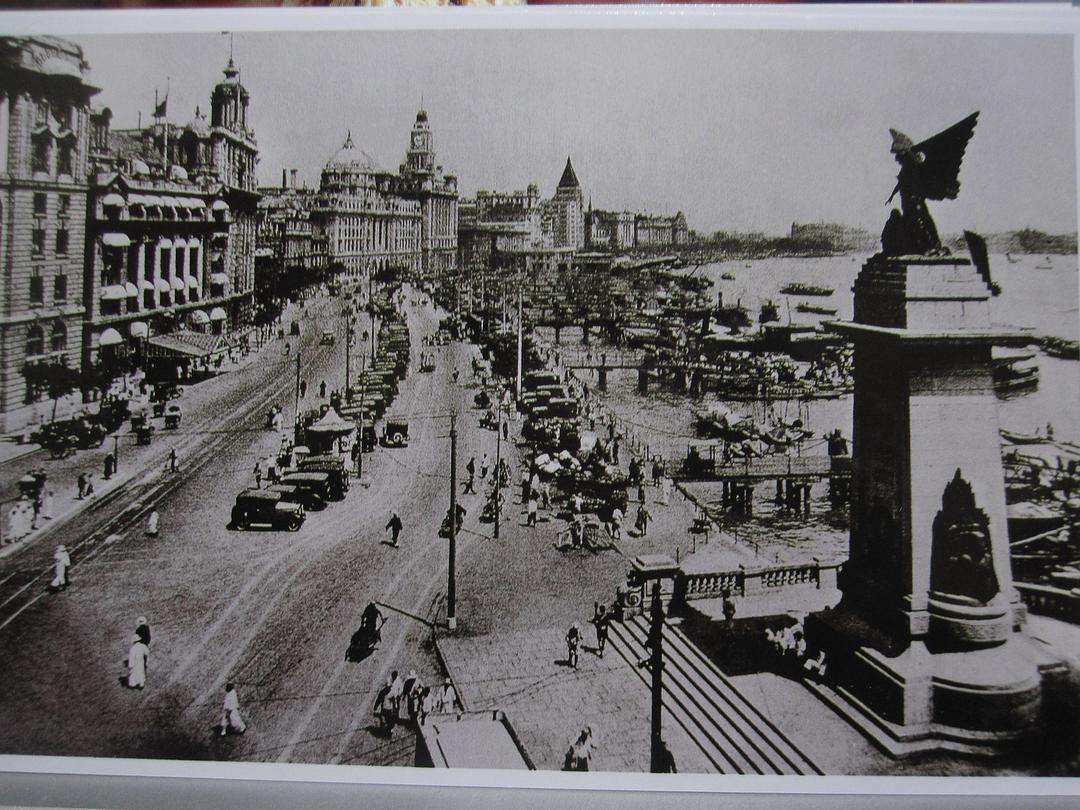
The western part of modern-day Shanghai wasinhabited 6000 years ago. During the Spring and Autumn period (approximately771 to 476 BC), it belonged to the Kingdom of Wu, which was conquered by theKingdom of Yue, which in turn was conquered by the Kingdom of Chu. During theWarring States period (475 BC), Shanghai belonged to Lord Chunshen of Chu. Heordered the excavation of the Huangpu River. In memory of him, Shanghai wasnicknamed "Shēn". Fishermen living in the Shanghai area then createda fishing tool called hu and used it in the Suzhou Creek, hu became anothernickname and abbreviation of the city. During the Tang and Song dynasties,Qinglong Town (青龙镇) in modern Qingpu District was a major trading port. Established in746 (the fifth year of the Tang Tianbao era), it developed into whathistorically called a "giant town of the Southeast", with thirteentemples and seven pagodas. Mi Fu, a scholar and artist of the Song dynasty,served as its mayor. The port experienced thriving trade with provinces alongthe Yangtze and the Chinese coast, as well as with foreign countries such asJapan. By the end of the Song dynasty, the centerof trading had moved downstream of the Wusong River to Shanghai. It wasupgraded in status from a village to a market town in 1074,. In 1172, a secondsea wall was built to stabilize the ocean coastline, supplementing an earlierdike. From the Yuan dynasty in 1292 until Shanghai officially became amunicipality in 1927, central Shanghai was administered as a county underSongjiang Prefecture, which was located in the present-day Songjiang District. Two important events helped promoteShanghai's development in the Ming dynasty. A city wall was built for the firsttime in 1554 to protect the town from raids by Japanese pirates. It measured 10m (33 ft) high and 5 km (3 mi) in circumference. A City God Temple was built in1602 during Emperor Wanli’s reign. This honor was usually reserved forprefectural capitals and not normally given to a mere county seat such asShanghai. Scholars have theorized that this probably reflected the town'seconomic importance, as opposed to its low political status. During the Qing dynasty, Shanghai becameone of the most important sea ports in the Yangtze Delta region as a result oftwo important central government policy changes: in 1684, the Emperor Kangxireversed the Ming dynasty’s prohibition on oceangoing vessels—a ban that hadbeen in force since 1525. In 1732, the Emperor Qianlong moved the customsoffice of Jiangsu from the prefectural capital of Songjiang to Shanghai, andgave Shanghai exclusive control over customs collections for Jiangsu's foreigntrade. As a result of these two critical decisions, Shanghai had become themajor trade port for all of the lower Yangtze region by 1735, despite stillbeing at the lowest administrative level in the political hierarchy. Riseand Golden Age In the 19th century, internationalattention to Shanghai grew due to European recognition of its economic andtrade potential at the Yangtze River Delta. During the First Opium War(1839–1842), British forces occupied the city. The war ended in 1842 with theTreaty of Nanjing, which opened Shanghai as one of the five treaty ports forinternational trade. The Treaty of the Bogue, the Treaty of Wanghia, and theTreaty of Whampoa (signed in 1843, 1844, and 1844, respectively) forced Chineseconcession to European and American desires for visitation and trade on Chinesesoil. Britain, France, and the United States all established a presence outsidethe walled city of Shanghai, which remained under the direct administration ofthe Chinese. The Chinese-held Old City of Shanghai fellto rebels from the Small Swords Society in 1853, but was recovered by the Qinggovernment in February 1855. In 1854, the Shanghai Municipal Council wascreated to manage the foreign settlements. Between 1860 and 1862, the Taipingrebels twice attacked Shanghai and destroyed the city's eastern and southernsuburbs, but failed to take the city. In 1863, the British settlement to thesouth of Suzhou Creek (northern Huangpu District) and the American settlementto the north (southern Hongkou District) joined in order to form the ShanghaiInternational Settlement. The French opted out of the Shanghai Municipal Counciland maintained its own concession to the south and southwest. The First Sino-Japanese War concluded withthe 1895 Treaty of Shimonoseki, which elevated Japan to become another foreignpower in Shanghai. Japan built the first factories in Shanghai, which was sooncopied by other foreign powers. All this international activity gave Shanghaithe nickname "the Great Athens of China". In 1914, the Old City wallswere dismantled because they blocked the city's expansion. In July 1921, theCommunist Party of China was founded in the French Concession. On 30 May 1925,the May Thirtieth Movement broke out when a worker in a Japanese-owned cottonmill was shot and killed by a Japanese foreman. Workers in the city thenlaunched general strikes against imperialism, which became nationwide proteststhat gave rise to Chinese nationalism. The golden age of Shanghai began with itselevation to municipality after it was separated from Jiangsu on 7 July 1927.This new Chinese municipality covered an area of 494.69 km2 (191.0 sq mi),including the modern-day districts of Baoshan, Yangpu, Zhabei, Nanshi, andPudong, but excluded the foreign concessions territories. Headed by a Chinesemayor and municipal council, the new city government's first task—the GreaterShanghai Plan—was to create a new city center in Jiangwan town of Yangpudistrict, outside the boundaries of the foreign concessions. The plan includeda public museum, library, sports stadium, and city hall, which were partiallyconstructed before being interrupted by the Japanese invasion. The city flourished, becoming a primarycommercial and financial hub of the Asia-Pacific region in the 1930s. Duringthe ensuing decades, citizens from across the world came to Shanghai to liveand work. Those who stayed for long periods—some for generations—calledthemselves "Shanghailanders". In the 1920s and 1930s, almost 20,000White Russians fled the newly established Soviet Union to reside in Shanghai.These Shanghai Russians constituted the second-largest foreign community. By1932, Shanghai had become the world's fifth largest city and home to 70,000foreigners. In the 1930s, some 30,000 Ashkenazi Jewish refugees from Europearrived in the city. JapaneseInvasion On January 28, 1932, Japanese forcesinvaded Shanghai while the Chinese people strongly resisted. More than 10,000shops and hundreds of factories and public buildings were destroyed, leavingZhabei district ruined. About 18,000 civilians were either killed, injured, ordeclared missing. In 1937, the Battle of Shanghai resulted in the occupation ofthe Chinese-administered parts of Shanghai outside of the InternationalSettlement and the French Concession. People who stayed in the occupied citysuffered on a daily basis, experiencing hunger, oppression, and death. Theforeign concessions were ultimately occupied by the Japanese on December 8,1941. The anti-Japanese war lasted until Japan's surrender in 1945. Multiplewar crimes were committed by Japanese invaders during that time. A side-effect of the Japanese invasion inShanghai was the Shanghai Ghetto. Japanese consul to Kaunas, Lithuania, ChiuneSugihara issued thousands of visas to Jewish refugees who were escaping theNazi's Final Solution to the Jewish Question. They traveled from Keidan,Lithuania across Russia by railroad to the Vladivostok from where they traveledby ship to Kobe, Japan. However, the Jewish refugees' stay in Kobe was short asthe Japanese government transferred them to Shanghai by November 1941. OtherJewish refugees found haven in Shanghai, not through Sugihara, but came onships from Italy. The refugees from Europe were interned into a cramped ghettoin the Hongkou District, and after the Japanese attack on Pearl Harbor, eventhe Iraqi Jews who had been living in Shanghai from before the outbreak of WWIIwere interned. Among the refugees in the Shanghai Ghetto was the MirrerYeshiva, including its students and faculty. On September 3, 1945, the ChineseArmy liberated the Ghetto and most of the Jews left in the next few years. By1957, there were only one hundred Jews remaining in Shanghai. On 27 May 1949, the People's LiberationArmy took control of Shanghai through the Shanghai Campaign. Under the newPeople's Republic of China (PRC), Shanghai was one of only three municipalitiesnot merged into neighboring provinces (the others being Beijing and Tianjin). ModernHistory After the war, Shanghai's economy wasrestored. From 1949 to 1952, the city's agricultural and industrial outputincreased by 51.5% and 94.2%, respectively. There were 20 urban districts and10 suburbs at the time. On 17 January 1958, Jiading, Baoshan, and ShanghaiCounty in Jiangsu became part of Shanghai Municipality, which expanded to 863square kilometer. The following December, the land area of Shanghai was furtherexpanded to square kilometer after more surrounding suburban areas in Jiangsuwere added: Chongming, Jinshan, Qingpu, Fengxian, Chuansha, and Nanhui. In1964, the city's administrative divisions were rearranged to 10 urban districtsand 10 counties. As China’s industrial hub with the mostskillful industrial workers, Shanghai became a center for radical leftismduring the 1950s and 1960s. The radical leftist Jiang Qing and her threeallies, together called the “Gang of Four”, were based in the city. During theCultural Revolution (1966–1976), Shanghai's society was severely damaged, with310,000 wrongful convictions involving more than 1 million people. About 11,500people were unjustly persecuted to death. Yet, even during the most turbulenttimes of the revolution, Shanghai was able to maintain economic production withpositive annual growth rate. Since 1949, Shanghai has been acomparatively heavy contributor of tax revenue to the central government; in1983, the city's contribution in tax revenue was greater than investmentreceived in the past 33 years combined. Its importance to the fiscal well-beingof the central government also denied it from economic liberalizations begun in1978. In 1990, Deng Xiaoping permitted Shanghai to initiate economic reforms,which reintroduced foreign capital to the city and developed the Pudongdistrict, resulting in the birth of Lujiazui. As of 2020, Shanghai isclassified as an Alpha+ city by the Globalization and World Cities ResearchNetwork, making it one of the world's top 10 major cities. |