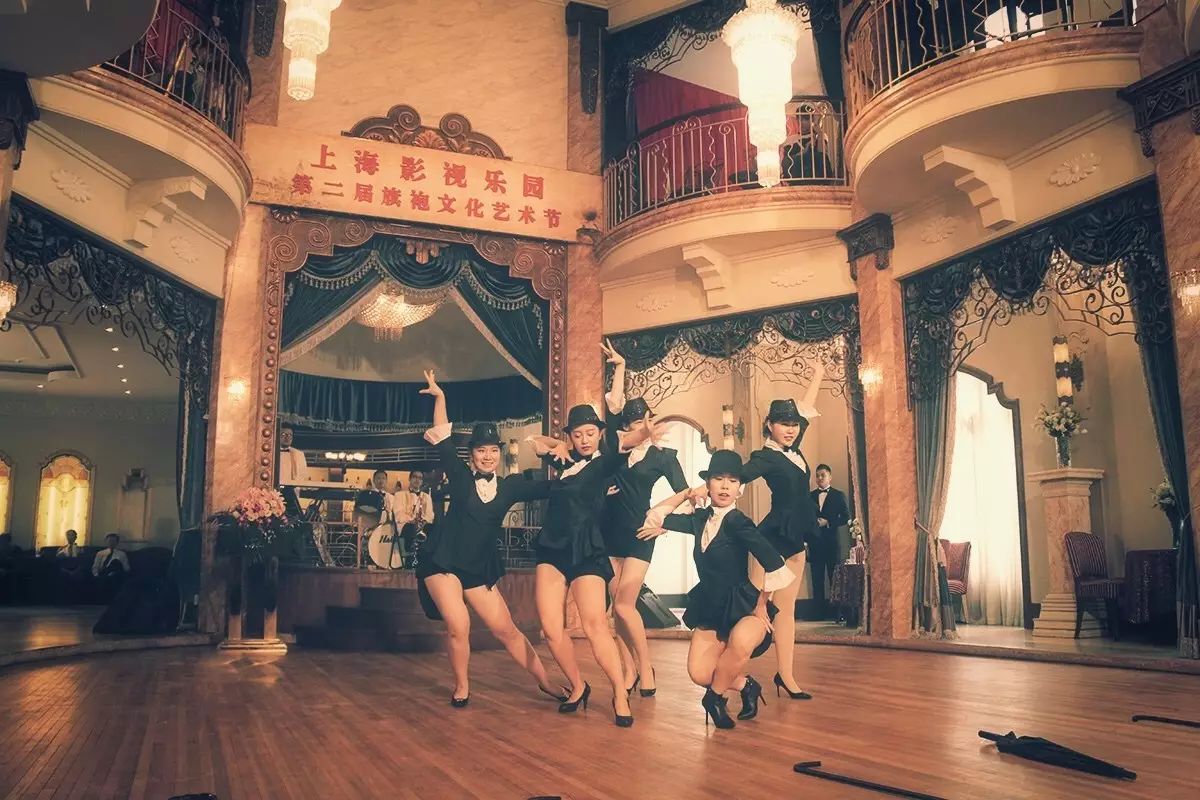
Located at the intersection of Yuyuan Roadand Wanhangdu Road, Paramount Ballroom was built by Gu Liancheng, a merchantfrom Zhejiang Province, with an investment of 700,000 silver yuan in 1932.Designed by Yang Xiliu and constructed by Lu Gen Kee Construction Firm, thethree-story ballroom was of American style. On the first floor were the kitchen and thestorefronts, on the second floor stood the dance halls and the dining roomwhile the third served as the hotel. The largest dance hall covered a space ofmore than 500 square meters with the floors which produced a swinging orrocking effect on dancers. When all the dance halls were put into use, theycould hold one thousand people dancing at the same time. On the ceiling was agiant cylindrical fiberglass tower on which the plate numbers of the customers’cars would be projected to inform the drivers of their masters' departure. Popular stars that used to take the stageincluded Zhou Xuan, Bai Guang, Li Xianglan and so on. Among the celebritiesfrequenting the ballroom were Run Lingyu, Zhang Xueliang and Xu Zhimo. Theballroom was also the scene of the betrothal ceremony of Chen Xiangmei andClaire Lee Chennault. When Charles Chaplin and his wife visited Shanghai, theycame to dance in the ballroom. Shanghai Paramount Ballroom had itsgreatest moments for a time in the period of People’s Republic of China. It wasan important public place where European and American social dance as well asoverseas and domestic singing and dancing performances had been gatheredtogether in terms of its business operation; a special place which embodied thefemale's pursuit of independence and defending the survival rights andinterests of citizens; The above mentioned elements are interwoven to reflect aserial of problems that constitute,with the modernity as the point ofpenetration,the wider perspective of arts sociology to further learn andunderstand modern urbandance in China, especially thegeneration,spread,deformation and acceptance of the dance in the dance hall. The Paramount Ballroom was an innovativeurban space that challenged traditional Chinese values. In doing so it playedan important role in Shanghai's modernization. Traditional Confucian moralityset very strict regulations on the social interaction of men and women, while,in contrast, the architectural space of the Paramount Ballroom allowed men andwomen to have close contact. The experience created by this architecture wasnot just pleasurable and fashionable; it was a sign of modernity. This study reconstructsthe entertainment experience of the contemporary middle class in the newlyconstructed ballrooms of Shanghai. It examines how the Paramount Ballroomemerged, how it was interpreted by Chinese society, and the historical role itplayed in modernizing Shanghai's urban space in the 1930s. Owing to management problems, thegovernment took it over in 1954. Then the main building became the Red CapitalTheater. Later the Red Capital Cinema and the attached buildings wererestructured into shopping malls. In 2001, Zhao Shichong, a businessman fromTaiwan took it over and furnished a huge amount of money for its interiorrenovation. The ballroom reopened in 2002 and in 2006,the second and the third floors of the new Paramount became disco bars while thefourth floor becomes an international standard dance bar. |