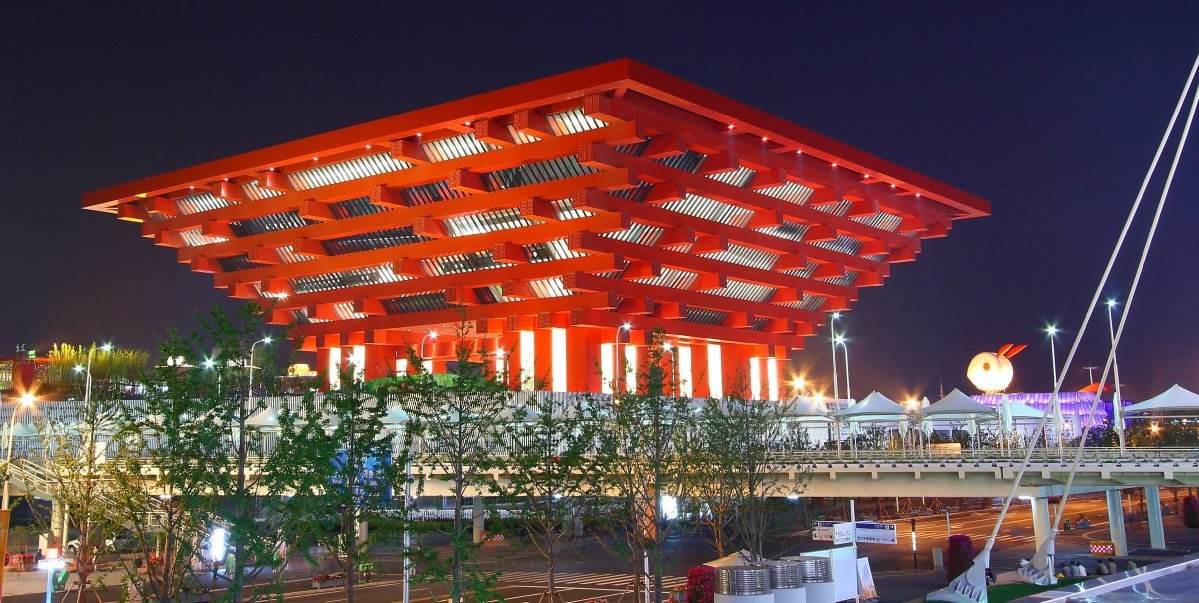
The China pavilion at Expo 2010 (中国国家馆) inPudong, Shanghai, colloquially known as the Oriental Crown (东方之冠), is thelargest national pavilion at the Shanghai Expo. It is also the most expensivepavilion at the Shanghai Expo, having cost an estimated US$220 million. The pavilion showcases China's civilizationand modern achievements by combining traditional and contemporary elements inits architecture, landscaping and exhibits. After the end of the Expo 2010, thebuilding was converted to a museum. On October 1, 2012, it was reopened as theChina Art Museum, the largest art museum in Asia. The 160,000 square meter China Pavilion forShanghai World Expo was unveiled on February 8, 2010 in Pudong, Shanghai after2 years’ construction. The 69-meter-tall giant pavilion has two storiesunderground and five stories above the ground with a total floor space of43,904 square meters. It would consist of four reinforced concrete columns anda steel core tube, between which would be the cantilevered steel structure withthe ground height of 35 meters, covering an area of 19,600 square meters. The construction started on December 18,2007. The first red decoration plate was installed onto the exterior wall onMay 25, 2009. The steel-structure roof was sealed off on December 28, 2009. Thefollowing five months were left for exhibition unit and management team. The construction was demanding and huge.The groundwork equaled to eight football pitches. The whole pit was 8 meters deep and 2,920 pileswere driven in. The most perilous part of the construction was the250-meter-long western edge of the groundwork. It was only 20 centimeters fromthe ceiling of number 8 subway in normal daily operation. The groundwork mustbe safe enough to ensure that the 20,000-ton steel structure and other weightswould not crush on the subway. China had never had such a huge redstructure before. The structure has two Chinese elements: the 56 bracketsrepresenting the country's 56 natonalities and the color called China Red. The designers had recommended a sort ofglaze red applied onto a glass wall material. The sample was provided by a Guangdong manufacturer.The installed color sample looked dull. Moreover, glass wall is a hard materialto install. The designers admitted the idea would not work. On a larger trial scale, a huge aluminumplate was painted red and put up together with a 140-meter-long beam. Theeffect looked monotonous. It now occurred to engineers that they needed asurface that was not smooth since a smooth surface would surely producemonotony. They spent a month testing various materials and another month tryingto figure out appropriate surfaces. During that period, the managers, designersand engineers examined dozens of color samples and compared their colors everyday. The final solution did not come from eyes and experiments and tests. Itmaterialized out of verbal discussions. The surface texture looked like a corduroyfabric. The result was very encouraging. Top leaders of Shanghai Municipalitydidn't voice their objection after examining the larger color sample made onthe corduroy surface. With the solution to the surface texturefound, Yao' s next question was what China Red was. He discovered to his bigsurprise that there had never been a color officially called China Red. Song Jianming, a professor withHangzhou-based China Academy of Art, had studied colors for nearly thirtyyears. After he finished his visit to another pavilion site nearby one day, theprofessor came over to the China Pavilion site and chatted with Yao Jianping.The professor explained that the color scheme used in the Forbidden City tooksunshine and shadow and many other factors into consideration and that theresult looks deceptively and wonderfully uniform. The Forbidden City has a numberof red colors for different parts of the palaces and the compound so that theholistic effect looks in balance in all weather conditions and from variousangles, directions and distances. According to the professor, if the reds usedon the royal palaces in Beijing can be called China Red, then China Red isactually a combination of different red colors. Song and other experts at China Academy ofArt in Hangzhou were officially engaged to come up with a solution. Song jokingly called theexpert panel a group of men after colors (color and sex are homonyms inChinese). Officially they called their pursuit ajourney in search of reds (well, that added a touch of revolution). Prettysoon, formulas and sealed samples were sent to Shanghai. Yao Jianping and histeam test-produced large samples and sent them back to Hangzhou for evaluationand approval. In the end, seven reds were adopted, four for the exterior andthree for the interior. On July 31, 2009, all the aluminum plateswere installed to the exterior. The color looks royal and solemn andeye-catching. It is unanimously agreed that the red looks perfect on the ChinaPavilion. Yao Jianping hopes the China Pavilion is the final word on China Red. The China Pavilion has other features thatcan be topics for lengthy discussions and even lectures. For example, there areChinese hieroglyphic characters on the walls of the pavilion that indicatedirections; there are the names of 24 solar terms written in Chinesehieroglyphic characters on the gray surrounding wall of the regional museum inthe close neighborhood of the pavilion. All these characters are written inseal script which is more than 2,000 years old. There can be interestingdiscussions about the ideas in the hieroglyphic shapes. Take the grey granite stones used in the 76steps that lead from the ground to the door of the pavilion. How many stonesare there? Who were these stonemasons? What special technical skills andrequirements were used? How many months had elapsed before the contractor foundqualified stone masons? Long and fascinating stories can be told about them.For the sake of space here, let' s omit them and talk about what will beinside. In short, the pavilion will feature amovie, a long scroll of painting, a green area, an experience, and a bit ofenlightenment. AnimatedQingming Shanghe Tu The journey through the Chinese NationalPavilion starts on the top floor. Visitors can either take elevators to the topor take the flight of 76 steps on foot. On the top floor, an eight-minute moviein a poetic style will introduce visitors to the unprecedented process ofurbanization in China over the past 30 years since the policy of reform andopening up, to the Chinese people's zest to build up our motherland andpeople's vision of the future. Visitors will view an animated modernversion of "Along the River on the Qing Festival" , a breathtakingpanorama of Kaifeng, the capital of the northern Song Dynasty presumablycreated by artist Zhang Zeduan (1085-1145). The Pavilion version of the ancientpainting is 100 meters long. In the animated version to be screened on the wallof the top floor, about 600 characters in the painting move around and thispart of the city looks real as the day brightens up and darkens from sunrisetosunset. The "green area" on the secondfloor portrays not only the harmony between man and nature in cities but also a nationwide strategy forintegrating rural and urban development. An exciting cable car ride will takevisitors on a 10-minute trip along an elevated zigzag rail through the greenarea. Visitors will see examples of traditional Chinese courtyards, houses ofbricks and tiles, gardens and stone bridges often seen in the south of theYangtze River, and several wooden structures, which are a special feature inChina's traditional construction. The enlightenment is designed to wrap upthe visit at the ground floor: a low-carbon future is a mo dernpursuit of a natural way of life. Along the River During the QingmingFestival, also known by its Chinese name as the Qingming Shanghe Tu (清明上河图), is apainting by the Song dynasty painter Zhang Zeduan (1085–1145). Itcaptures the daily life of people and the landscape of the capital, Bianjing(present-day Kaifeng) during the Northern Song. The theme is often said tocelebrate the festive spirit and worldly commotion at the Qingming Festival,rather than the holiday's ceremonial aspects, such as tomb sweeping andprayers. Successive scenes reveal the lifestyle of all levels of the societyfrom rich to poor as well as different economic activities in rural areas andthe city, and offer glimpses of period clothing and architecture. The paintingis considered to be the most renowned work among all Chinese paintings, and ithas been called "China's Mona Lisa." As an artistic creation, the piece has beenrevered and artists of subsequent dynasties made re-interpretive versions, eachfollowing the overall composition and the theme of the original but differingin details and technique. Over the centuries, the Qingming scroll was collectedand kept among numerous private owners, before it eventually returned to publicownership. The painting was a particular favorite of Puyi, the Last Emperor,who took the Song dynasty original with him when he left Beijing. It wasre-purchased in 1945 and kept at the Palace Museum in the Forbidden City. TheSong dynasty original and the Qing versions, in the Beijing and Taipei PalaceMuseums respectively, are regarded as national treasures and are exhibited onlyfor brief periods every few years. |