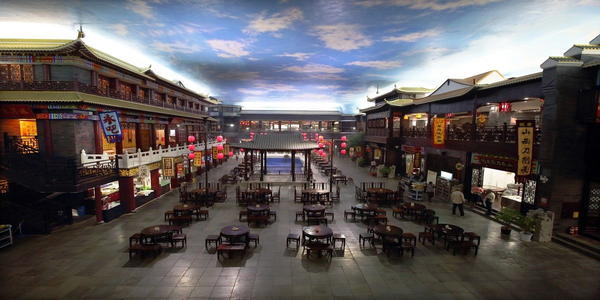
Kaifeng is located in the East of HenanProvince 72 kilometers from Zhengzhou, It has served as the capitalintermittently for seven dynasties in history, including the state of Wei ofthe Warring States Period, the later Liang Dynasty (907-923), the Later JinDynasty (936-947), the Later Han Dynasty (947-951), the Later Zhou Dynasty(951-960), the Northern Song Dynasty (960-1127) and the Jin Dynasty(1115-1234). The glory of Kaifeng was at its peak whenit was the capital of the Northern Song Dynasty (960-1127). Being thepolitical, economic and cultural center, it boasts of being the then mostprosperous metropolis in the world where a host of renowned historical figuresemerged, including the upright Bao Zheng, loyal generals of the Yang Family andthe national hero, Yue Fei. It was also a time that science and educationflourished, not only benefitting that era, but the policies of the time set theprecedent for the later dynasties. The prosperous era of Kaifeng isinterestingly exhibited in the Riverside Scene at the Pure Moon Festival drawnby Zhang Zheduan from the Northern Song Dynasty (960-1127). The Kaifeng Museumdisplays the rich history of the city and is worth a visit. With an area of 6,444 square kilometers(2,488 square miles), Kaifeng is located at the south of the Yellow River tothe north, and faces the Huanghuai plain to the south. It has about Travelingin Kaifeng highlights the characteristics of the Song Dynasty (960-1279), duringwhich you can appreciate the colorful folk customs such as lion dancing andstilt walking performances. Kaifeng Jewish Quarters The former Kaifeng Jewish community livedon two adjacent streets in the past called North Teaching Scripture Road andSouth Teaching Scripture Road. By the 19th century, it is said that thedescendants were living all over the city and that they had lost almost allknowledge of the Jewish religion. However, like Muslims, they followed thecustom of not eating pork. Recently, an elderly lady in her 80s whoclaimed to be a descendant of this community lived on one of these streets inher house. She had a menorah in the house. She may now be dead. Unless othersof these descendants decide to move to the area, the two lanes are basically aMuslim Chinese neighborhood. This is interesting in itself since Muslimcustoms, food and clothing differ somewhat from those of regular urban Chinese. You can also see the place where thesynagogue building stood. It is now a hospital. There is a special stone markererected at the spot, and the back of the marker details some of the history ofthe community in Chinese. Tourists come to Kaifeng to see places of Jewishhistorical interest to learn about the history and current state of the ancientcommunity. The origins of the community isn't clear.For various reasons, it is thought a large segment of the community originatedfrom a group of people from Persia who settled in India and had a cottontextile business. Then a large number of them moved to Kaifeng during the SongDynasty period about 1,000 years ago. But there is a little evidence that Jewsmay have been already been living in Kaifeng before this large group arrived. During the Yuan Empire era 700 years ago,foreign merchants and officials came to the area in large numbers. The Mongolrulers had a policy of bringing in foreigners to their empire. Kaifeng was anunusually rich and powerful city during the Song and Yuan eras, and foreigntraders and merchants were attracted to live there. Now, for a fee and with the help of a tourguide or with special permission, you might be able to see three ancient stonesteles. They date from 1489, 1512, and 1663. These are said to be from thesynagogue before it was destroyed. These are on the fourth floor of the KaifengMunicipal Museum. Also, you may be able to talk to modern descendants. Thereare thought to be about 500 people who are descendants of this community. So far, about 10 or 20 young people havemade aliyah to Israel to study and learn about Israel and modern Jewish life. Afew of the local people meet for Sabbath services now. Some people hope to opena museum one day, and there is a mini-museum that might be open. Thedescendants almost look like typical Chinese, but not quite. They actually havea little Caucasian facial features. Millennium City Park Millennium City Park or Qingming RiversideLandscape is a historical and cultural theme park which recreates "RiversideScene", an outstanding and world-famous painting work by Zhang Zeduan, awell-known painter in the Northern Song Dynasty (960–1127). When you step into the park, you will feellike you are traveling back the flourishing Song Dynasty. Large and grand ancientSong-style buildings and staff wearing ancient Chinese clothes make the parkfull of ancient charm and elegance. The main examples of architecture inMillennium City Park are City Gate Tower, Rainbow Bridge, Street Scenes,distinctive shops, riversides, docks, ships, and so on. The whole park isarranged exactly like the original layout of Riverside Scene in the SongDynasty. People can see the Jiu Lou ('wine buildings', like restaurants today),teahouses, pawnshops, and the manufacture of Kaifeng embroidery, mandarinporcelain, new year pictures, and so on. Abandoning blandness and seriousness,Millennium City Park expresses the passion and thriving nature of the SongDynasty through its buildings and performances, creating an entertaining andunique atmosphere. More than 20 performances are provided for you everyday toexperience the life and customs of the Song Dynasty. The Great Song Dynasty - Reminiscences ofthe Eastern Capitals is a large scale live action performance, which is enactedby hundreds of actors, creating a fantastic and magnificent effect, and makingpeople feel like they are living in the prosperous Song Dynasty. It is themust-see performance not only of the park, but also of the whole ancient cityof Kaifeng. The performances are divided into 9 parts:songs of 8 beautiful Chinese Song poems, and a lifelike picture of"Qingming Festival by the Riverside" by Zhang Zeduan. The stage,including Jinglong Lake in the Royal Garden of Millennium City Park, thepavilions, bridges, and corridors on the water, is one of the highlights ofthis performance, as well as the gorgeous lighting. Daxiangguo Temple Da Xiang Guo Temple is one of the tenfamous temples of Chinese Buddhism. It plays an important role in and hasextensive influence on the history of Chinese Buddhism. Da Xiang Guo Temple used to be theresidence of Lord Xinling who was a gentleman of Wei State. His name was Wuji.In the sixth year of Tianbao during the reign of Emperor Wenxuanin the NorthernQi Dynasty (550-577, one of the Northern Dynasties), Da Xiang Guo Temple beganto be built here. It was called Jian Guo Temple at that time. However, Jian GuoTemple was ruined in the wars. In the first year of Yanhe in Tang Dynasty(712 A.D.), to memorized that he became emperor when e was King Xiang, EmperorRuizong Li Dan named Jian Guo Temple Xiang Guo Temple, and wrote the horizontalboard "Da Xiang Guo Si" (Da Xaing Guo Temple) himself. In the 15thyear of Chongzhen in Ming Dynasty, Da Xiang Guo Temple was flooded in a dike breachof Yellow River. In the 21st year of Daoguang in Qing Dynasty, Yellow Riverflooded again, and Da Xiang Guo Temple was destroyed badly. After the foundingof People's Republic of China, Da Xiang Guo Temple was rebuilt. The main buildings are Tian Wang Dian (Hallof the Celestial Kings), Da Xiong Bao Dian (the Great Buddha's Hall), Ba JiaoLiu Li Hall (a hall with eight angles and roof made of colored glaze), PhraMondop (depositary of Buddhist sutra) and so on. Tian Wang Dian (Hall of the CelestialKings) has 5 rooms and 3 doors cornices and roof made of yellow glaze tiles. Inthe center, there is a statue which is a seated Maitreya Buddha with kindfacial expressions and honest smiles. He is sitting on a lotus platform. It issaid that he is the Buddha of the Future who will come into the man's world asthe successor of Sakyamuni (the founder of Buddhism) 240 million years later.On both sides of Maitreya Buddha stand the Four Heavenly Kings. North of Hall of the Celestial Kings is agarden with rockeries, quiet and elegant. Further north is the main hall: DaXiong Bao Dian (the Great Buddha's Hall). The hall is solemnly built, withcarved beams and painted rafters. The Great Buddha's Hall is rounded with bluestonebanister, on which tens of lively and vivid little lions are carved. There isno statues of the gods or Buddha now. However, there often are some exhibitionsof cultural and historical relics and works of art. Going out of Da Xiong Bao Dian (the Great Buddha'sHall), people will see Luo Han Dian (Arhat Hall), which is also known as BaJiao Liu Li Hall (a hall with eight angles and roof made of colored glaze).Being a cloister-style building with eight angles, the structure of it is quiteunique and rare seen even in the world. There is a statue group in the cloister ofthe hall, whose theme is "Sermon of Sakyamuni". The 500 Buddhistarhat are all vividl shaped, with different positions and facial expressions.In the center of Luo Han Dian (Arhat Hall), there stands a wooden pavilion witheight angles, in which is a wooden statue of Guanyin (a Bodhisattva namedAvalokitesvara). The Guanyin has four faces facing four different directions,with about a thousand hands and a thousand eyes. It is 6.6 meters high. It was carved by skillful craftsmen with aginkgo tree during the reign of Emperor Qianlong in Qing Dynasty. The Guanyinfaces four directions, with 6 big hands and over 200 small hands in everydirection. Altogether, there are more than a thousand hands. There is an eye (amind which perceives both past and future) in the palm of each hand. Therefore,there are over a thousand eyes. That is why this statue is called"Bodhisattva with A Thousand Hands and A Thousand Eyes". Phra Mondop (depositary of Buddhist sutra)is in the back part of the temple. This is a two-storey building with carvedbeams and painted rafters, looking magnificent. Now, this building is used as apart of Kaifeng Painting and Calligraphy Institute. There are calligraphicworks and paintings of various styles both upstairs and downstairs for visitorsto appreciated and buy. In the east corner of the temple stands apavilion where a bronze bell is hung there. Casted in 1768, this bell measures2.67 meters in height and more than 5000 kilograms (over 5 tons) in weight. Itis a precious cultural relic of the temple. |