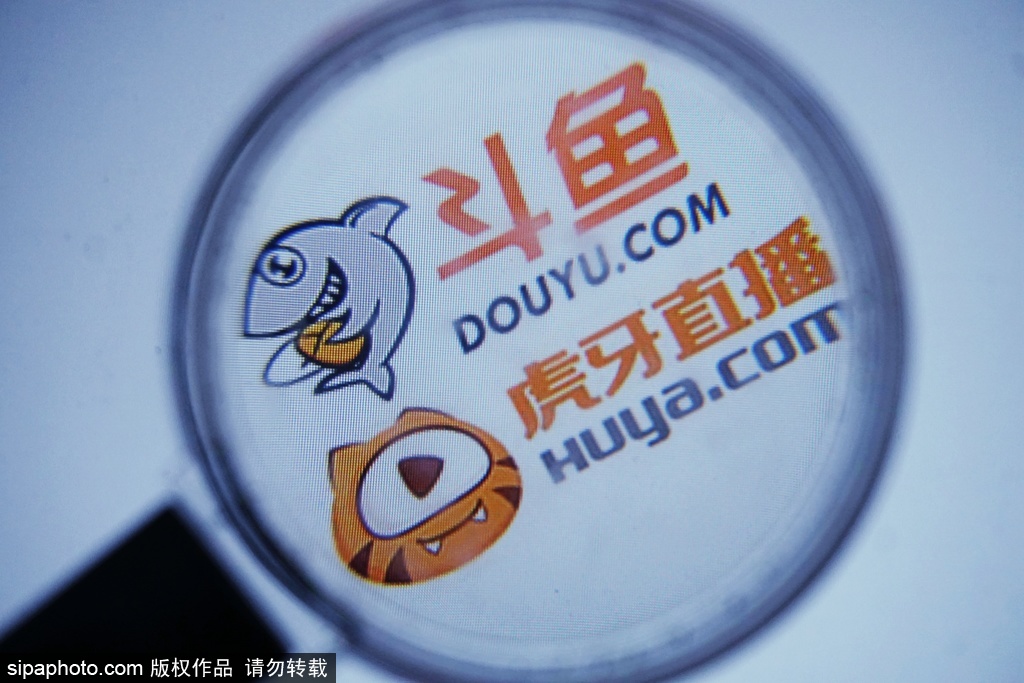
China's market regulator on July 10announced a block on the Tencent-driven merger of the two streaming sites Huyaand Douyu after an anti-monopoly review. The ban was based on the country'santi-monopoly law after the State Administration for Market Regulation on Jan 4launched an antitrust review on the merger filed by Tencent Holdings Ltd. DouYu International said on July 12 it hadterminated its $5.3 billion deal with Huya Inc., two days after China's marketregulator blocked Tencent's plans to merge Huya and Douyu . Tencent-drivenmerger may eliminate market competition Tencent has a market share of more than 40percent in upstream online-game operation services, ranking first in themarket. Huya and Douyu have a market share of over 40 percent and 30 percentrespectively in downstream live games, ranking first and second, and their totalmarket share is over 70 percent, the review showed. Tencent first announced the merger plan inOctober, 2020. The deal fell under investigation at the beginning of this year.The two firms are worth a combined market value of $5.3 billion. Huya and Douyu announced they were to mergelast October. According to the deal, Douyu would become a unit ofGuangzhou-based Huya and would delist from the Nasdaq. The new entity wouldhold around 80 percent of China’s e-sports market and Tencent, which solely ownsHuya and is joint controller of Wuhan-based Douyu, would have 68 percent votingrights. Tencent already has sole control of Huyaand joint control of Douyu. If the merger went ahead, Tencent would have solecontrol of the new unit, further strengthening Tencent's dominance in thelive-game market, the regulator said. Tencent might have the ability andmotivation to implement a blockade in the upstream and downstream markets,which may have the effect of excluding and restricting competition, hurtingfair competition in the market, the regulator said. Also, the additional commitments proposedby Tencent cannot effectively resolve the fair competition concerns, theregulator said. The blocking of the merger between Huya andDouyu is the first instance of its kind in China’s internet platform economyand demonstrates regulators’ determination to rein in monopolistic behaviors,according to a government advisor. It is a clear signal that the Chinesegovernment is stepping up anti-trust regulation and preventing disorderlyexpansion in the field of the platform economy, Zhang Chenyin, a member of theState Council’s Anti-Trust Committee advisory team, wrote in the Economic Dailyon July 10. The case will encourage internet-basedcompanies to increase their market share through fair means, such astechnological innovation and improving consumer welfare. It will also spur suchfirms to re-evaluate their business practices, she added. To the announcement, Tencent said in astatement it will abide by the decision and comply with regulatoryrequirements. It will operate per applicable laws and regulations and fulfillits social responsibilities, said Tencent. Tencent'sSogou acquisition given approval The State Administration for MarketRegulation has unconditionally approved Chinese internet giant Tencent'sacquisition of the country's second-largest search engine Sogou Inc, accordingto an announcement from the administration on July 13. Tencent shares were upmore than 4 percent as of 10:29 am. The approval comes days after watchdogsnixed its plan to merge Huya and Douyu, two live-streaming platforms underTencent. Tencent, Sogou’s largest shareholder, madea buyout bid for the US-listed firm a year ago. Tencent owned about 45 percentof Beijing-based Sogou. The Tencent-Sogou deal was among 20 given“unconditional approval,” according to a document added to the StateAdministration for Market Regulation’s website. It did not disclose specificinformation about the mergers and acquisitions. The SAMR previously penalized Tencent forbuying 36.5 percent of Sogou in 2013. The regulator fined it$77,300 because themerger was not reported to the relevant State Council department as requiredand violated the anti-trust law, according to a statement released by the SAMRon July 6. The document also noted that the SAMR hadevaluated the impact of the acquisition and concluded that it would not excludeor restrict competition. Sogou, a subsidiary of portal Sohu foundedin 2004, is China’s largest search engine and Chinese input method serviceprovider after Baidu, according to public information. Nationstrengthening antitrust enforcement China has never made and will never makeantitrust enforcement a tool for geopolitics, and the nation always treats allentities, whether State-owned, foreign or private enterprises, equally andfairly, said a senior official from the country's top market regulator. The comments came as China joins othernations in stepping up regulation of big tech companies and strengtheningantitrust enforcement to ensure the healthy development of internet economies. Wu Zhenguo, director of the anti-monopolybureau of the State Administration for Market Regulation, said anti-monopolylaw is fundamental to international trade and economy, and geopolitical climatenever affects China's anti-monopoly law enforcement. Wu made the comments in a written interviewwith Antitrust Source, an online periodical edited and published by theAmerican Bar Association. According to Wu, strengtheningcommunication and cooperation between China and the United States in theanti-monopoly field is in the common interests of the enterprises and people ofboth countries. "We hope to work with our counterpartsin the US to accelerate the negotiation and signing of a new Sino-US memorandumof understanding on antitrust cooperation," Wu said. He said Chinese companies' overseasbusiness operations should be treated fairly and not subject to unprovokedinvestigations, accusations or blockades that harm not only Chinese companies,but also US companies. "In the future, we will strengthenChinese companies' overseas antimonopoly compliance and provide them withnecessary guidance and assistance," Wu added. Given that the thriving digital economybrings about competition issues while promoting economic development, thesenior official said beefing up anti-monopoly law enforcement in key sectors,including platform enterprises, is a top priority for the regulator this year. On July 8, the administration imposed 22fines of 500,000 yuan ($77,000) each on tech giants including Alibaba GroupHolding, Tencent Holdings and Didi Global for a series of violations of theanti-monopoly law related to merger deals over the past years. All the cases were found to have caused anunlawful concentration of business operations, although they were notconsidered to have limited or restricted competition. Wu said that for digital platforms, the"winner takes all" effect is prominent, and strong players normallygrow even stronger. This is an area prone to a situation in which one orseveral players dominate. Sun Nanxiang, a researcher at the ChineseAcademy of Social Sciences' Institute of International Law, said the ultimatepurpose of antitrust measures is to leverage legal tools to restore fair andeffective competition to the market. US tech giants like Google, Apple andAmazon have faced continuous scrutiny and fines from government authoritiesworldwide for monopolistic behavior in recent years. European Union regulatorshit Google with a 4.34 billion euro ($5.14 billion) antitrust fine in 2018 forusing its Android mobile operating system to squeeze out rivals. On July 8, the top Chinese antitrustregulator and four other government departments jointly issued a detailedregulation on a fair competition reviewing system. The top regulator said it will furtherbreak barriers in regional markets to safeguard fair competition and marketorders. The new rules have highlighted the wider implementation of the reviewsystem by emphasizing the role of the joint review mechanism among governmentsfrom ministerial to county level. China issued antitrust guidelines on thecountry's platform economy in February, signaling stricter antitrustenforcement against monopolistic behaviors in the country's internet platformsector. |