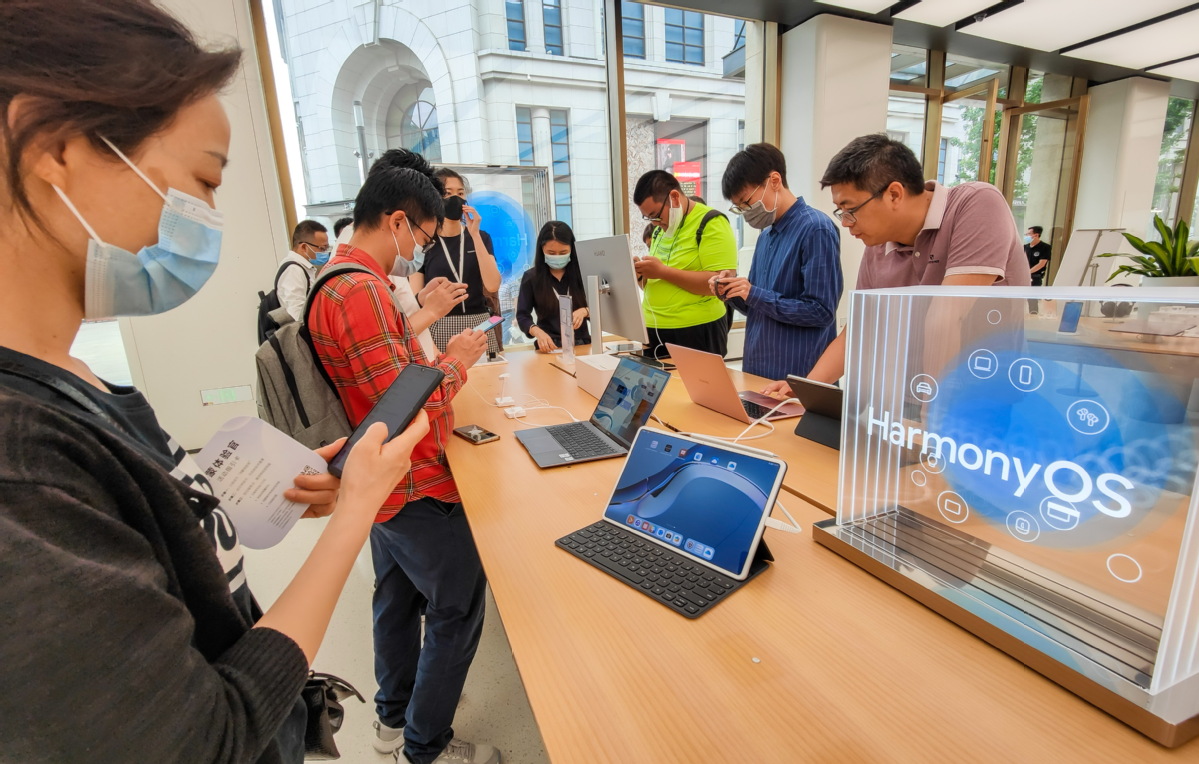
Chinese telecom giant Huawei on June 2officially launched its operating system HarmonyOS 2 for smartphones, providingcustomers worldwide with a competitive alternative that works on a diverserange of devices. HarmonyOS, or Hongmeng in Chinese, is anopen-source operating system designed for various devices and scenarios. Itfirst launched on Internet-of-Things (IoT) devices, including wearables andtablets, in August 2019. Huawei expects the number of devices equippedwith HarmonyOS to reach 300 million by the end of 2021, including more than 200million for Huawei devices. "We are surrounded by more and moresmart devices these days, and are now in a world where all things areconnected," said Richard Yu, CEO of Huawei's Consumer Business Group."Every single one of us is a part of this fully connected world, as isevery device." "We look forward to working with morepartners and developers to build a thriving HarmonyOS ecosystem," he said. Huaweilaunches HarmonyOS 2 for smartphones As a next-generation operating system forsmart devices, HarmonyOS provides a common language for different kinds ofdevices to connect and collaborate, providing users with a more convenient,smooth, and secure experience, according to Huawei. Analysts believe that the new operatingsystem, featuring adaptability and openness, will give an impetus to the globalsmart-device market and offer billions of mobile terminal users worldwide morediversified choices. The operating system launches at a timewhen the United States continues to restrict Huawei from accessing key Americantechnologies and products in an attempt to lock the company out of the global5G market. In the first quarter of 2021, Huaweirecorded a sales revenue of 152.2 billion yuan ($23.8 billion), down by 16.5percent year-on-year. A US crackdown against the company was widely blamed forthe decline. Zhao Xiaogang, an associate professor withthe school of computer science at Wuhan University, called HarmonyOS a"mega-terminal" that enables more streamlined and efficientcross-device connectivity. "HarmonyOS greatly enhances theinteractive speed between devices and improves the efficiency of theircomputing power, thus providing customers with a more optimized cross-deviceuser experience," said Zhao. He has been tracking the development of theoperating system for years. Industry insiders say the success of thesystem hinges largely on whether it can attract, within a short window of time,enough hardware and software developers to embrace the ecosystem by HarmonyOS. For Wang Chenglu, president of the softwaredepartment of Huawei's Consumer Business Group, the short-term market sharegoal for HarmonyOS's ecosystem is 16 percent. "Sixteen percent is athreshold for an operating system's ecosystem to develop prosperously. It is athreshold that Huawei must pass," Wang said. He said HarmonyOS is an operating systemdesigned for the internet of things era, and it can connect all kinds of IoTdevices. "Huawei wants to have 300 milliondevices running HarmonyOS this year, with 200 million of them being smartphonesand more than 30 million tablets, smartwatches, smart TVs and otherproducts," Wang said, adding the rest would be third-party products fromHuawei's partners. Chinese industries, including homeappliances, sports and fitness, travel, entertainment, and education, havewelcomed the launch of HarmonyOS. The operating system has already been used intablets, smart TVs, as well as third-party companies' home appliances such asovens and smoke exhaust ventilators. In May, Midea Group, a leading Chinese homeappliances maker, announced that it would roll out some 200 new productsrunning on HarmonyOS by the end of this year. "It is very important to cultivate asound ecosystem for HarmonyOS in two years. Now, we have hundreds of millionsof Huawei mobile phone users. If they upgrade their smartphone systems toHarmonyOS and feel that the experience is good, they will stay with ourproducts," Wang said. Originally conceived as a system for IoTdevices, the application of HarmonyOS on smartphones was almost an afterthoughtfor Huawei. The idea of developing an operating systemwas first proposed in 2012 by Wang, who was then working at Huawei's softwareinstitute. It was floated as a technical solution to catalyze the company'ssoftware-developing potential. With the fast growth of Huawei's customerbusiness, the project gained increasing internal support, and the first versionof the operating system was developed in May 2017. After the US adopted a string ofrestrictive measures on Huawei in 2019, citing national security concerns, theproject took on more urgency. In August 2019, Huawei launched HarmonyOS on IoTdevices. Techgiant's IoT OS offers a competitive alternative Huawei Technologies Co has made a majorbreakthrough with the successful launch of its Harmony operating system forsmartphones, but still has a long way to go before it can successfully build astrong software ecosystem, experts said. Their comments came after the Chinese techgiant launched its latest operating system Harmony-OS 2 on June 2 forsmartphones, tablets and smartwatches. Wang Baohua, a computer expert at thedepartment of information and computational science at the school ofmathematics and statistics at Shenzhen University, said Google's Android andApple Inc's iOS system are the two most widely-used smartphone systems inChina. HarmonyOS is testament to Huawei'stechnological prowess and will help it to retain customers to some extent,particularly at a time when it cannot guarantee enough smartphone shipments toattract new consumers due to restrictions by some overseas governments, Wangsaid. Huawei has unveiled the name list of thefirst batch of its existing smartphones and indicated a timeline for bringingother models under the new operating system by the first half of next year. The move marks a crucial step for Huawei,which had prepared for its transition from Google's Android operating system toHarmonyOS for a long time after Washington restricted its access to Googlesoftware and services in 2019. Huawei said earlier that it expects thenumber of devices equipped with HarmonyOS to reach 300 million by the end ofthis year, including more than 200 million for Huawei devices. Yu Chengdong, CEO of Huawei's consumerbusiness group, said HarmonyOS is by no means a substitute for Android or iOS.Instead it is designed to power the internet of things. The IoT-compatibleHarmonyOS is designed to quickly connect different devices from differentbrands and enable them to "cooperate" with each other, said Yu. Zhao Xiaogang, an associate professor withthe School of Computer Science at Wuhan University, called HarmonyOS a"mega-terminal" that enables more streamlined and efficientcross-device connectivity. "HarmonyOS greatly enhances theinteractive speed between devices and improves the efficiency of theircomputing power, thus providing customers with a more optimized cross-deviceuser experience," said Zhao. HarmonyOS was first unveiled in August2019, and it had already been used in smart TVs, as well as third-partycompanies' home appliances such as ovens and smoke exhaust ventilators beforethe online launch. Experts said that it will take time andefforts for Huawei to build a vibrant ecosystem of software and hardwarepartners. That is the key for the operating system to survive in the highlycompetitive digital world, they added. Wang Chenglu, president of the softwaredepartment at Huawei's consumer business group, said the short-term marketshare goal for HarmonyOS's ecosystem is 16 percent. "Sixteen percent is a threshold for anoperating system's ecosystem to develop prosperously. It is a threshold thatHuawei must pass," Wang said. Yin Dong, a Beijing-based softwaredeveloper who has been using tools from HarmonyOS to develop mobileapplications for five months, said he is very optimistic about the operatingsystem's future. "It is very convenient to developapplications for cross-device experience based on HarmonyOS, giving it an upperhand over Android which is designed only for smartphones,"Yin said. |