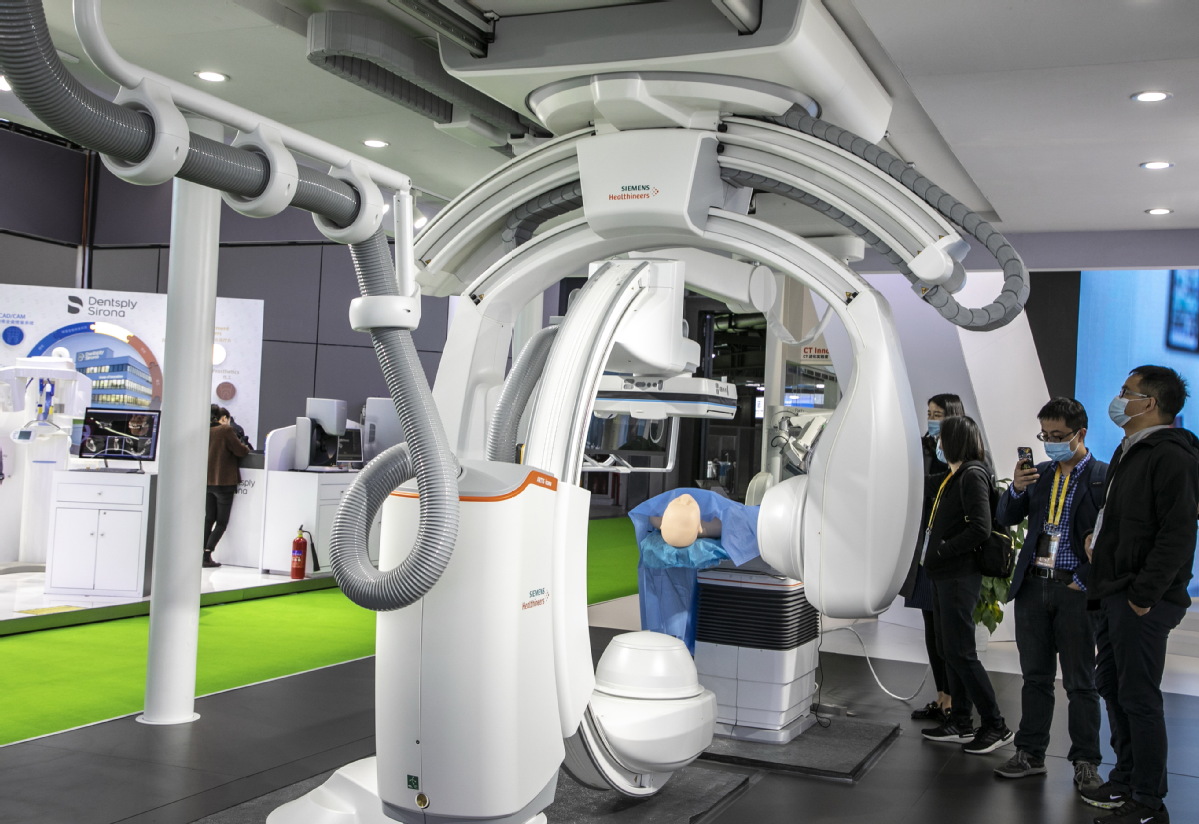
For multinational corporations, China hasbecome the look-to market turbocharging global growth amid the COVID-19pandemic. In the medical sector, such a phenomenonhas shown particular momentum. The country's organic market growth iswhetting the appetites of foreign healthcare players vying for a slice of thepie. Effortsto build comprehensive infrastructure for healthcare create new opportunities A case in point is Siemens Healthineers, aGerman medical technology giant, which saw first quarter growth in China jump25 percent year-on-year. "We had a very good start into theyear with strong growth coming from China," said Elisabeth Staudinger,Asia-Pacific president of Siemens Healthineers. The company recently raised growth guidancefrom 5-8 percent to 8-12 percent for 2021, as China is expected to be one ofthe "main pulls" amid medical imaging equipment demand such as forX-ray machines and MRI scanners. "This is also very clearly connectedto establishing fever clinics and the (country's) continued push to build amore comprehensive infrastructure for healthcare not only in big cities but inremote, provincial areas," Staudinger said. For medical device maker Boston Scientific,China-currently trailing Japan-is ready to returnto high double-digit growth this year and become the largest overseas market infive years after its home market of the United States. Art Butcher, the company's executivevice-president and president for Asia-Pacific, cited "broad-based recoveryacross all of its business units" in China, which experienced speedyeconomic recovery following the pandemic and the consequent bounce-back ofprocedural volumes. "The strategic importance of Chinacannot be overstated," he said. "China is incredibly important to ourregional and global strategy. I fully anticipate that China will be the largestsingle business unit outside of the United States." He expects particular growth to materializein areas like left atrial appendage closure devices, which are a therapy forstroke prevention, and its peripheral interventions business, with the launchof a drug-eluting stent technology. The story of China outperforming othermajor markets in the 2020 playbook also holds true for Boehringer Ingelheim.The German pharmaceutical company, which produces human and animal medicines aswell as biopharmaceuticals, recorded a 2020 sales surge of 20.5 percentyear-on-year to be the growth engine for its 19.6 billion euro ($23.1 billion)global revenue pie. Among them, animal healthcare productsexpanded over 50 percent thanks to booming needs for swine vaccines, whereasthe human healthcare sector also registered 13 percent year-on-year growth withclinical trials bouncing back in hospitals. "Looking ahead, we do believe that wehave ample opportunities that the Chinese market offers to us and we are verycommitted to contributing and harnessing these opportunities," saidHubertus von Baumbach, chairman of the board of managing directors. While the 9.35 billion yuan ($1.43 billion)in sales to China last year accounted for around 6 percent of BoehringerIngelheim's overall revenue, Felix Gutsche, China chairman and CEO, remainedrosy about the growth trajectory bolstered by macro policies such as thedual-circulation development pattern. "I think it gives a very cleardirection to where China is heading to," he said. "We have a lot ofassets here to support the domestic cycle… at the same time, we bringinnovation from other parts of the world to China." HealthyChina 2030 charting the course for future healthcare development Indeed, executives pointed to a series ofplans and directives in China that point to stronger business growth. The country has issued a grand plan calledHealthy China 2030, charting the course for healthcare development in thecoming decade. The recently-released 14th Five-Year Plan,which laid the blueprint for China's development for the next five years,includes a number of healthcare-related policy focuses such as optimizingbalanced quality medical resources, promoting tiered diagnosis system anddeveloping high-end medical devices and the proliferation of remote medicalcare. Staudinger considers healthcare to be"a very core element" of the 14th Five-Year Plan (2021-25), which isalso the "strategic infrastructure "for China and constitutes thesource of optimism in the country. "For instance, this multitieredhealthcare system the country is pushing forward is really at the core ofdelivering high-quality healthcare to the people, and it's also an opportunityfor us," she said, referring to the need for imaging equipment like X-raymachines and blood testing equipment. "We are here to deliver four missions-expandprecision medicine, transform care delivery, improve patient experience anddigitalize healthcare," said Wang Hao, president of Siemens HealthineersChina. For instance, the company is using5G-equipped vehicles installing CT scanners to tap into populations living inChina's remote regions where medical resources are relatively scarce. For Boston Scientific, the common threadrunning the business playbook is the focus on expanding access to medical careand improving quality. "So our focuses are on expanding accessto care and improving quality of care, which I think is very much aligned withwhat the Chinese government has outlined as the China healthcare policy,"Butcher said. It is also training its sights on physicianeducation as part of efforts to improve quality, and last year's online pushthrough webinars and digital courses, reaching more than half a millionhealthcare providers, opened up "a whole new chapter for us", headded. "So we figured out new ways oftraining remotely, so that we can accelerate procedural growth. And thenultimately, all of that ties back to expanding access to care and quality ofcare, which ties exactly to the two sessions' (China's annual top legislatorand political consultative meetings) goals," he said. Multinationalcompanies collaborating with Chinese peers Gone are the days when multinationalcompanies regarded China only as a source of raw materials or research. Instead, they are now flocking to enterinto partnerships with Chinese peers, not just for product customization tomeet unique local needs, but also to include Chinese perspectives and wisdomfrom the very beginning of product design. Making global offerings relevant for keymarkets in China is one approach for local tie-ups for Siemens Healthineers.After all, 30 to 40 percent of all revenue the company created is based onproducts that are no older than three years, and that's inseparable withdeepened tie-ups in China. But the company is definitely "taking things tothe next level", Staudinger said. "We will discuss with Chinese playerswhat our global platform would be like, what the products or the basis of theworks would be," she said. "We are beginning to ask here in Chinabecause we believe there's a lot of insights here that we need to capture inorder to do this." She cited an example of collaborating withthe Chinese Academy of Sciences in Beijing and Fudan University in Shanghai ona pipeline project related to brain research. Another group of stakeholders insimilar tie-ups include leading Chinese hospitals. Staudinger saw China's dual-circulationdevelopment pattern a positive note to enterprises operating in the country. "I don't perceive it as something onlyprotecting local players," she said, adding that the company sourceslargely 80 percent of products or parts in products locally. "I think it makes a lot of sense tostrengthen the domestic circle as much as the international one, because thatwill be a strong combination, not only for China, but allows China to be tiedin to the global value chains," said Gutsche from Boehringer Ingelheim. Apart from a 450 million euro investmentplan over the course of five years, the company has spared no efforts in takingstronger steps in localization. Last year alone saw the company setting up anexternal innovation hub, establishing its first overseas digital lab BI X inShanghai, and acquiring an equity stake in New Ruipeng Group to better tap intoChina's booming pet market. The Chinese government has been advocatinglocal enterprises to step up indigenous innovation in order to achieve technologicalindependence in core areas. "I think the government directive canactually bring about more opportunities for cooperation," said ZhangWeiyi, head of Boehringer Ingelheim China External Innovation Hub. "Themore the government encourages local innovation, the more chances we will haveto tap into more downstream enterprises in driving technological and scientificbreakthroughs." In a similar vein, Boston Scientific hascarried out a number of pilot programs such as a therapy for benign prostatichyperplasia and using 5G technologies, in Hainan Boao Lecheng InternationalMedical Tourism Pilot Zone, a dedicated area where preferential policies areallowed to import medical devices, technologies and drugs. "If you think about that mission ofexpanding access and quality, and (China's) dual circulation (developmentpattern), which is localization and partnering and helping to develop localindustry while also delivering global innovation, I think we're really tryingto grow in the partnership with shared vision of the Chinese government,"Butcher said. |