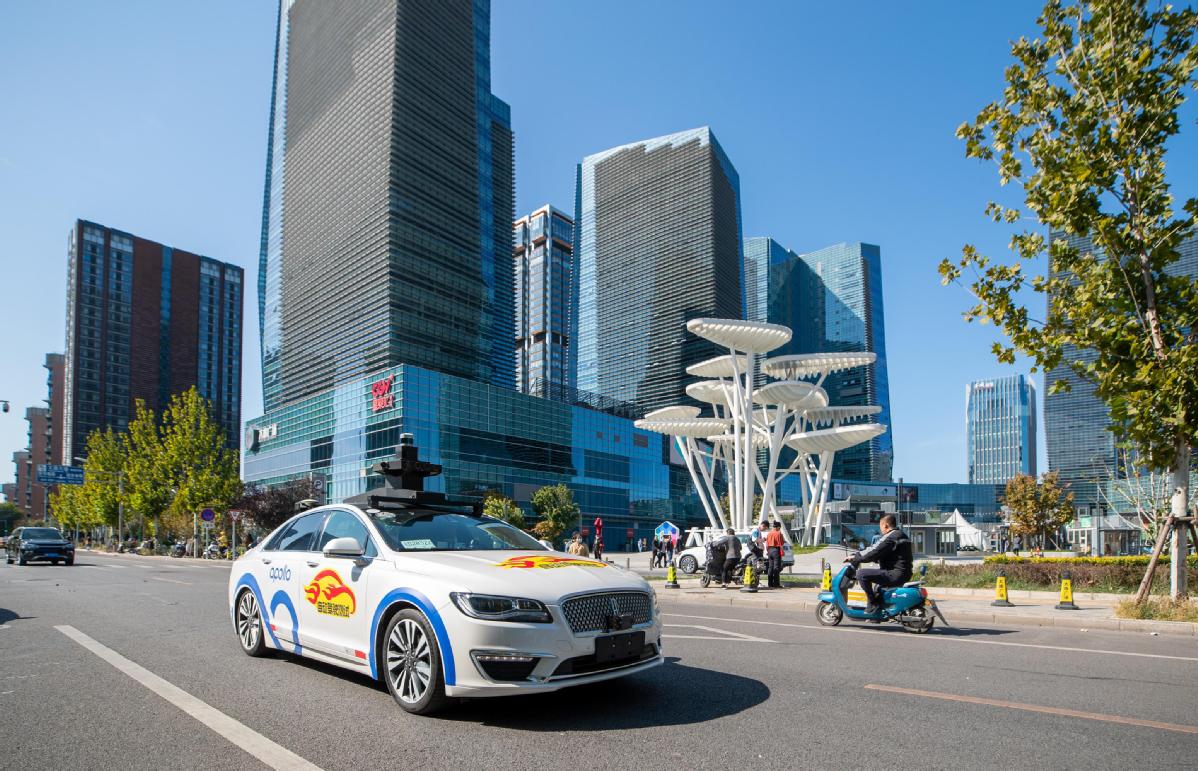
Chinese internet search giant Baiduannounced on January 11st that it plans to establish an intelligent electricvehicle company and has formed a strategic partnership with auto manufacturerZhejiang Geely Holding Group as the country's new energy vehicle market gets inthe fast lane. It is an inevitable trend that more andmore technology companies will make their forays into the emerging new energyvehicle sector, ramp up production and roll out new smart vehicles in a bid toseek new growth engines and expand business landscapes, industry experts said,while noting the competition in this sector will intensify. Baiduteams with Geely on electric cars The new company, which will operate as anindependent subsidiary of Baidu, will oversee the entire industrial chain, fromvehicle design and research and development to manufacturing, sales andservice, Baidu said in a statement. The Beijing-based technology behemoth willproduce the vehicles with intelligent driving capabilities while Geely willcontribute its expertise in automobile design and manufacturing. In addition, Baidu will support thecompany's rapid growth with its full portfolio of core technologies, includingApollo autonomous driving, DuerOS voice assistant for Apollo and Baidu Maps. The new company aims to reshape intelligentvehicle offerings and bring about a revolution in intelligent transportation.The two parties will collaborate closely in vehicle manufacturing and willleverage Geely's new sustainable experience architecture or SEA, a world-leadingEV manufacturing platform, to jointly develop the next generation ofintelligent vehicles. " China has become the world's largestmarket for EVs, and we are seeing EV consumers demanding that next-generationvehicles be more intelligent," said Robin Li, the co-founder and CEO ofBaidu. Li added as a top Chinese automaker withglobal reach, Geely has the unique experience and resources to design, produceand market energy-efficient, reliable and safe automobiles on a large scale. He believed that by combining Baidu'sexpertise in smart transportation, connected vehicles and autonomous drivingwith Geely's expertise as a leading automobile and EV manufacturer, the newpartnership will pave the way for future passenger vehicles. Li said Baidu has long believed in thefuture of intelligent driving, and over the past decade it has invested heavilyin artificial intelligence to build a portfolio of self-driving services. "The collaboration marks a significantexpansion into auto making for Baidu, which is in need of a new platform toshowcase its accumulated cutting-edge technologies, such as autonomous driving,intelligent connected vehicles and artificial intelligence, as well as topromote its technology upgrades," said Jiang Zheng, an expert at the researchand development center affiliated to Guangzhou Automobile Group. Jiang explained Baidu only served as asupplier of technology solutions when partnering with other car manufacturersin the past and couldn't give full play to its overall strengths, especially inthe self-driving segment, in consideration of current laws and regulations,costs and safety issues. "It is of great significance thatGeely, as an automobile and EV manufacturer, is teaming up with Baidu. Vehiclemanufacturing is a typical asset-heavy industry, which requires hugeinvestments in land, production facilities and factory construction and maytake a long time," Jiang said. Baiduunlikely to sell vehicles to individuals Baidu's decision to produce cars havecaused a stir in the capital and automotive markets, but the Chinese techcompany is more likely to build robotaxi fleets than sell vehicles toindividual customers, analysts said. The company announced its plan last week tobuild a standalone car company to produce and market passenger vehicles, usingChinese carmaker Geely's electric vehicle architecture. Baidu did not offer details on how itsvehicles will be different than those from Tesla or any other gasoline carchallenger or when the vehicles will hit the market. Though much remains a mystery, the newsdrove investors into a frenzy. Baidu's stock price hit $249 on January 15th,the highest since July 2018 and up from around $180 in December, when Reutersfirst reported its intention to make cars. Nearly 1.37 million electric cars andplug-in hybrids were sold in China last year, up 10.9 percent from 2019,according to statistics from the China Association of Automobile Manufacturers. The association estimates the figure willreach 1.8 million in 2021. China expected such vehicles to account for 20percent of total vehicle sales in 2025. Roy Lu, director of Gasgoo Auto ResearchInstitute, said Baidu is unlikely to sell vehicles to personal customers.Unlike Apple or Sony, Baidu does not produce any customer products, so it wouldbe unwise to try its hand at the more expensive vehicles, he said. "Its biggest competitive edge lies inits autonomous driving technology. And it may co-build vehicles with Geely forcar-hailing or autonomous driving fleets." Compared with Alibaba, Tencent and Huawei,Baidu is lagging behind in its collaboration with the automotive industry, Lusaid. Baidu established its autonomous driving unit Apollo in 2017.The unitmainly supplies technology powered by artificial intelligence and it hasattracted automakers such as Geely, Volkswagen, Toyota and Ford. However, many leading carmakers laterstarted to develop their own systems instead of installing those developed byothers. "That is because nobody wants to let others serve as theirbrains," said Yale Zhang, managing director of Shanghai-based consultingfirm Automotive Foresight. Zhang said Baidu may try to promote its Apollosystem as well. It can tailor-make fleets of robotaxis withits own autonomous driving system, enhance its popularity with passengers, andthen convince carmakers to use its system. Zhang said even if it does not workout, it can grow its robotaxi fleets, because offering mobility services willreplace selling cars as the auto industry's most profitable area. Baidu now operates the autonomous robotaxiservice, Apollo Go, in Beijing, Changsha in Hunan province and Cangzhou inHebei province, and plans to expand to 30 cities in three years. Earlier in December, it won the green lightto carry out robotaxi tests without safety drivers in Beijing, marking anothermilestone for the company. China'sNEV market to boom in next five years: report China's new energy vehicle (NEV) marketwill see robust growth in the next five years driven by government promotion,investments from vehicle manufacturers and advancements in battery technology,a report from global market research firm International Data Corporation (IDC) said. The total sales of NEVs in the country willreach 1.16 million this year and further expand to around 5.42 million in 2025,according to IDC. China's NEV market is expected to grow at a compound annualgrowth rate of 36.1 percent between 2020 and 2025, according to an industrialreport. The IDC attributed the surging expansion ofChina's NEV market to government promotion, transformation and investment fromvehicle manufacturers, advancements in battery technology, autonomous vehicledevelopment and more open-minded consumers. It may take two or three years for Baidu tomass produce its intelligent electric vehicles, said Zhang Xiang, an automobileanalyst at the new energy and intelligent connected car industry think tankunder the Ministry of Industry and Information Technology. "China's internet companies, whichpossess a large number of users and abundant capital, have encountered somedevelopment bottlenecks, such as facing difficulties in making profitscontinuously," said Zhang, adding that they hope to find new businessgrowth points and that developing autos in collaboration with traditionalautomobile makers is a good choice. Local players including Nio, Xpeng and LiAuto have already tapped into the NEV sector, with sales rising and stockssoaring in recent months. In addition, e-commerce giant Alibaba Grouphas formed a joint venture with automaker SAIC Motor Corp to produce smart EVs,while ride-hailing company Didi Chuxing launched the purpose-built car modelfor ride-hailing services in partnership with BYD. Statistics from the China Association ofAutomobile Manufacturers showed that about 200,000 NEVs were sold in Novemberin China, more than double the previous year. |