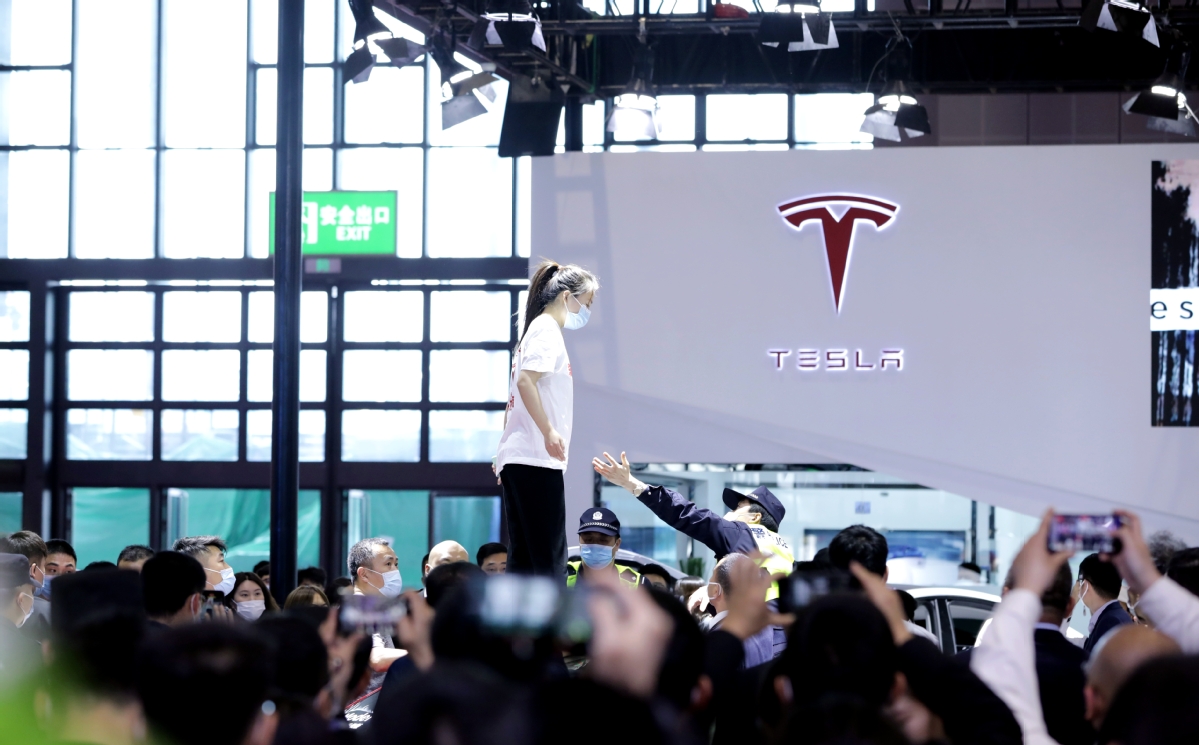
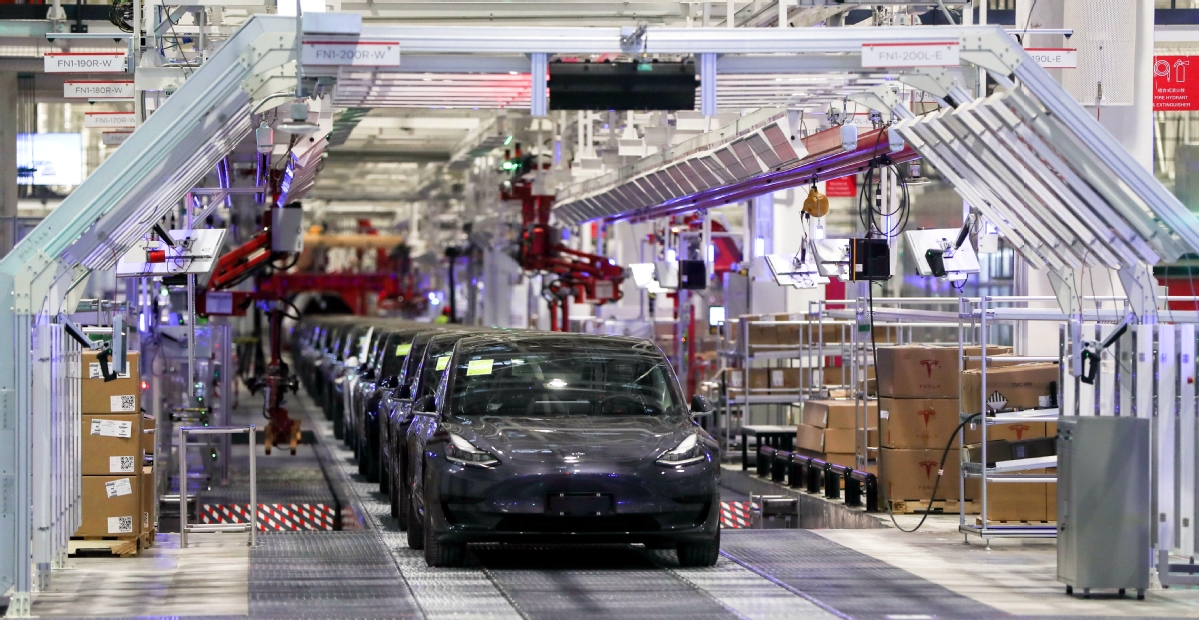
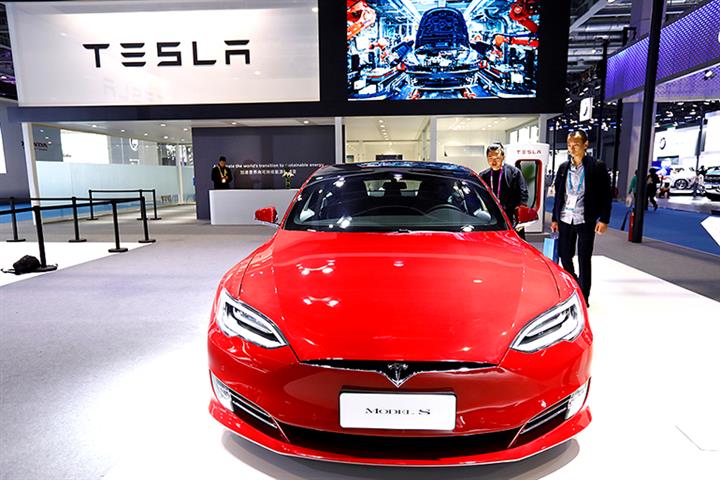
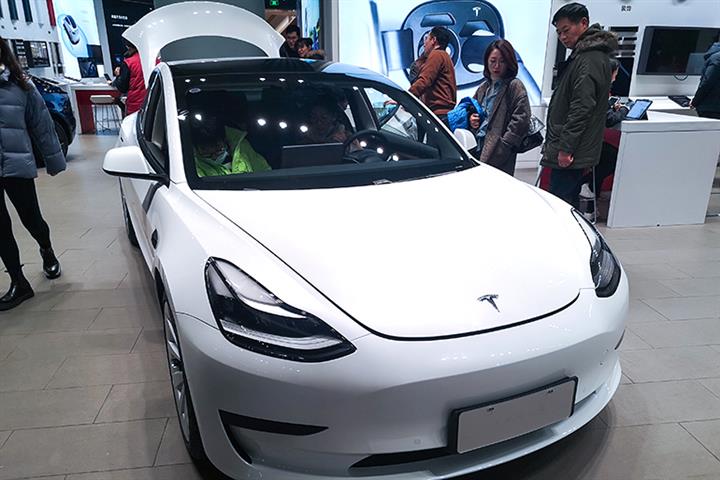
Elon Musk and his electric car company Tesla have a large following in China-the world's largest vehicle market-much to the envy of rivals. Tesla was the bestselling maker of such vehicles in China last year, and in March this year was its best in the country to date, with 35,478 cars sold, according to the China Passenger Car Association. However, a number of potential customers are deciding against placing orders and some owners are refusing to drive their Teslas to protest the way a customer who complained about an alleged brake failure was treated at the Shanghai auto show. Electric carmaker criticized for its handling of unhappy customer On April 19, the opening day of the show, which is held every two years, a woman got on top of a Tesla Model 3 car and shouted that the brakes did not work. She was quickly dragged away by security guards, who attempted to hide her from visitors with open umbrellas. The protester, who was detained by police for disturbing public order, owns a Tesla Model 3 in Henan province, and her father was involved in a traffic accident in February while driving the car. The woman claimed that the crash was caused by a technical problem with the car, but Tesla insisted the accident was due to excessive speed. Soon after the protest, Grace Tao, a Tesla vice-president, told reporters: "There is no possibility Tesla will compromise ... I think she (the protester) is quite professional ... She has contributed to most of the negative news about Tesla recently." Faced with mounting pressure, the company softened its stance, issuing a series of late-night statements. On April 20, it put out an apology and said it was carrying out a "self-inspection". Next day, it said it was "working with regulators for investigation". On April 22, Tesla disclosed data about the vehicle that crashed, generated before the accident. The data have not been independently verified. Yang Zhongyang, a senior auto reporter at Economic Daily, said the criticism leveled against Tesla centers mainly on how it responds to complaints, rather than referring to the quality of its vehicles. In a news analysis, Reuters said Tesla defies industry convention, as it is based on a corporate culture that rarely admits mistakes. The company has long been accused by customers of responding in an irresponsible manner to complaints about incidents such as battery fires, unexpected acceleration and failure to provide software updates. Only two months ago, Tesla promised to "strictly abide by Chinese laws and regulations and always respect consumer rights "after the State Administration for Market Regulation urged it to heed consumer complaints. Tu Le, an analyst at research company Sino Auto Insights, said, "There have been constant complaints on social media about Tesla in China regarding quality and service issues, but they seem to have been largely ignored by the local team until April 20." Doubts rise over Tesla as April sales tumble Recently, Tesla saw its Chinese sales slump in April following its controversial handling of customer complaints, raising concerns over the US electric carmaker's prospects in the world's largest vehicle market. A total of 25,845 Model 3 sedans and Model Y crossovers were delivered in April, down around 27 percent from March, according to China Passenger Car Association data released on May 20. This has caused speculation that Tesla is suffering from a backlash of its tough stance and response to the incident at Shanghai Auto Show in April. The incident caused outrage against the brand that was deemed one of the best electric carmakers. However, in a statement to China Daily, Tesla said the sales fall was primarily due to a two-week production halt to update its manufacturing equipment at its Shanghai plant. The plant also produces vehicles for export. Statistics from the CPCA showed that Tesla exported around 14,000 of the 25,845 vehicles sold in April. Tesla did not give an estimate whether its sales would rebound to levels in March, which saw 35,000 vehicles delivered in the country. But orders of its Chinese-made Model Y will not be delivered until July. Tesla sold more than 95,000 vehicles in the first four months in China. But sales in January and February combined were around 33,000, which was lower than its sales in March. A source close to Tesla told China Daily that the repercussions of Tesla's incident at the Shanghai auto show would not be felt in the month it happened. In a separate development, Reuters reported Tesla is suspending its plan to expand its Shanghai plant. Tesla refrained from bidding in March on a plot of land across the road from the plant. It no longer aims to boost Chinese production capacity significantly, at least for now, citing three people with knowledge of the matter. "Tesla Shanghai factory is developing as planned. It is progressing but there is nothing to disclose at this stage," said Tesla in a statement to China Daily on May 20. Tesla's Shanghai factory is designed to make up to 500,000 cars per year. It has the capacity to produce Model 3 and Model Y vehicles at a rate of 450,000 total units per year. The firm faces intensifying competition in China with traditional carmakers including Volkswagen and Chinese startups such as Nio. Analysts said Tesla should tread its path more carefully in the Chinese market and show respect to its customers, which should be the golden rule for any business. Rivals speeding up efforts to introduce their electric cars Chinese electric vehicle startups continue to be billed as Tesla rivals by international media, and the company has also done a great deal to boost the sector's appeal. However, Chinese rivals are doing a much better job in terms of customer relations. Take Nio for example. Some 50 percent of its sales are due to recommendations from people already owning vehicles made by the company. Technology companies, including Huawei, are joining the competition and are expected to eclipse Tesla in terms of driver-assist functions. The first vehicle to feature Huawei's operating system, chips and autonomous driving solutions was shown at the Shanghai auto show this month. Xu Zhijun, deputy president of Huawei, said the vehicles can operate safely for 1,000 kilometers, "much better than Tesla's". As the protester was dragged away from Tesla's booth, international manufacturers are speeding up efforts to introduce their electric cars to China.Volkswagen Group China CEO Stephan Woellenstein was delivering a speech in Chinese, presenting the latest electric vehicles made by the company. In the same pavilion, Volkswagen's premium arm, Audi, reaffirmed its ambition to launch a "golden decade" with its local partners in China. An electric SUV concept named after the city of Shanghai was a highlight of its booth. Also on April 19, General Motors' Cadillac debuted its LYRIQ crossover in Shanghai, which features Super Cruise hands-free driver assistance, including lane change on demand. The company said the system can be used on nearly 300,000 km of highways across China, which is the brand's largest market worldwide. Felix Weller, a senior executive for Cadillac's operations in China, said the model would be delivered early next year. At the same tine, Ford, the second-largest vehicle maker in the US behind GM, launched its electric Mustang Mach-E early this month. The company said its main rival is Tesla's Model Y. Roy Lu, director of the Gasgoo Auto Research Institute, said Tesla is pushing potential customers away. "The market is so competitive, and Tesla shows no respect for car owners who complain about its vehicle quality. Surely its sales and reputation will be hurt," Lu said. Tesla's troubles in China underscore a problem that some of the company's senior executives have acknowledged, although the difficulties mainly relate to its North American business. Tesla Chief Financial Officer Zach Kirkhorn told investors in January, "Service expansion is really important to the future strategy of the company." |