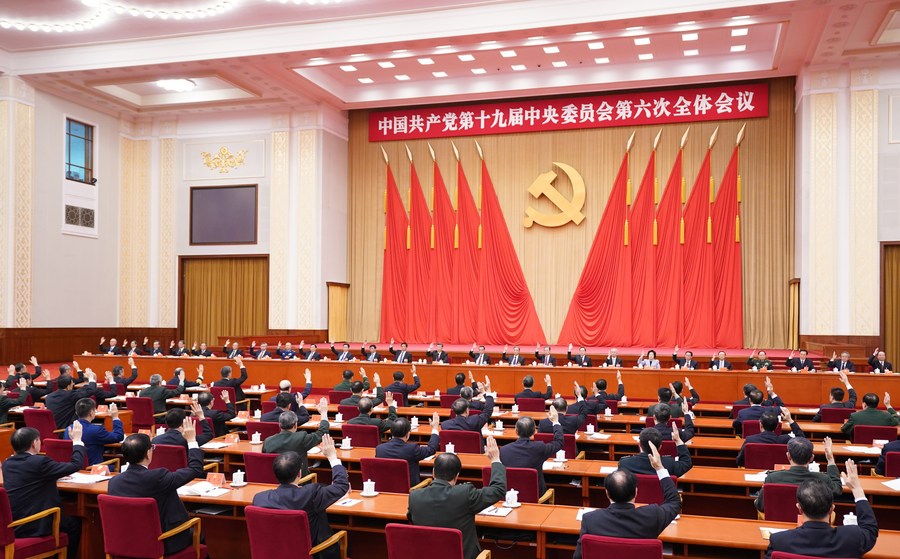
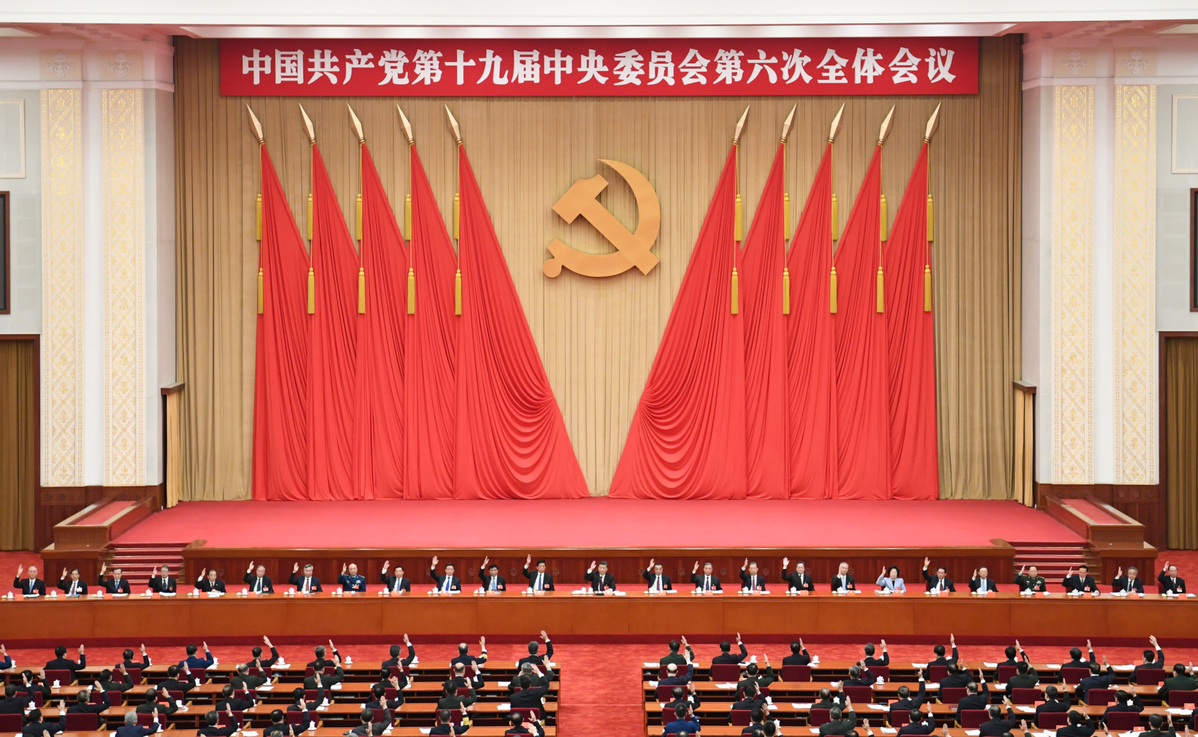
From November 8 to 11, politicalheavyweights of the Communist Party of China (CPC), the world's largest rulingparty, convened a high-profile meeting in Beijing -- the sixth plenary sessionof the 19th CPC Central Committee -- at which a resolution on historical issueswas adopted. The 30,000-plus-character Resolution on theMajor Achievements and Historical Experience of the Party over the PastCentury, is only the third of its kind in the Party's 100-year history: thefirst in 1945 before the victory in the War of Resistance against JapaneseAggression, and the second in 1981 with the advent of the reform and opening-updrive. The timing of the third resolution has itsown historical significance. In 2021, the CPC celebrated its centenary,announced the completion of building a moderately prosperous society in allrespects -- known in China as the First Centenary Goal -- and is leading thenation toward building a great modern socialist country -- the Second CentenaryGoal -- by the mid-21st century. Past,present and future On Nov 8, Xi Jinping, general secretary ofthe CPC Central Committee, opened the plenum by delivering a work report onbehalf of the Political Bureau of the CPC Central Committee. Sitting in the audience were Party cadresand officials, including more than 300 members and alternate members of the CPCCentral Committee, as well as some grassroots delegates to the 19th CPCNational Congress and experts and scholars. Xi said the Political Bureau, whileadvancing work in all areas, focused on three major things over the past year:the CPC centenary celebration, Party history learning and education campaign,and the preparation for the sixth plenary session of the 19th CPC CentralCommittee. All these three activities centered on a singletopic -- history. As an ancient Chinese saying goes: withhistory as a mirror, one can understand the rise and fall of a state. Xi told the plenum that summarizing theParty's major achievements and historical experience over the past century wasof great significance to further unifying the thinking, will and action of thewhole Party. This, Xi said, will help the Party uniteand lead the nation to secure the great success of socialism with Chinese characteristicsin the new era. "Standing at a new historical startingpoint, we review the past and look to the future," Xi said when heexplained the Party leadership's considerations on the theme of the plenum. "Everyone at the plenum shared thesentiment that a great historical responsibility has fallen upon ourshoulders," said a CPC Central Committee member. "We feel that theresolution is bound to have a profound influence on the future of the Party'sand nation's causes." "It is a resolution that connects thepast, present and future," said a plenum attendee. Xi'score position From November 8 to 11, plenum attendeeswere divided into 10 groups for deliberation on the draft documents. There wereoften heated discussions. But all agreed that the historicachievements since the 18th Party Congress, as summarized in the resolution in13 aspects, have provided robust institutional conditions, strong materialfoundations and a source of inspiration for advancing the cause of nationalrejuvenation. They all felt very strongly about oneparticular statement in the resolution: -- Xi Jinping Thought on Socialism withChinese Characteristics for a New Era is the Marxism of contemporary China andof the 21st century. It embodies the best of the Chinese culture and ethos inour times and represents a new breakthrough in adapting Marxism to the Chinesecontext. -- The Party has established Comrade XiJinping's core position on the Party Central Committee and in the Party as awhole and defined the guiding role of Xi Jinping Thought on Socialism withChinese Characteristics for a New Era. This reflects the common will of theParty, the armed forces and the Chinese people of all ethnic groups, and is ofdecisive significance for advancing the cause of the Party and the country inthe new era and for driving forward the historic process of nationalrejuvenation. The attendees said this is an answer to thecall of the times, and a significant political judgment made in response to notonly the Party's common will but also the people's common aspirations. Also included in the resolution were fiveaspects of the historical significance of the Party's endeavors over the pastcentury, and 10 pieces of historical experience. This content reflects the secret behind theParty's success. For instance, the principles of staying independent, breakingnew ground and standing up for ourselves, all are deeply rooted in the Party'shistory and still bear great immediate significance. Unanimouslyadopted On the afternoon of November 11, Xipresided over a plenary meeting of the session at which the resolution wasunanimously endorsed by every CPC Central Committee member in attendance.Thunderous applause broke out and resonated inside the Great Hall of thePeople. The meeting then passed a resolution onconvening the 20th National Congress of the CPC in the second half of 2022 inBeijing. After that, Xi delivered an importantspeech on behalf of the Political Bureau on studying and implementing the spiritof the plenum. "The Party was chosen by history andthe people, and it has lived up to their choice," Xi said, adding thatthere would be no national rejuvenation without the CPC. The resolution particularly emphasized theimportance of strengthening the Party's centralized, unified leadership, Xisaid, explaining that the aim is to demand everyone in the CPC to align withits central committee, unify the Party as "a solid piece of iron" andmarch forward in unison. Xi also stressed the need for "greatstruggle" and "even more arduous and strenuous efforts" andasked Party members to pay close attention to all sorts of "majorrisks" and take effective measures to fend off and resolve them. "With all the great achievements overthe past century, our Party has won much praise from both inside and outsidethe Party, from home and abroad," Xi said. "It is particularly in thesecircumstances that we must promote the spirit of self-reform even more. We cannever allow ourselves to get carried away by the applause," he added. In 1945, when the Party's first resolutionon history was passed, Mao Zedong issued the call for Party-wide unity likemembers of a family. In 1981, when the second such resolutionwas passed, Deng Xiaoping emphasized its importance in unifying the thoughts inthe Party. In 2021, upon the passing of the thirdresolution, Xi urged all Party members to maintain strategic resolve, focus onstrategic targets and bear in mind the country's most fundamental interests. "Today, we are closer, more confident,and more capable than ever before of making the goal of national rejuvenation areality," Xi said. "We must fulfill the duties of our generation inthe relay for attaining national rejuvenation." FromPoverty to Prosperity The speed, scale and span of the economicand social transformation of China during the past 40-odd years have been unprecedentedin human history. One hundred years ago, times were not goodfor China. Its 400 million people lived mainly in rural areas, mired inpoverty. It was a nation ravaged by imperial mismanagement, foreign colonialismand civil wars. On July 23 1921, 13 disillusioned Chineseyoung men and two representatives from the Communist International, metsecretly in an inconspicuous house, 106 Rue Wantz, in Shanghai's FrenchConcession, which began the first national congress of the Communist Party ofChina (CPC). The police interrupted the meeting on July 30, and the Chinesemembers shifted their discussions to a tourist boat on the South Lake inJiaxing, Zhejiang province, to continue the first National Congress. The firstcongress marked the founding of the CPC. Mao Zedong became the leader of thisfledgling party during the early days of struggle. The Party operated fromprimitive quarters dug in the hills of inland city of Yan'an. The cave-likequarters of these early leaders are now a far cry from the latest modern housesof Beijing or Shanghai. It is perhaps unlikely that the pioneersimagined that in only 30 years, the party they formed would govern the nationand continue to lead the country on its successful journey even more than sevendecades after that. Nor would they have imagined that the CPC would become theworld's largest ruling Party with some 95.15 million members in about acentury. Reform and opening-up lead to rapiddevelopment In 1949, under the leadership of the CPCwith Mao at its core, the People's Republic of China was born. The next pivotal transformation of Chinaoccurred in 1978, under the leadership of Deng Xiaoping, with the launch of thepolicy of reform and opening-up. Prior to 1978, food shortages were aconstant problem in China. Thus, initial institutional reforms started in theagricultural sector with two fundamental policy changes. First, prices ofagricultural products were increased. Second, the collective farming system wasgradually abolished and replaced with "household responsibilitysystem". Under this new system, each household had a fixed quota of grainsthat it had to sell to government at official prices. However, any extraproduce could be sold at the market price, which was much higher. These reforms were progressivelyimplemented and were completed by 1984. Consequently, China's agriculturaloutput increased by 47 percent during 1978-1984.This solved the recurring foodscarcity problems and initiated a structural transformation, leading toallocated surplus agricultural labor to industry. Within six years, over 49million workers, 19 percent of China's labour force, shifted from agricultureto industry. Further reforms were implemented in theagricultural sector from 1990. Government interventions were reducedsignificantly. Except for some restrictions on land ownership, China now hasone of the least distorted agricultural economies in the world. This remarkable success in agriculture ledto two major market reforms in the industrial sector during the early 1980s.First, State-owned enterprises were given production inputs and outputs quotasat official prices. However, beyond these quotas, they were free to buy inputsand sell outputs at market prices. Non-State-owned enterprises, includingforeign-owned companies in special economic zones, were allowed to enter somesectors that were previously banned and could buy inputs and sell outputs atmarket prices. Second, from 1980, many economicdecision-making powers were devolved to lower levels of government, with addedfiscal incentives. Consequently, State-owned enterprises at provincial, cityand country levels, and collectives at township and village levels,proliferated. All these reforms ensured China became themanufacturer of the world, boosting national GDP and people's income. In 1978, before the launch of the reformand opening-up process, China's per capita GDP was one-fortieth that of theUnited States and one-tenth of Brazil. By 2020, its per capita GDP, at$10,500.40, was about one-sixth of the US, but 54 percent higher than Brazil. Interms of GDP, Japan Centre for Economic Research now forecasts China will surpassthat of the US by 2028. One impressive part of China's policymakingis it does not have any preconceived ideas or dogmas. New policies are tried inpilot areas. If a policy works, it is further fine-tuned before it is rolledout nationwide. Accordingly, its record of successfully implementing nationwidepolicies is higher than most other countries. An important success of its social andeconomic policies has been that it has now completely eradicated absolutepoverty. In fact, a primary reason why the poverty alleviation target of theMillennium Development Goals of United Nations was achieved, was due to China'ssuccess in lifting about 800 million people out of poverty in the past fourdecades, a remarkable 70 percent of entire global poverty eradication duringthis period. Gloriousfuture lies ahead China had announced two national centenarygoals. The first was achieved by the end of 2020, a year before the 100thanniversary of the founding of the CPC. No country has managed to bring about800 million people out of extreme poverty in only 40-plus years. The second centenary goal, to be achievedby the middle of this century (2049 being the 100th anniversary of the foundingof the People's Republic), is to "develop China into a great modernsocialist country that is prosperous, strong, democratic, culturally advanced,harmonious and beautiful". This second goal is ambitious. However,China's continuing record in terms of enormous investments in all types ofinfrastructure, education (especially in science, technology, includingengineering and medicine), heavy investments in research and development(R&D), and steady economic growth, should enable it to meet the target intime. This will be further helped by its ability to formulate, and speedilyimplement, policies which most societies may find difficult to replicate. Take for example the COVID-19 pandemic. Howit has been managed by China, compared with major industrialised countries ofthe US, United Kingdom or Germany. China, with a population of 1.4 billion, hashad 5,000 death to date due to pandemic. In contrast, the US, with a populationof 330 million which is less than a quarter of China, has a death toll of 756,000,or 146 times that of China. Economically, after a contraction duringJanuary-March 2020, the first time in four decades due to the pandemic, Chinarecovered its economic mojo much faster than any other country. What helped the Chinese economy to recoverwere the efficient and targeted pandemic prevention and control measures. Suchhas been the economic recovery that last month China's exports increased by awhopping 27 percent year-on-year. China has generally focused on geoeconomicsrather than geopolitics. Accordingly, most countries searching for economicprosperity have looked at China for help. Currently, China is the main economicpartner for most countries. The Belt and Road Initiative, which isaimed at improving infrastructure connectivity and boost trade, is likely tofurther accelerate China's economic and trade position by substantiallyimproving and integrating world trade among the countries of Asia, Europe,Africa and Latin America. By constructing new connectivities and strengtheningexisting ones, the initiative is increasing total trade volumes within andbeyond the involved countries, accelerating industrialisation and developmentprocesses, attracting additional foreign direct investments, catalyzingefficient production processes and further advancing regional and globalcollaboration on many fronts. More important, the Belt and RoadInitiative is likely to help build a community with a shared future formankind. In October 2020, the Fifth Plenary Sessionof the 19th CPC Central Committee charted a new development road map for China.Domestic consumption will become increasingly important because of the pandemicand intensifying disruptions to the global supply chain. The plan is tosignificantly increase it by spurring its progress in all possible ways andexpanding investments. Known as the "dual circulation" paradigm, theobjective is to allow domestic and international circulation to reinforce eachother. The "dual circulation" paradigmwill further uphold the central role of modernization in China's continuedquest for economic innovations and implementation of innovation-drivenstrategies. China has decided to accelerate green and low-carbon developments,increase efficiencies of resources utilization and continue to improve theenvironment and stability of ecosystems. To achieve these targets, China's annualR&D expenditure has increased significantly since 1995. Between 1995 and2018, China's R&D expenditure increased annually by over 15 percent.According to OECD, China's annual R&D spending reached $463 billion in2018, only $89 billion less than the US figure. By most accounts, China'sR&D spending will overtake that of the US by 2025. Results of this phenomenal increase in thecountry's R&D input is already evident. It has raised the country'seconomic and political status on the global stage, so has its technologicalambitions, innovations and accomplishments. In several areas, China hasovertaken, or is on the verge of overtaking, many developed countries in termsof advances and deployments of specific technologies. An ever-increasing budget for technologicalinnovations, plus a focus on developing and retaining scientific andtechnological talents, the concerted efforts, including the smooth coordinationamong government departments, to cultivate and retain scientific andtechnological talents have enabled China to overtake its Western counterparts inmany fields. China's approach to global technologyleadership has been threefold: significantly improve and expand domesticeducation, attract overseas Chinese talents to return to China and attractforeign talents China's domestic education reform has beenremarkable. Annual science and engineering degrees awarded more than quadrupledbetween 2015 and 2020, from 360,000 to 1.7 million. China is now the world's biggest source offoreign-born talents. Countries are now competing to attract and retain them.Equally, China has been increasingly successful in attracting and retainingreturnees through attractive salaries and generous R&D budgets. Thissuccess has made some Western countries concerned about their competitivenessand national security. The success could also bring more challenges in thecoming years as certain countries could increasingly consider China to be afierce competitor in many sectors. Resolutioncharting country's course hailed by experts The sixth plenary session of the 19thCentral Committee of the Communist Party of China will lead China to greatersuccess in the next century, global experts said. The session held last week adopted theResolution on the Major Achievements and Historical Experience of the Partyover the Past Century, according to the meeting's communique. "The CPC has made tremendousachievements in its 100 years of history and is ready to lead the Chinesepeople into the future," said Gennady Zyuganov, chairman of the CentralCommittee of the Communist Party of the Russian Federation. He said that the main secret to its successis that "the Party set itself the goal of striving for people's happinessand the great rejuvenation of the nation". Salman Bashir, a former foreign secretaryof Pakistan and former ambassador to China, said that under President XiJinping's leadership, China is well positioned to become an economicallyprosperous, militarily strong and beautiful country. "This communique is afurther illustration of the working of people's democracy, which is unique toChina and has no parallels with political parties and governance systems inother countries," he said. Carlos Martinez, co-editor of Friends ofSocialist China, said China set two centenary goals: to achieve a moderatelywell-off society by the CPC's centenary in 2021; and the development of Chinainto a "strong, democratic, civilized, harmonious and modern socialistcountry" by the centenary of the founding of the People's Republic ofChina in 2049. "With the completion of the project toeradicate extreme poverty in late 2020, the first centenary goal has been met.The CPC is now moving steadily toward the second centenary goal," he said. Dennis Munene, executive director of theChina-Africa Center at the Africa Policy Institute, said that under Xi'sleadership, China is committed to lifting people out of poverty and helpingthem become prosperous in the shortest time possible, and is fueling the pushtoward national rejuvenation by providing new, dynamic institutional guaranteesas well as the material conditions for rapid development. "The lesson for Africa is that we needto build political parties that are driven by ideals and convictions, partiesthat maintain political integrity and ensure and enhance people's well-being inthe course of development," he said. Munshi Faiz Ahmad, former chairman of theBangladesh Institute of International and Strategic Studies, and a formerBangladeshi ambassador to China, said that most developing countries, likeBangladesh, are China's partners and friends. "China is the largest contributor toBangladesh's efforts in socioeconomic development. But Bangladesh is not theonly country that benefits from partnership with China," he said, addingthat most countries would benefit from such a partnership to promote a communityof shared prosperity. Ronnie Lins, director of the China-BrazilCenter for Research and Business, described the resolution adopted at thesession as "landmark". Mustafa Hyder Sayed, executive director ofthe Pakistan-China Institute, said, "China's unique developmentmodel" is a unique story in history of "rapid development andeconomic growth, while maintaining social harmony and stability". |