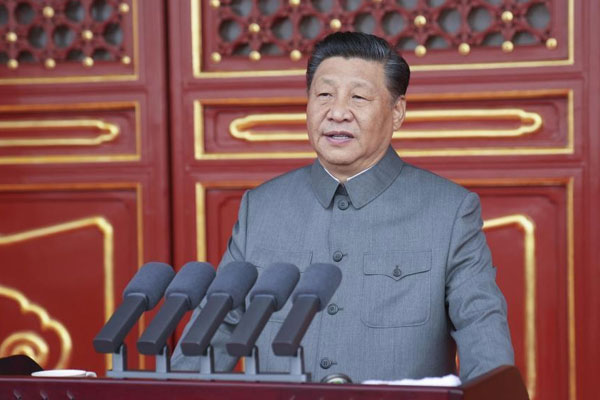
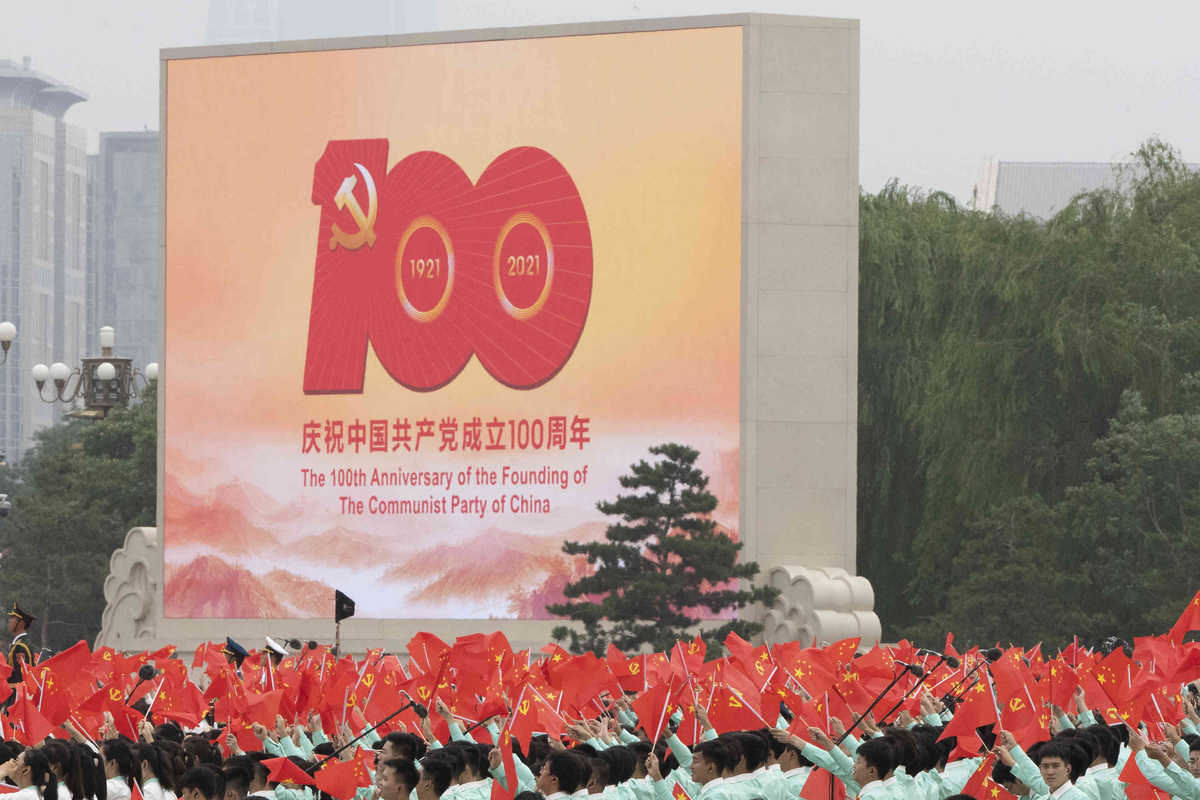
GrandCentenary Celebration On July 1, the Communist Party of China(CPC) celebrated the 100th anniversary of its founding, as its top leaderdeclared the achievement of a milestone development goal and announced that theChinese nation is "advancing with unstoppable momentum toward rejuvenation." Addressing a grand gathering at the iconicTian'anmen Square, where CPC forefather Mao Zedong proclaimed the birth of thepeople's republic, Xi Jinping, general secretary of the CPC Central Committee,hailed the Party's success over the past century and called on the whole Partyto continue its hard work and carry out "a great struggle" to achievenational rejuvenation. Xi delivered a nationally-televised speechfrom Tian'anmen Rostrum before a 70,000-strong crowd. The historic event alsowitnessed a chorus of Party songs, a flypast of fighter jets and helicopters, a100-gun salute, and a flag-raising ceremony. Xi, also Chinese president and chairman ofthe Central Military Commission, declared that China has realized the firstcentenary goal of "building a moderately prosperous society in allrespects." "This means that we have brought abouta historic resolution to the problem of absolute poverty in China, and we arenow marching in confident strides toward the second centenary goal of buildingChina into a great modern socialist country in all respects," Xi said. Reviewing the past 100 years, Xi said theParty has united and led the Chinese people in achieving great success in thenew-democratic revolution, socialist revolution and construction, reform,opening up and socialist modernization, as well as for socialism with Chinesecharacteristics in the new era. In 1921 when the CPC was founded, it hadjust over 50 members. Today, with more than 95 million members in a country ofmore than 1.4 billion people, it is the largest governing party in the worldand enjoys tremendous international influence. Xi paid tributes to CPC forefathersincluding Mao Zedong and Deng Xiaoping, as well as revolutionary martyrs whodied for the Party's cause. "All the struggle, sacrifice, andcreation through which the Party has united and led the Chinese people over thepast hundred years has been tied together by one ultimate theme -- bringingabout the great rejuvenation of the Chinese nation," Xi said, adding thatthis prospect "has become a historical inevitability." The ceremony was presided over by LiKeqiang, and attended by Li Zhanshu, Wang Yang, Wang Huning, Zhao Leji and HanZheng -- all members of the Standing Committee of the Political Bureau of theCPC Central Committee, as well as Vice President Wang Qishan. At the event, Wan Exiang, chairman of theCentral Committee of the Revolutionary Committee of the Chinese Kuomintang,read a congratulatory message on behalf of the eight non-CPC political partiesin China, the All-China Federation of Industry and Commerce, and personageswithout party affiliation. Over 1,000 young people, who arerepresentatives of the Chinese Communist Youth League and Young Pioneers,conveyed their congratulatory message through a recitation at Tian'anmenSquare, expressing the younger generation's commitment to the CPC's cause.Xi'sone-hour speech captured the Party's tremendous success over a century. Under the Party's leadership, the countryhas lifted nearly 800 million people out of poverty over the past four decades.China is now the world's second-largest economy, the largest recipient offoreign direct investment, and boasts one of the world's largest consumermarkets. Its GDP has exceeded the 100-trillion-yuan (about 15.47 trillion U.S.dollars) threshold. Many people have experienced a significant improvement intheir lives. In his address, Xi laid down principlesthat must be followed on the journey ahead. The firm leadership of the Party must beupheld, he said, calling it the foundation and lifeblood of the Party and thecountry, and the crux upon which the interests and wellbeing of all Chinesepeople depend. Vowing to remain committed to combatingcorruption and root out "any viruses that would erode its health," Xisaid the CPC must continue to advance the great new project of Party building. "We must unite and lead the Chinesepeople in working ceaselessly for a better life," he added. Any attempt todivide the Party from the Chinese people or to set the people against the Partyis bound to fail. The more than 95 million Party members and the more than 1.4billion Chinese people will never allow such a scenario to come to pass,"he said. Xi also stressed continuing efforts toadapt Marxism to the Chinese context.Xi said efforts to uphold and developsocialism with Chinese characteristics must be continued. In doing so, theParty has "created a new model for human civilization." The Party is eager to learn what lessons itcan from the achievements of other cultures, and welcomes helpful suggestionsand constructive criticism.” Xi said, "But we will not, however, acceptsanctimonious preaching from those who feel they have the right to lecture us." Xi added that the Chinese nation does notcarry aggressive or hegemonic traits in its genes. "We have never bullied,oppressed, or subjugated the people of any other country, and we never will.But the Chinese people will never allow any foreign force to bully, oppress, orsubjugate us.” he said. "Anyone who would attempt to do sowill find themselves on a collision course with a great wall of steel forged byover 1.4 billion Chinese people," Xi said, as the crowd present atTian'anmen Square burst into thunderous applause and cheers. GloriousDeveloping Experience A century on, the Communist Party of China(CPC) has grown from just over 50 members at the time of its founding to theworld's largest governing party with more than 95 million members. Having started from nothing, the CPC hasled the Chinese people in transforming a poor and lagging country into thesecond-largest economy in the world. President Xi Jinping, also generalsecretary of the CPC Central Committee and chairman of the Central MilitaryCommission, summed up the great founding spirit of the CPC in his speech at aceremony marking the Party's centenary on July 1. Calling it the Party's source of strength,Xi said this founding spirit consists of the following principles: upholdingtruth and ideals, staying true to the Party's original aspiration and foundingmission, fighting bravely without fear of sacrifice, and remaining loyal to theParty and faithful to the people. The spirit has demonstrated its strength invarious endeavors, be it scientific and technological research, ruralvitalization, space programs, social governance, or business operation. At a national key laboratory of hybrid ricein Changsha, Central China's Hunan province, Wu Jun and his team were doingresearch on the breeding of rice varieties that are resistant to majordiseases, insect pests, high and low temperatures and drought. "Developing super-high-yielding ricevarieties is important to ensuring grain security. We will make down-to-earthefforts in pushing forward with the research and live up to the originalaspiration of our predecessors," said Wu, deputy director of thelaboratory. China in February declared a "completevictory" in eradicating absolute poverty. Over the last few years, morethan 1,800 CPC members and officials had sacrificed their lives for the cause. During times of crisis, whether triggeredby earthquakes, floods or epidemics, great numbers of Party members have rushedto the forefront without the slightest hesitation. In July, Party members in all lines ofwork, ranging from rescue workers and medics to engineers and train crewmembers, have built up a strong force of rescue and recovery after recordrainfall triggered severe floods in central China. As the country strives for the ChineseDream of national rejuvenation, the Party's founding spirit will continue toinspire the nation to overcome various tests and trials on the way forward,observers said. The Party's founding spirit has afar-reaching influence on the country's younger generation, who will carry thebaton for national rejuvenation. CPCStrengthens Disciplines The Communist Party of China CentralCommittee on July 2 made public the first document that targets the supervisionof chief officials and leadership teams at all levels in a bid to strengthenstrict governance and discipline within the Party. The guidelines say that many effectivemeasures have been implemented and experience has been accumulated in this areaof work since the 18th CPC National Congress in 2012, yet oversight of chiefofficials at all levels remains a weak link, exposing the urgent need toimprove the Party's internal supervision system. "The greater the responsibility thatleading officials assume, the more important positions they hold and the moreurgent it is to strengthen supervision of them," the guidelines said. The focus of such oversight should bepolitical, which scrutinizes the performance of chief officials and leadershipteams at all levels in remaining loyal to the Party and acting in accordancewith the Party's nature and purpose, according to the document. Noting that oversight of chief officials atall levels should be the top priority, the guidelines said those officialsshould willingly accept such oversight and have the courage to shoulderresponsibilities in their work. "Leadership teams are the backbone ofthe Party's governance structure and they lead the Party's future development,so they are a key group and key object of supervision," said Chen Yaxin,deputy director of the regulations office of the CPC Central Commission forDiscipline Inspection and the National Supervisory Commission. He said that since the 18th CPC NationalCongress, the Party has attached great importance to supervision. However,among the cases of serious disciplinary violations these years, a considerableproportion involved chief officials. "The formulation of the guidelinesdemonstrates the CPC Central Committee's firm determination to crack down ondifficult problems related to internal administration," he added. The document stresses top-downorganizational oversight, requiring chief officials to step up theirdisciplinary supervision of chief officials at the lower level of thehierarchy. It also highlights peer supervision amongmembers of a leadership team, stating that any acts against Party discipline orrules should be promptly reported to the central disciplinary watchdogs. Thosewho conceal these problems will also be held accountable. The guidelines also make clear that chiefofficials must draw a clear line with businesspeople, never use political powerfor personal gain or allow family members to take advantage of their powers tomake profits. Chen said these requirements are also themain focus of political supervision and the purpose is to urge leading teams atall levels to constantly "improve their political judgment, understandingand practice, adhere to loyalty, cleanliness and responsibility and take thelead in upholding the authority of the CPC Central Committee and itscentralized and unified leadership over the country". CPCPuts People’s Interests Atop Committed to promoting the well-being ofthe people, the Communist Party of China (CPC) has enabled China to makeremarkable leaps in its development, a senior official of the French CommunistParty (PCF) has said in a recent interview with Xinhua. Fabien Roussel, national secretary of thePCF, congratulated the CPC on the centennial of its founding. In his eyes, theCPC has been dedicated itself to improving the people's well-being, and enjoysstrong leadership as well as highly efficient executive ability, which are keyto the party's success. "I find remarkable the incredibleeconomic leap achieved by China in a very short period of time, and theobjectives set by the Communist Party of China, in particular the objective offighting poverty and eradicating poverty," he said. China was the first country outside EuropeRoussel visited after being elected as the PCF national secretary. Recalling his trip to China's Beijing andShanghai in 2019, Roussel told Xinhua that he was impressed by the places hevisited, and "would have liked to be able to stay there longer." The PCF leader lauded China's determinationto tackle the climate issue and its stunning efforts to reduce air pollutionand protect the environment, especially in large cities like Beijing andShanghai, speaking highly of the strong measures China has taken to promote newenergy vehicles and reduce cars' exhaust emissions. Roussel paid his tribute to the Chinesepeople's solidarity in fighting the COVID-19 pandemic under the leadership ofthe CPC, and appreciated China's contribution to the global anti-pandemicfight. "I salute the approach and the greatsolidarity that China has demonstrated in this fight against thepandemic," he said. "I would also like to underline the help in manycountries of the world, especially in Africa." According to Roussel, the PCF, whichcelebrated its 100th birthday last year, and the CPC "share the idea thatthe United Nations is the only universally legitimate basis for aninternational order that respects the rule of law and the sovereignty ofpeoples." "This is important because thisinternational order, this international law, is regularly flouted, and it isimportant to be able to give back all its weight to the UN and to enforce thedecisions and resolutions taken by the UN," he said. Enditem Serving the people wholeheartedly has beenthe fundamental purpose of the CPC -- a party taking pride in coming from thepeople and being rooted in the people. "The Party has always represented thefundamental interests of all Chinese people; it stands with them through thickand thin and shares a common fate with them," Xi said at the centenary ceremonyat Tian'anmen Square, the symbolic political heart of China. "The Partyhas no special interests of its own -- it has never represented any individualinterest group, power group, or privileged stratum." "Looking back over the one hundredyears of history, always staying with the people is the secret of the CPC'sgreat achievements in the annals of history," said former Japanese PrimeMinister Yukio Hatoyama. "China has suffered many misfortunesand difficulties, including the aggression caused by Japan, but the CPC hasalways worked with the people to overcome many difficulties," he added. The latest of such misfortunes struckaround the turn of 2020, when the deadly COVID-19 epidemic broke out, claiminglives and sinking economies around the world. It is also this people-centered philosophythat enabled the Chinese leadership to carry out what the World HealthOrganization dubbed "perhaps the most ambitious, agile and aggressivedisease containment efforts in history" and make China the first countryto control the pandemic. "We are willing to save lives at allcosts," Xi said. "No matter how old the patients are and how serioustheir conditions have become, we never give up." In China's central HubeiProvince alone, where the disease was first reported, more than 3,600 COVID-19patients aged over 80 have escaped the clutches of death. The CPC "is a people's party, which isrooted in people," said Jawad Anani, Jordan's former deputy primeminister."Though our Party's founding mission is easy to define, ensuringthat we stay true to this mission is a more difficult task," Xi remarkedat the CPC centenary ceremony. In May 2019, the CPC launched a campaignamong all its members themed "staying true to the original aspiration andfounding mission," which is to seek happiness for the Chinese people andrejuvenation for the Chinese nation. Committed to promoting people's well-being,the CPC has enabled China to make remarkable economic leaps in a very shortperiod of time, said Fabien Roussel, national secretary of the French CommunistParty. A little more than four decades ago, thepolicy of reform and opening up was adopted under the leadership of lateChinese leader Deng Xiaoping in 1978, unleashing the creativity andentrepreneurial potential of the Chinese people and laying the foundation forwhat has now become a vibrant socialist market economy open to the outsideworld. From 1978 to 2020, China's GDP rocketedfrom 367.9 billion yuan (56.67 billion U.S. dollars) to 101.6 trillion yuan(15.7 trillion dollars), upgrading the country from a low-income to amiddle-income one. Fast economic growth lifted most people inChina out of poverty, yet the CPC was not satisfied. It vowed to eliminatepoverty and complete the building of a moderately prosperous society in allrespects. "This is a society to be enjoyed byeach and every one of us," Xi has said. "On the march toward commonprosperity, no one must be left behind." Since 2012, the Chinese leadership hastreated poverty alleviation as a major priority, putting forward new thoughtsand ideas, and making new policies and arrangements. Eight years later, the number of Chinesepeople living under the poverty line had been reduced from 100 million to zeroin 2020, which means more than 10 million people out of poverty every year onaverage, or one person lifted above the poverty line every three seconds. "Through the continued efforts of thewhole Party and the entire nation," Xi declared at the ceremony, "wehave realized the first centenary goal of building a moderately prosperoussociety in all respects." "This means that we have brought abouta historic resolution to the problem of absolute poverty in China," hesaid. China's success in poverty reduction is a "miracle," said KhuonSodary, second vice-president of the Cambodian National Assembly and a memberof the standing committee of the Cambodian People's Party. "This success has clearly reflectedthe CPC's goal that has prioritized the Chinese people's well-being andlivelihoods," she said. "The rise of something may be fast, but itsdownfall is equally swift," educator Huang Yanpei said to late Chineseleader Mao Zedong during a visit to Yan'an, the CPC's revolutionary base, in1945. "Has any person, family, community,place, or even nation ever manage to break free of this cycle?" Huangasked. This conversation has been repeatedly invoked by Xi as a warning ofcomplicated and long-term risks faced by the governing CPC. For him, a common denominator that leads tothe decay of political power is internal erosion, especially corruption. Hehighlighted "self-reform" or "turning the blade inward andscraping the poison off the bones" as a prime means to forestall thevicious circle and maintain good health and strong vitality of the party. "I believe the one who can defeat usis ourselves, no one else," Xi warned when addressing senior officials ata seminar at the Party School of the Central Committee of the CPC in January2018. Accordingly, it has been made a priority tocrack down on malpractice by party officials, particularly those losing faithin the party, taking bribes, leading extravagant lives, or being autocratic. Since 2012, the CPC has taken comprehensiveand zero-tolerance policies to fight corruption, noted Dmitry Novikov, deputychairman of the Central Committee of the Communist Party of Russia. "It is important that the veryconditions leading to corruption are destroyed," Novikov said, citing theCPC's practices such as strict internal party management, steady discipline,and a stern struggle against formalism, bureaucracy, hedonism and extravagance. Serbian President Aleksandar Vucic pointedout that anti-corruption forms the precondition for development and is essentialto leading the world's biggest political party. CPC members "symbolize thefuture of all other people" in China and "need to be a role model toall the others," said Vucic. The CPC's battle against corruption, headded, has given "significant strength" to the party's leadership toshow the nation and the world that "China is very resolute" in therule of law and in bringing higher living standards to the people. "Only the wearer of the shoes knows ifthey fit or not," Xi said at Russia's Moscow State Institute ofInternational Relations in March 2013 on his first overseas trip as Chinesehead of state. "Only the people can best tell if thedevelopment path they have chosen for their country suits or not," headded. Through decades of painstaking explorations and hard struggle, China,under the leadership of the CPC, has established that socialism with Chinesecharacteristics is the only path to rejuvenation and prosperity. ]The CPC, observed Tej, the Thai diplomat,has been firmly marching on that path, flexibly adapting to changes andimproving its policies. This is a source of the party's strengths. Jessie Duarte, deputy secretary-general ofSouth Africa's ruling African National Congress, said "it is importantthat nations adopt ideologies and developmental paths which are true to theirown history, national identity, and unique circumstances instead of just followingwhat others are doing." China never copies others' models, neitherdoes the country urge others to copy its own.Instead, China has consistentlyadvocated that each country should choose a development path in accordance withits own circumstances and its people's needs, and all countries should respectand learn from each other. "The world will be lifeless and dull,if there is only one single model and one single civilization," ChineseState Councilor and Foreign Minister Wang Yi has said. "Democracy is not Coca-Cola, which,with the syrup produced by the United States, tastes the same across theworld," he said.People were told that the Western system of democracy isthe best way for social progress, yet what the CPC has achieved proves thatthere is another feasible model, said Pakistani Prime Minister Imran Khan, whois also chairman of the country's ruling Pakistan Tehreek-e-Insaf party. Dogu Perincek, chairman of Turkey'sPatriotic Party, said the CPC is truly admirable for respecting other parties'choices of path in line with each country's unique conditions."It does notimpose its position," he said. "When telling its stories, it alwayssays 'these are our experiences.'" MemorialHall Opens to Commemorate the Centenary After more than a year and a half ofrenovation and expansion, the Memorial for the First National Congress of theCommunist Party of China in Shanghai opened on June 4 for the upcomingcentenary of the founding of the Party in July. The expanded memorial in the city's Huangpudistrict includes an exhibition hall where visitors can view 1,168 historicalrelics, photos and diagrams illustrating the history of the founding of theParty. In addition, there is a preserved hall where Party members take their admissionoath, and the renovated original site where 13 Chinese delegates and twoforeign representatives from the Communist International attended the First CPCNational Congress in July 1921. "This place has witnessed thegroundbreaking event of the founding of the Party, which marked the great startof the Chinese revolution, carried the great dream of the Party, and inheritedthe great spirit of Party members. It's the eternal glory of the city to be thebirthplace of the Party," said Li Qiang, the Party secretary of Shanghai,at the opening ceremony. Li emphasized that the city will make fulluse of the rich resources of the Party to promote its culture and history. The exhibition hall, called Epoch-MakingBeginnings: Founding of the Communist Party of China, spans 3,700 square meters-a more thanthreefold increase from the previous memorial, which has been open to thepublic for free since 1952. Key exhibits cover 72 translated versionsof The Communist Manifesto by the great German thinkers Karl Marx and FriedrichEngels; medals commemorating the 1911 Revolution, from October 1911 to February1912, which ended China's last imperial dynasty; flyers from the May FourthMovement of 1919; and a toolkit used by the martyr Li Bai, who died in 1949 atthe age of 39 in the fight to liberate the country. Some exhibits have been donated by thepublic. Among them is a logbook recording the duties of the Chinese militarybefore Shanghai's liberation in May 1949, and relevant policies after theliberation. The logbook was donated this year by Liu Shaling, a Shanghairesident. "I found it when I sorted out thebelongings of my late parents. I hope it will be useful in teaching the newgenerations to inherit the revolutionary spirit of the Party and to understandthe country's history," said Liu, who served as deputy Party secretary,from 1992 to 2004, of the previous Memorial for the Site of the First Congressof the Communist Party of China. Technology is used in the hall to create abetter visitor experience, according to Hu Xiaoyun, chief designer of theexhibition. A sand table of over 20 square meters presents a miniaturelandscape model of Shanghai in the 1920s, showcasing local landmarks related tothe Party's growth from 1921 to 1933 through multimedia. The whole meeting process of the FirstNational Congress of the CPC in 1921 is displayed in a 300 sq m space in thehall, through holographic projection and "naked-eye" 3D technology.One of the decoration highlights is a 3-meter-long, 7-meter-high oil painting,which depicts the first group of 58 Party members in China striding forward. "We did research on every Partymember's life including their profession before the founding of the Party.These factors are taken into account in their clothing styles and appearance inthe artwork. Overall, they are marching in firm steps, as they had themotivation and confidence to change the country," said Chen Shudong, oneof the painters of the work and a member of the Chinese Artists Association. The exhibition hall features 612 culturalrelics -- five times more than in the previous memorial. Key exhibits cover the72 versions of The Communist Manifesto by German philosophers Karl Marx andFriedrich Engels and 100 newspapers and magazines that spread Marxism andsocialism thoughts around the period of the May Fourth Movement (1917-21). "This place has witnessed thegroundbreaking event of the founding of the Party, which marked the great startof the Chinese revolution, carried the great dream of the Party, and inheritedthe great spirit of Party members. It's the eternal glory of the city to be thebirthplace of the Party." said Li Qiang, the Party secretary of Shanghai,at the opening ceremony. Li stressed that the city will make full use of therich resources of the Party to promote its culture and history. |