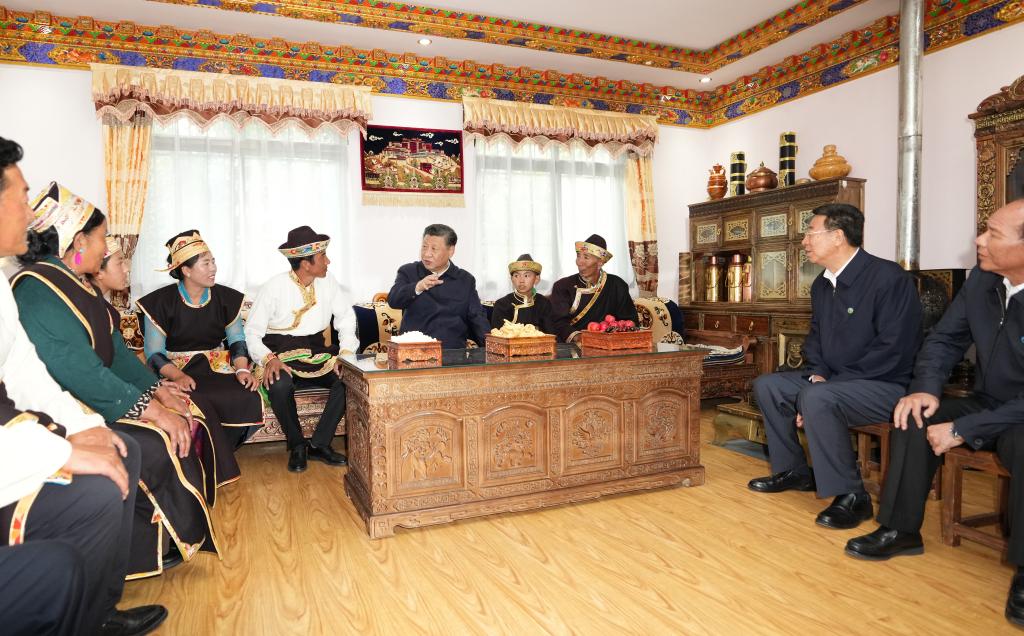
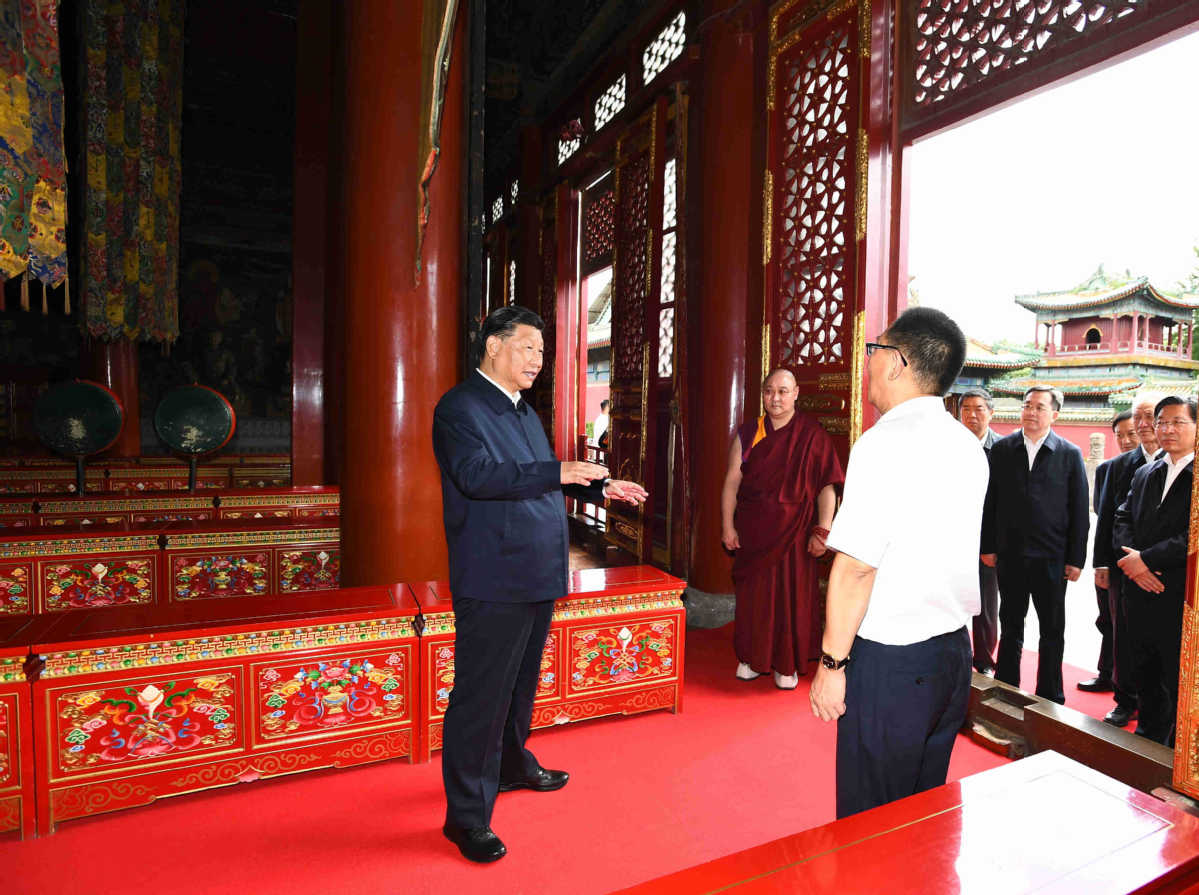
Xi Jinping, general secretary of theCommunist Party of China Central Committee, has underlined the importance offully implementing the Party's theories and policies concerning ethnic groupsin order to further promote equality, unity, mutual assistance and harmonyamong all of them. Xi, who is also China's president andchairman of the Central Military Commission, made the remark on August 24during his two-day inspection tour of Chengde in Hebei province. While visiting an exhibition about ethnicgroups in the Qing Dynasty (1644-1911) at the Chengde Museum, Xi learned aboutthe development of ethnic groups in the country as well as the measures topromote ethnic solidarity, border stability and national unification at thattime. Noting that China is a unified multiethniccountry, Xi said that thanks to consistent efforts by the entire Party and thenation, China has completed the building of a moderately prosperous society inall respects, with ethnic minority groups included in the process. Practice has proved that only the CPC canmake it possible to realize the great ethnic unity in the country, and onlysocialism with Chinese characteristics can help unite, develop and provideprosperity to all ethnic groups, he said. When visiting the Puning Temple, a Buddhisttemple complex in Chengde, Xi stressed the Party's policy of religious freedomand called for creating a sound environment for the development of allreligions. Xi also inspected the Chengde MountainResort, a large complex of imperial palaces and gardens that was awarded WorldHeritage Site status in 1994. He highlighted the historic significance of thesite's heritage and underlined the need to protect, inherit and take advantageof the nation's fine traditional culture to inspire the people by boostingcultural confidence. While visiting a local village, Xiinspected its residents' efforts to promote rural vitalization. He stressed theneed to develop industries based on local resources to benefit more farmers,strengthen infrastructure and public services in the countryside, and he urgedlocal governments to fix weaknesses in public health services in rural areas. During the inspection, Xi also urgedefforts to fully, faithfully and comprehensively implement the new developmentphilosophy, take solid steps to prevent and control the pandemic, promotesocioeconomic development and coordinate development and security to advancehigh-quality growth. August 23, he visited the Saihanba forestfarm, where he called for progress in boosting green development and ecologicalconservation. He also inspected locals' efforts in thepreservation and development of cultural heritage, as well as in religiousaffairs, ethnic unity, rural vitalization and eldercare services. In China, a unified multi-ethnic country,the proper handling of ethnic affairs concerns the lasting security andprosperity of the entire country and the Chinese nation's rejuvenation. President Xi Jinping said that ethnic unityis the cornerstone of development and progress. Since the 18th NationalCongress of the CPC in 2012, the CPC Central Committee with Xi at the core hasbeen making long-term policies to consolidate the foundation for ethnic unityand development. By putting forward the call of heighteninga strong sense of community for the Chinese nation, Xi has been leading China'sefforts in making innovative progress in the work related to ethnic affairs.The central leadership has always attached great importance to ethnic affairsand development in areas with large ethnic populations. In May 2014, Xi put forward an importantnotion -- the sense of community for the Chinese nation. In September 2014, at a central workconference on ethnic affairs, Xi once again highlighted the importance oflaying a solid foundation for the sense of community for the Chinese nation. He has since on many occasions stated theprofound implications and great significance of consolidating such a sense. At the 19th CPC National Congress inOctober 2017, the idea was officially written into the Party's Constitution. Four inspections to regions with largeethnic populations have been made by Xi so far this year, deepening andextending the implications of the theories and practice of the sense ofcommunity for the Chinese nation. In 2014, Xi carried out frequentinspections and research to learn about the opinions on ethnic affairs at theprimary level. During his inspections to Inner Mongoliaand Xinjiang, Xi had face-to-face talks with people from multiple ethnicgroups. He also joined lawmakers from Guizhou Provinceduring the annual session of the National People's Congress (NPC) and visitedmembers from the ethnic minority groups of the National Committee of theChinese People's Political Consultative Conference (CPPCC). Based on in-depth research, Xi noted thatstrengthened Party leadership is a must for advancing the work of ethnicaffairs in China. The system of regional ethnic autonomy has played animportant role in promoting ethnic equality and unity, fueling development inethnic areas, and enhancing the cohesion of the Chinese nation, he said. He also noted that to enhance the unity ofthe Chinese nation, the long-term and fundamental way is to strengthen thecultural identity and consolidate the sense of community for the Chinesenation. "An ethnic group will enjoysustainable development only when it integrates into the big family of themotherland," said Kurban Niyaz, a primary school principal in southXinjiang. Xi has long paid close attention to theeconomic and social development of areas with large ethnic populations. On the eve of the Spring Festival in 2018,he paid a visit to Sanhe Village, a poor village inhabited by the ethnic Yipeople in Sichuan Province. In February 2021, at a gathering to markthe country's poverty eradication achievements, Li Kai, a Party official ofSanhe Village, expressed the villagers' gratitude to Xi using the Yi ethniclanguage. All the 28 ethnic-minority groups withrelatively smaller populations in China have shaken off poverty. What is more,ethnic areas have sped up efforts in fostering and promoting high-qualitydevelopment in all aspects. In 2020, these areas contributed more than 10percent of the national GDP. During the 13th Five-Year Plan period(2016-2020), these areas registered an annual GDP growth of 6.6 percent, 0.9percentage points higher than the national rate. During the same period, 12.8million new urban jobs were created in these areas, accounting for nearly one-fifthof the country's total. Also, the traditional cultures of ethnicgroups are flourishing. More than one-third of China's cultural heritage itemsinscribed on the UNESCO Intangible Cultural Heritage List are related to ethnicminorities. Ecological conservation has also beenpushed forward in these areas, where people enjoy bluer skies, lusher mountainsand clearer waters. Safe housing, safe drinking water,accessible medical services and education all speak volumes about the improvedlivelihoods of various ethnic groups. Earlier this month, 10 veteran Party chiefsfrom nine border villages of the Wa ethnic group in Yunnan Province wrote aletter to Xi, reporting local progress in poverty relief and expressing theirwillingness to build a more beautiful and prosperous home under the CPC'sleadership. After securing a victory in fightingpoverty, China has embarked on a new quest to fully build a modern socialistcountry. Xi has personally drawn the blueprint for the modernization drive inthe ethnic areas. During the annual sessions of the NPC andthe CPPCC National Committee in March, Wei Zhenling, a representative of theMaonan ethnic group, one of the 28 ethnic groups with relatively smallerpopulations, from south China's Guangxi Zhuang Autonomous Region, told thepoverty-to-prosperity story of her hometown, expressing her villagers'confidence in a brighter future. "I used to think that my hometownwould never be connected to the outside world unless a miracle happened,"said Wei, a member of the CPPCC National Committee. "That miracle hasreally happened."
The following are some highlights of XiJinping‘s remarks: -- Developing sound viewpoints on themotherland, nation, culture, and history is central to building a cultural homeshared by all ethnic groups and fostering a strong sense of community for theChinese nation. -- We will encourage more exchanges andinteractions among different ethnic groups, helping them remain closely unitedlike the seeds of a pomegranate that stick together, and work jointly forcommon prosperity and development. -- Not a single ethnic group should be leftbehind in China's efforts to fully build a modern socialist country. -- All ethnic groups as one family -- thisis one of the fundamental guarantees for the rejuvenation of the Chinesenation. -- Ethnic unity is the cornerstone ofdevelopment and progress. -- To improve our work in ethnic affairs inthe current era, we must strengthen Party leadership in this regard. -- All 56 ethnic groups of China are equalmembers in the big family of the Chinese nation. |